
January 27, 1952 – February 11, 2018
“I don’t know why he thinks I am the most dangerous person in Pakistan,” Asma Jahangir says, speaking by phone to a news reporter while under house arrest. Outside her gated two-storey home in Lahore, armed officers make sure no one comes in, that no one leaves.
In the last 24 hours, president Pervez Musharraf has declared a national state of emergency across Pakistan. Jahangir, one of the country’s most prominent human rights lawyers, has frequently criticised Musharraf’s authoritarian rule. “I suppose anyone who calls a dictator a dictator is dangerous and imbalanced,” she suggests, her typical humour intact. The 90-day preventative detention order issued on November 3, 2007 is officially “to prevent her making inflammatory speeches.”
The military government has been increasingly unpopular in recent months, with police arresting thousands who Musharraf accuses of undermining his efforts to protect Pakistan. Many of the other activists, lawyers and opposing politicians arrested in the crackdown are released on bail a few days later, but Jahangir’s detention order remains in effect.
Twice during her house arrest, armed guards storm her home, thinking she has absconded. In an email she sends during that time, intended for public dissemination, she declares that president Musharraf has “lost his marbles.” Her preparation for going to prison is to make sure she has stocked up on cigarettes: “I was thinking that if I’m in jail, I should have something to sustain me.”
She is released after two weeks, and is almost grateful for the incident, saying it has made her more resilient. She is typically self-effacing: “Look at the world, all the suffering… being under house arrest is the least I can sacrifice.”
From a young age, Asma Jahangir had no fear about speaking out for what she believed in. Her activism started in the late 1960s, at her church-run school in Lahore, where the head girl was always selected by nuns.
A teenage Asma did not think this was right, so arranged a pro-democracy protest demanding there should be “at least a semblance of an election.” The school reluctantly agreed to changing the way the head girl was chosen. The democratic process she implemented still continues at the school today.
Bravery ran in Asma’s family – she was just 18 when her father Malik Ghulam Jilani was sent to jail for opposing Pakistan’s first military dictatorship. She took to the streets to call for his release and filed a petition at the Lahore High Court, the Supreme Court ruling in her favour. Those early experiences of challenging state power stayed with her for the rest of her life, continuing her father’s legacy while creating her own. As a lawyer she was a confident performer in the courts, a formidable opponent, blending a sense of humour with calculated aggression.
Suggested Reading
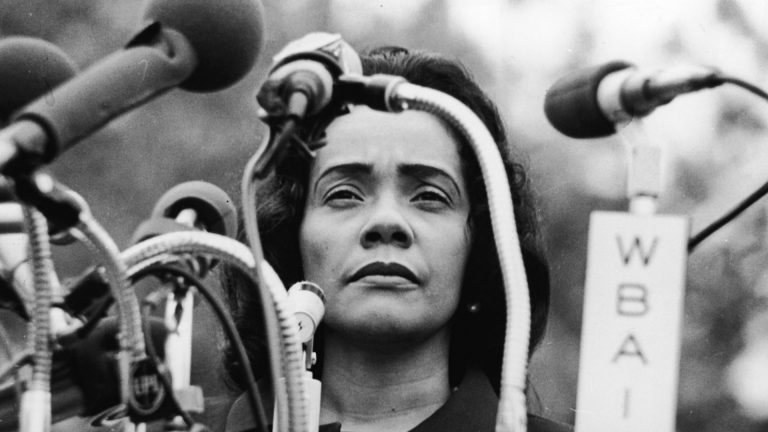
Coretta Scott King, the architect of a legacy
In 1980, with her sister, Hina Jilani, she started Pakistan’s first all-women law firm. The sisters, who had been brought up visiting their father in prison, shared a fearlessness and courage learned through necessity. They soon became the most recognised faces of the movement for women’s rights in Pakistan.
Under the military dictatorship of General Zia-ul-Haq, Jahangir set up a trust, alongside her sister and other lawyers and activists, using their own money to support political prisoners. They made a list of prisoners they wanted to help and approached their families to give them money, but although they quickly realised their finances did not come close to matching their ambition, their efforts had proved to them there was sizeable public support.
With the support of like-minded activists and lawyers, in 1986 the Human Rights Commission of Pakistan was founded: its mission to document human rights abuses and to hold the state publicly accountable. Opponents fiercely opposed the Commission, certain that their aim was to embarrass Pakistan, believing that helping people of all religions was a deliberate anti-Muslim agenda. Jahangir’s activism against the regime saw her jailed.
Munizae, the eldest of Asma Jahangir’s three children, now a senior journalist specialising in human rights issues for Pakistani news outlets, remembers how animated her mother was when returning home after her first arrest for activism in 1983: “She made jail time sound like it was an adventure, a thrilling journey.”
Munizae remembers asking her mother to take her along when she went to jail again; it sounded like fun. “We saw her struggle as an adventure. We grew up singing the songs of freedom and singing and wishing for a truly democratic Pakistan.”
In May 2005, Jahangir organised a women-only marathon in Lahore to highlight violence against women. It was condemned by religious groups as an affront to morality. As Jahangir ran, police officers tore her clothes and attacked participants, dragging them into police vans.
When her daughter arrived, she saw her mother “with her clothes torn off, her bare back exposed, being manhandled by police officials.” When Munizae arrived at the police station to collect her, “she was shouting and essentially leading a protest in jail,” still wearing her ripped clothes, now held together with safety pins.
Asma Jahangir defended the most vulnerable: religious minorities, women, children and the poor. After her sudden death at the age of 66, Omar Waraich, Amnesty International’s deputy director for South Asia, wrote that Jahangir was “the bravest person I knew. She fearlessly stood up to dictators, thugs, misogynists.”
She dealt with being imprisoned at home in the same way she dealt with everything that was ever thrown at her – with dignity, humour and certainty. Musharraf’s rule ended a year after the two weeks Jahangir spent under house arrest; his decision to impose a state of emergency and to imprison those who stood up to military dictatorship led to the end of his reign.
In her lifetime, she braved tear gas, beatings, discrimination, abuse and multiple arrests. “She was never daunted by the attacks that came her way,” Waraich said. “She never wavered from her principles. Her loss is incalculable.”