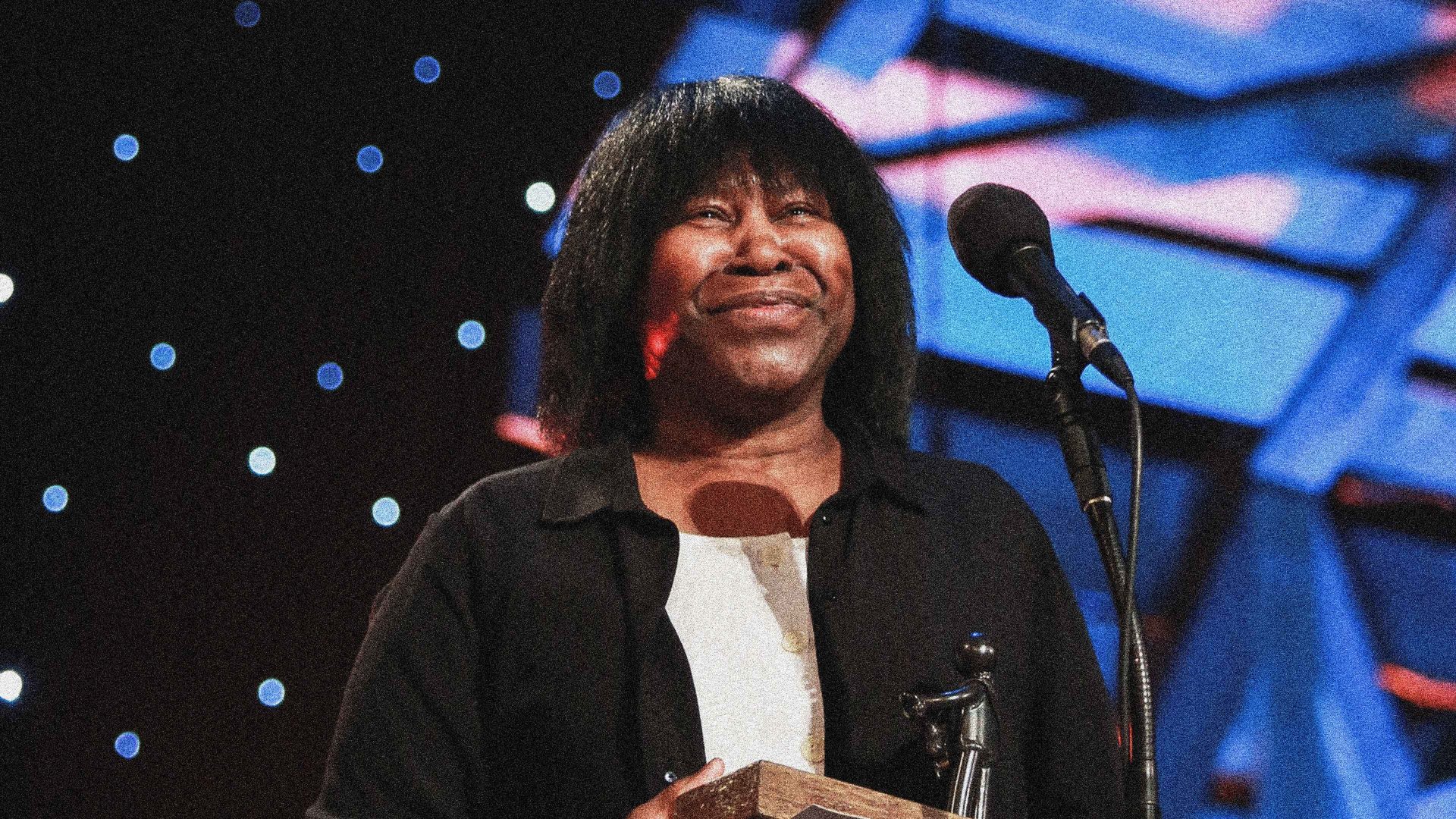
Joan Armatrading’s life in music began in the front room. After moving to England from Antigua, as a seven-year-old, the arrival of a modest upright piano at the family home in the Brookfields area of Birmingham altered the course of her life. Two years after first summoning sound from its keys, in 1966 she played her first concert, at the city’s university. Aged 16, a cover version of Simon & Garfunkel’s The Sound Of Silence was the only non-original song in the set.
“Nobody showed me [how to do this],” she tells me . “Nobody said ‘this is how you write a song, this is how you play’. Because it was so natural, I knew that this is what I was born to do. Once I started to write, that’s when I knew that that was it, that was my calling.”
She was right. Fifty-three years after the release of her debut album, Whatever’s For Us, on December 7, Joan Armatrading’s seemingly boundless creativity will find yet another avenue of expression when the Birmingham Symphony Orchestra and Chorus premiere her 15-minute classical and choral piece Homeland at the Birmingham Symphony Hall.
With lines such as “every scent evokes a fondness for this place I cannot leave”, the piece is a paean to a city its author, now 74, considers her home. In a time when terms such as “assimilation” and “integration” are employed with a wink, back in the 1950s the eight-strong Armatrading family dived straight into life in an already multicultural Birmingham. To the city’s credit, she cannot recall a single incident of discrimination or racism from her time as a new kid in town.
Her parents, she says, “weren’t going to Jamaica or Trinidad or anywhere else in the Caribbean. They were coming to England. So why not go to England? They didn’t think ‘[let’s] settle in the bit that has the most West Indian thing about it’, they thought ‘[let’s] settle in the bit that has the most English thing about it’… That’s what they were doing, they were coming to England. And to me that makes absolute sense.”
At times, Armatrading reminds me of a defensive batsman grinding out a draw on the final day of an attritional test match. Prior making her acquaintance via a Zoom call – her camera is turned off, so my questions are directed to her name in white on black on my computer screen – I’d been warned that enquiries about politics, and especially Robert Jenrick’s recent comments that Handsworth was “one of the worst integrated places” he’d ever seen, would not be entertained.
Like an enemy aircraft in a cloudless sky, even a general and gentle query as to why it might be that Birmingham receives far more than its share of derision was shot down in flames. “If you’re straying into political issues, I’m not going to do that,” she says.
Not a bit of it. Far from laying a trap, I was trying only to ease the conversation onto the traduced terrain of Birmingham itself. Much like Sheffield, the city’s reluctance to trumpet its own worth makes it an easy mark for trash-talkers and dog-whistlers.
People mock the accent. Popular overseas bands eschew a night at the Utilita Arena, near the heart of town, in favour of a date at the new Co-Op Live, in Manchester.
It might even be that I wanted Armatrading to know that I have all the time on the clock for her Homeland. In the company of architectural splendours such as the Town and Symphony Halls, a recent visit on a Saturday night showed me Birmingham was everything a vibrant metropolis should be.
“All I say is ‘I love Birmingham’ and that’s all [you] need to know,” she says, again with the fire extinguisher. “The people are great. Most of the people I talk to like Birmingham as well. I’m not part of a negative perception of Birmingham. I don’t get that in my circles.”
Which isn’t to say that Brum doesn’t have its problems. The council, the largest local authority in Europe, went bankrupt. Knife crime is a persistent problem. And then there’s the bin strike, an ongoing dispute that puts its (justified) absentee workers in the company of long-term stayaways such as miners and dockers.
Suggested Reading

What Robert Jenrick doesn’t understand about Birmingham
But the real reason people throw dirt at Birmingham, I think, is because its social experiment has worked in ways that really matter. When put to music, certainly, the place is a triumph; as a vessel of soft power, its diverse and talented working-class residents have produced a city that rocks as hard and as well as Detroit or San Francisco ever did.
Birmingham forged Black Sabbath and Judas Priest. Steel Pulse and UB40 conjured reggae from its streets. The pop scene delivered Duran Duran and Dexys Midnight Runners. There’s ELO, The Moody Blues, Steve Winwood, GBH, Roy Wood, Ocean Colour Scene, Denny Laine, The Streets, The Beat… the catalogue is voluminous. Alchemising disparate strands of music into the melodies of multiculturalism itself, the name Joan Armatrading, too, resonates from this roll call of honour.
“It’s in the water,” she says. “It’s in the water. Who knows why, I’ve got no idea. Don’t include me, but maybe it’s because that’s where the people socialise. Because I know a lot of people socialise in a way that I don’t; they get together, they jam, they form one band and then form another band out of that… they try and get gigs together, those kinds of things. But I’m not a part of that [so] I’m guessing that’s how it works.”
It’s worth noting, I think, that Joan Armatrading really isn’t a part of that. After working with musicians of the calibre of Mark Knopfler and Pino Palladino, these days the personnel credits on her newer albums feature only one name. Whether it’s writing songs of a kind with which her attentive audience is most familiar, or else layering vocal arrangements for a piece of music that will this month be sung at the Symphony Hall by a 100 choristers, the work is a solitary pursuit. “I’m an island,” she says, more than once, “I’m Joan.”
All the same, she remains Birmingham’s most notable living daughter. Despite no longer living in the city – enquiring exactly where she resides is of course off limits – Joan Armatrading returns regularly to the streets that became her home almost 70 years ago.
She puts her shoulder to local causes. Along with her role as a public face of a restoration project at the Town Hall, a scholarship in her name at the nearby BIMM Music Institute pays the tuition fees of low-income students.
As our interview ticks to a close, I ask the name on my computer screen if the people of Birmingham are proud of her. “You’d have to ask them,” she says.