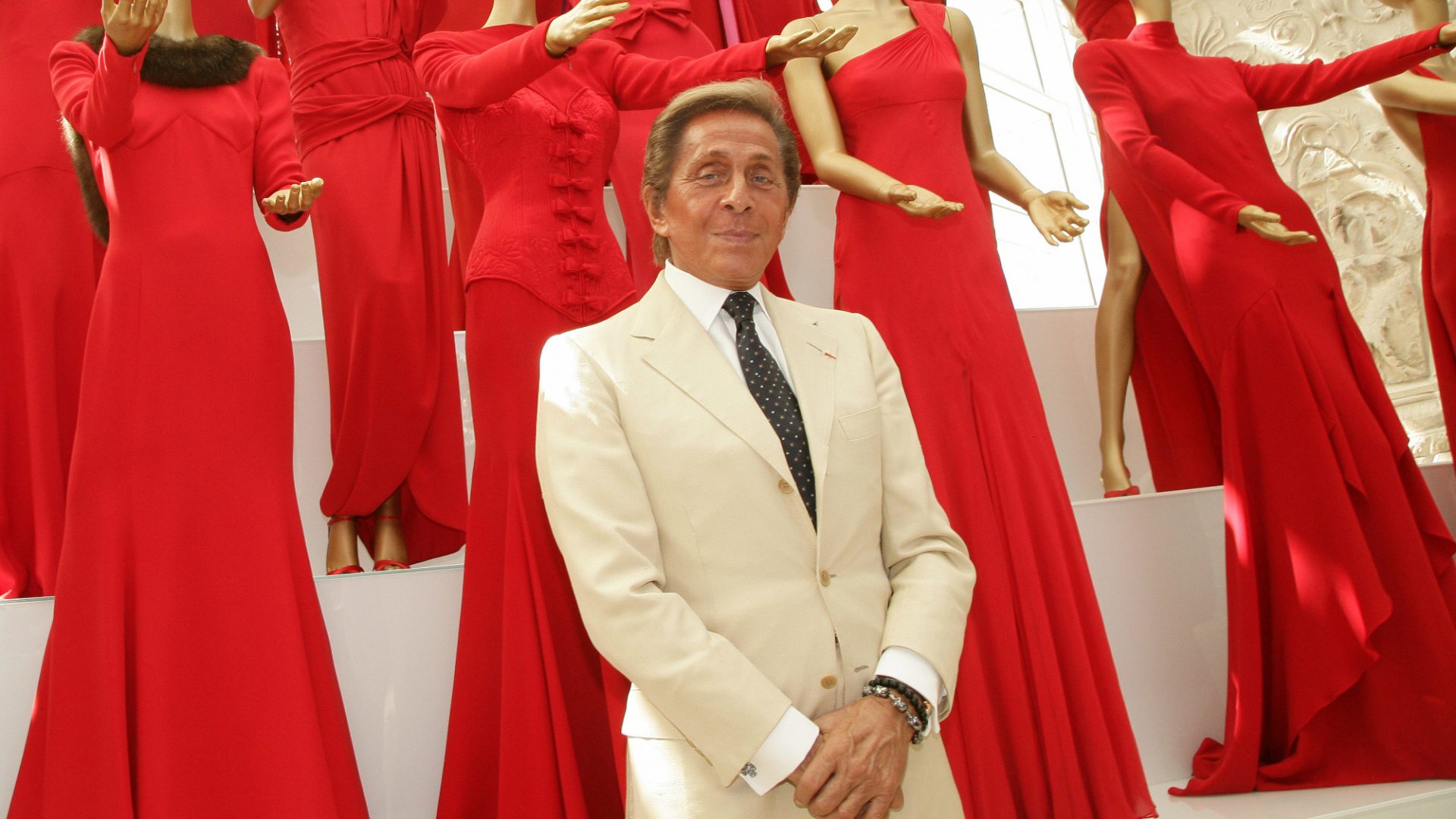
When the fashion designer Valentino Clemente Ludovico Garavani, mononymously known as Valentino, passed away last month, I was slightly put out.
I didn’t quite fit the Italian ideal of a fashionista when I first stepped on to Italian soil nine years ago. I wore jeans with rips in them, old baggy jumpers and scuffed trainers during my first year.
It wasn’t until I clocked a red Valentino belt I liked (and later bought) that I decided to change up my clothing habits to mimic the annoyingly chic people around me. I became an avid wearer of the colour red.
Think of red, and it’s all too common to think of Valentino. After all, Valentino red has its own spot on the Pantone colour chart.
His death was followed by tributes from Italian PM Giorgia Meloni and some celebrity customers – Gwyneth Paltrow, Anne Hathaway and Cindy Crawford. But when the 93-year-old’s body lay in state at the Valentino Garavani and Giancarlo Giammetti Foundation’s headquarters near the Spanish Steps in Rome, behind black blinds adorned with his quote “I love beauty, it’s not my fault”, ordinary people flocked to pay their respects.
“I loved his work, though I couldn’t afford any of it,” one woman told me. “I spent a lot of time here window shopping. He had great talent.”
“Valentino for me was the best of the designers here,” another mourner said. “His work embodied grace and it felt very Italian and feminine.”
Working alongside lifelong partner Giancarlo Giammetti, he founded his fashion house in 1960, and his creations were worn by the likes of Julia Roberts, Grace Kelly, Audrey Hepburn, Sophia Loren and Elizabeth Taylor. When Jackie Kennedy married Aristotle Onassis in 1968 she was wearing a Valentino wedding dress.
His private life was as lavish and stylish as his designs. Valentino and Giammetti owned a villa on Rome’s Via Appia, a villa in Capri, a 16th-century chateau near Paris, a 19th-century townhouse in London’s Holland Park, a penthouse on Manhattan’s Park Avenue, a ski chalet in Gstaad and – for when they got bored – a 152-foot superyacht.
Chiara Colombi, design professor at the Politecnico di Milano, one of the best design schools in the country, calls Valentino “the guardian of haute couture”.
Colombi told me: “What set him apart from many other designers was not a quest for rupture or novelty, but a conception of fashion as an act of continuous refinement.
“Valentino was undoubtedly one of the key protagonists of the second generation of Italian fashion: a perfectionist of elegance rather than an innovator, capable of constructing a coherent language grounded in fabric quality and sartorial construction through a continuous pursuit of beauty.”
Suggested Reading

Tearing down a piece of Italian history
But what comes after him? Valentino’s death follows that of Giorgio Armani last September, six months after Donatella Versace stepped down as the creative director of the eponymous brand.
Colombi says that these events confirm that a changing of the guard has taken place. There is a “new way” of fashion, no longer just about the vision and drive of an individual per se, but more about a bunch of systems coming together and working. Even Valentino’s own brand has been owned by the Qatari investment group Mayhoola since 2012.
“Today, fashion – even when it inherits the imagery of haute couture – is a complex industrial project. Quality and continuity are the result of strategies, competencies, and collective visions, rather than the aura of a single individual,” she said.
“In this sense, his passing does not represent a rupture within the system, but rather the symbolic closure of a season of fashion founded on strong authorship and on the idea of the couturier as the ultimate guarantor of value.”
Fashion houses now embrace new technology, with teams of designers working hybrid-style across the world and across different products. “It is significant that the new generations no longer define themselves solely as fashion designers, but as designers capable of intervening on product, process, communication, and impact,” Colombi says. “This shift reflects a profound transformation: the future of Italian fashion will not be built on new ‘individual icons,’ but on systemic design competencies.
“The legacy of figures like Valentino does not reside in form alone. Italian fashion will remain relevant if it evolves as a cultural industrial system, rather than by trying to defend ‘classical’ aesthetics as an end in themselves.”
Meandering through central Rome after talking to Colombi, the change seems suddenly obvious. Italian street fashion has evolved through the generations, and it’s as common now to see younger people wearing casual jeans and trainers à la Jessica, circa 2017, as it is to see someone older in the kind of effortless, stereotypically sleek Italian garb that made Valentino globally famous.
The golden greats have exited the runway, and something else is coming. I hope lots of it is red.
Jessica Lionnel is a freelance journalist based in Rome, specialising in politics, the environment and culture