
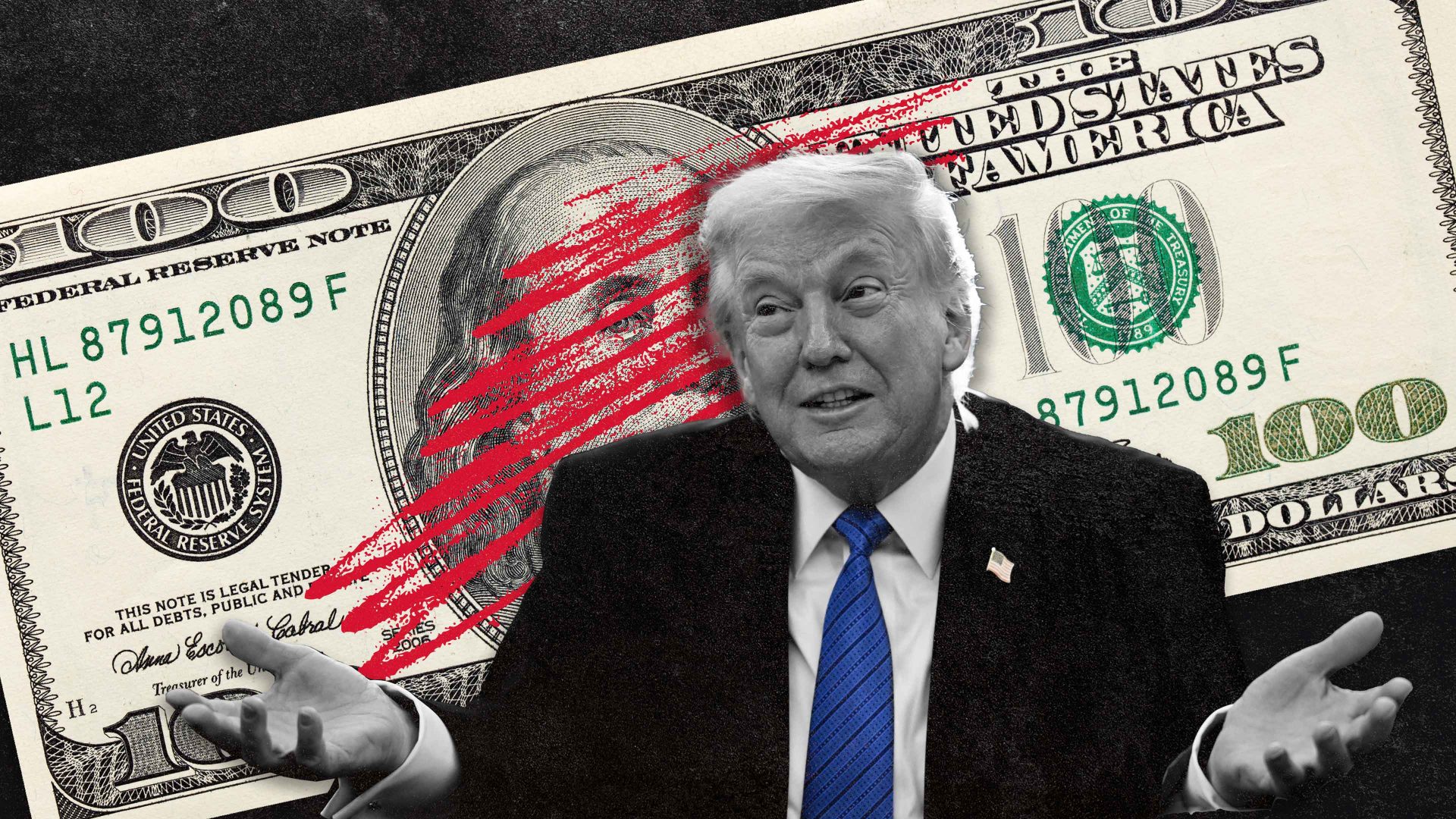
A few years ago, during Trump pt1, I was sitting in a restaurant with Michael Lewis, author of Liar’s Poker, Moneyball and The Big Short, and we were talking about the weird new US president.
Trump, he pointed out, was essentially an anti-institutions man. The media, the universities, the law – any institution of public life that checked his power, he instinctively hated and wanted to reduce to a pile of smoking rubble.
Events have proved Lewis correct. But he also made another prediction, which at the time seemed more outlandish: that the one institution of US public life that Trump had not yet attacked was the dollar, and it was inevitable that at some point he would screw that up as well.
It looks as if that prediction is coming true. The dollar has already fallen 2% this year. Throughout 2025, it dropped by 9%. There could be worse to come.
Trump, of course, reckons this is fantastic news, and has said it’s “great” for the US, because “you make a hell of a lot more money with a weaker dollar”. And in one sense, he’s right. If your currency has dropped in value, then the stuff you sell overseas becomes cheaper, which means you can sell more of it – or you can sell the same amount, but for a higher price.
But the flip side of that is the stuff you import becomes more expensive, and all the more so if you have slapped tariffs on foreign imports, which Trump has done. Expensive imports drive up inflation, as US shoppers are currently discovering. A recent report by the New York Federal Reserve Bank found that almost 90% of the cost of Trump’s tariffs had in fact fallen on American consumers.
But the much more uncomfortable question is why the dollar is looking so weak, especially as all the overall US economic numbers look so strong – Goldman Sachs reckons GDP growth in 2026 will be 2.5%, which is robust.
The trouble is that, despite the Trumpian razzmatazz, the weak dollar indicates a fundamental global uncertainty about the US. Trump makes America look risky. The US is not only suffering from stubbornly high inflation, which Trump has made worse, but it’s also in the throes of an AI boom, driven by technology companies that are investing vast amounts of money in each other.
The White House view seems to be that the interests of the Silicon Valley tech bros are aligned with the interests of America. But they are not. The soaring share prices of those firms are beginning to look so bizarre and untenable that they now pose a systemic risk, especially when their colossal spending plans are factored in. The AI industry could well be heading towards its day of reckoning – its Minsky moment.
The threat of an impending stock market implosion is not great, especially as so many ordinary Americans own shares. Even worse is the US debt pile, which according to the US Treasury currently stands at $38.49 trillion, a number so vast that it is essentially meaningless. To give some idea of what $38.49 trillion actually means, if you imagine that a million dollars is a cube of bills about three feet square, then a billion dollars would be a pillar three feet wide, but three thousand feet high. That’s just over half a mile.
Keeping the same footprint, a trillion dollars would be a stack of dollar bills three feet wide but three million feet high, which means it would rise to an altitude of 568 miles. That is beyond the orbit of the International Space Station.
Thirty-eight pillars of dollar bills, each of them 568 miles high, is a lot of money. And when you add to that Trump’s statement that he plans to increase US defence spending to $1.5 trillion a year, then you come fairly quickly to the question of where the hell the US is going to borrow all that money from.
Suggested Reading

Trump’s lies are trashing the dollar
Most US government debt is bought by American companies, and around a third is bought by foreign investors. But if Trump is weakening the dollar, this will reduce the international incentive to own anything valued in dollars, because when the dollar value is converted back into pounds or euros or yuan, you get stuffed by the crappy exchange rate. Why buy US government bonds to fund Trump’s ballooning deficit if they’re only going to drop in value?
And right on cue, the latest guidance by the Chinese banking authorities urged the country’s financial institutions to reduce purchases of US government debt. If necessary, they were advised to sell holdings of US Treasuries to limit their exposure.
Things have not been helped by Trump’s persistent attacks on the chair of the Federal Reserve Bank, Jay Powell. Powell’s crime has been his failure to cut interest rates. In Trump’s mind, interest rate cuts create economic booms – but this is rather like smashing open the dashboard of a car and pushing up the speedometer in the hope of making it go faster.
Powell managed to fend off Trump’s call for rate cuts, but he is scheduled to step down in May. It is possible that Trump might try to remove him before his term expires, but that now seems unlikely.
However the timing works out, Powell’s successor will be Kevin Warsh, the son-in-law of the billionaire Ronald Lauder, who happens to be a close friend of Trump’s. It was Lauder who first proposed the idea of the US taking Greenland. (That madcap idea also led to investors selling the dollar.)
Warsh is a career bank regulator, and is by no means a partisan hack of the kind Trump has installed elsewhere in his administration. But, like Trump, Warsh is known to want lower interest rates. Also like Trump, he is prone to making fairly radical statements, for instance when he told CNBC television that it was time for “regime change at the Fed”, a soundbite perfectly tailored to fit Trump’s anti-institutional instincts. “It’s not just about a person,” Warsh continued, “it’s about an approach to economics.”
The worry is that, having installed Warsh, Trump will lean on him to cut rates as fast as possible, a very bad idea when you are facing stubbornly high inflation. In a recent interview with NBC News, Trump said the US central bank should be independent “in theory”. But the Fed, he remarked, should really follow his lead, because, the president said, he understands the US economy “better than almost anybody”.
When asked directly about interest rates, Trump said: “I just think they’re going to be lowered. I mean, they should be lower.” At another press event in the Oval Office, Trump told reporters that Warsh “certainly wants to cut rates – I’ve been watching him for a long time.” In February, analysts at State Street warned that aggressive US interest rate cuts could cause the dollar to fall this year by up to 10%.
Suggested Reading
Trump’s economic boost – to Europe
Global markets now face an unsettling possibility: that an impulsive, deeply unstable and economically illiterate president intends to fiddle with the dollar, and that his new, pliant central bank head will play along. If this happens, then the free market dream of the Reagan-Greenspan era will have curdled into a new form of authoritarian command economy.
The last strong-man leader to try this approach was president Erdoğan of Turkey, who also lost patience with his central bank and insisted that the cure for inflation was a cut in interest rates – which is, essentially, Trump’s current argument. Turkish inflation shot up to over 40%. Having realised his mistake, Erdoğan has since allowed rates to increase to deal with the inflationary problem. They currently stand at a crushing 37%.
So it looks as if Michael Lewis may have got it right. Trump is debasing the dollar, a currency that has become what the analyst Karl Schamotta of Corpay has called “a falling chainsaw” – no one wants to catch it.
So far, Trump’s second term has involved vicious attacks on sections of US society that MAGA voters see as the enemy. But if the dollar, the AI bubble and the US markets all hit trouble, and with inflation still high and job numbers looking weak, the economic pain will hit everyone – including Trump’s own supporters. That could prove decisive for the mid-term elections which, it should be remembered, take place in November. Hopefully.
 Most popular

Tony Blair’s never-ending legacy tour
Face it: Trump’s going mad
Is university worth it?
The coercive control of Marco Rubio’s Munich doctrine