
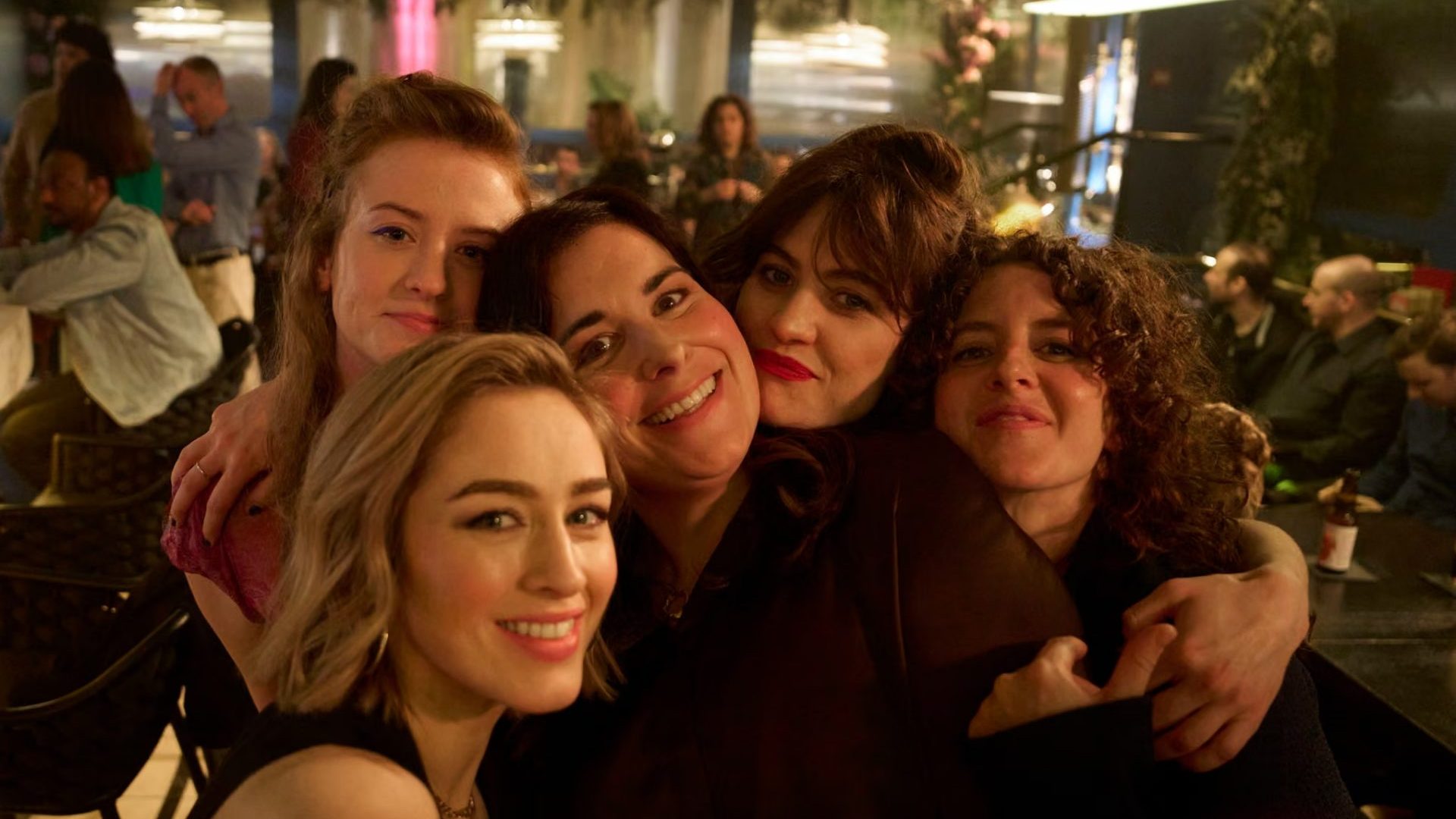
“I already have a trouble-maker, a drama queen, an unreliable and a people-pleaser.” That’s Mammy Walsh in the BBC The Walsh Sisters, talking about four of her five daughters – respectively Rachel, Anna, Claire and Maggie. There’s also Helen, overlooked in the list as she is often in Marian Keyes’ seven novels about the Walsh family, the source material for this new series.
There is pressure of expectation when it comes to adapting beloved works, both for the production team and for the fans. Keyes has many of those; she’s sold 35 million books and some of us have grown up with the Walshes, following them over a series that spans 30-odd years.
Compared to the outrage over the casting of Heathcliff in Emerald Fennel’s Wuthering Heights or the hundreds of Sense and Sensibility adaptations that the BBC seems to air annually, The Walsh Sisters works. Or certainly it works as much as elements of seven books amalgamated into a single series of six episodes can interpret five sisters with very different lives and storylines.
Keyes wrote the first four books in a decade. The last three appeared in 2012, 2022 and 2024. Recently, I re-read them all.
Many of the themes are ageless – addiction, domestic violence, family strife, infertility, money problems, fidelity issues and motherhood. Some of the phrasing and fat jokes, not so much. It was enough, though, to have me eagerly binge-watching the series during our 40 days of rain.
Trouble-maker Rachel (Caroline Menton) is the first sister we’re introduced to, and seems to have the biggest problems. She is autobiographically the closest to Keyes’ own struggles with alcohol abuse.
The series opens with Rachel comatose and her boyfriend Luke (Jay Duffy) calling an ambulance because he thinks she is dead. Her sister, best friend, and flatmate Anna (Louisa Harland of Derry Girls) downplays the episode, too entwined with Rachel to see how bad her alcohol and drug abuse really is.
Keyes’ first novel in the series was published in 1995, around the same time Candace Bushnell was writing the newspaper column that became Sex and the City but over 120 years since Louisa May Alcott wrote Little Women. All these ensemble works have a character individual women seem to relate to more than the others – I was a Jo, a Samantha and most definitely a Rachel.
When I first read the Walsh series, I was in the throes of heavy alcohol abuse. Second time around, I had been sober for four years. Reading about Rachel’s stint in rehab, and watching it in this adaptation, help me reflect on how much I minimised my substance abuse and how much strain it put on those that loved me – my own Walsh sisters.
Suggested Reading

Riot Women is the most important show of the year
What Keyes, her novels and the series, all capture pretty perfectly are the layers of the female experience. The guilt, the shame, the joy, the triumphs, the dancing, the outfits and the intimacy of women.
Her characters can deeply love one another and be really awful selfish bitches at the same time. Rachel can be the life of the party and take it too far with disastrous results. As she finds, it is one thing for her sisters to tear her apart, and quite another for someone who doesn’t value and love her to do the same.
So often, Keyes’ work is dismissed as chick lit when in reality, the issues she addresses around independence, financial and physical, around family guilt and around the day-to-day pressure of being a woman feel more thoughtful than most books on a modern day lit syllabus. Dismissing her work as beach reads diminishes the hidden value and toll of family life that women quietly carry – something Keyes captures and celebrates.
Suggested Reading
Lover, Liar, Predator: How four women took down a monster
This adaptation doesn’t quite nail the humour of the books or the intimacy of Mammy Walsh. Here, played by Carrie Crowley, she is mostly just a killjoy who seems equal parts exasperated by and jealous of the youth of her daughters.
But in Keyes’ hands, Mammy is a guiding force of conscience and hilarity. Her quiet, steadfast, funny marriage is the basis of what the girls all aspire to.
With a focus on trying to rescue Rachel from herself, there is much that’s missing from season one (a second series has already been commissioned). We will have to wait to see how the Walsh Girls and the Irish Boys collide in New York, and some of the love stories that make up Walsh lore.
But the spirit is here – the love, the wild loyalty and the sacrifices that the girls are willing to make for each other, while still judging and slating one another. The Walsh Sisters is still full of grief and destruction, love and joy. And for that, I found it a small triumph.
The Walsh Sisters is on iPlayer. Jamie Klingler is founder of London Book Club
 Most popular

‘Operation Epic Fury – as it happened’
Is Star Wars dead?
Morrissey returns.. and heaven knows he’s mythical now


Iran War: Trump has now sealed his own fate