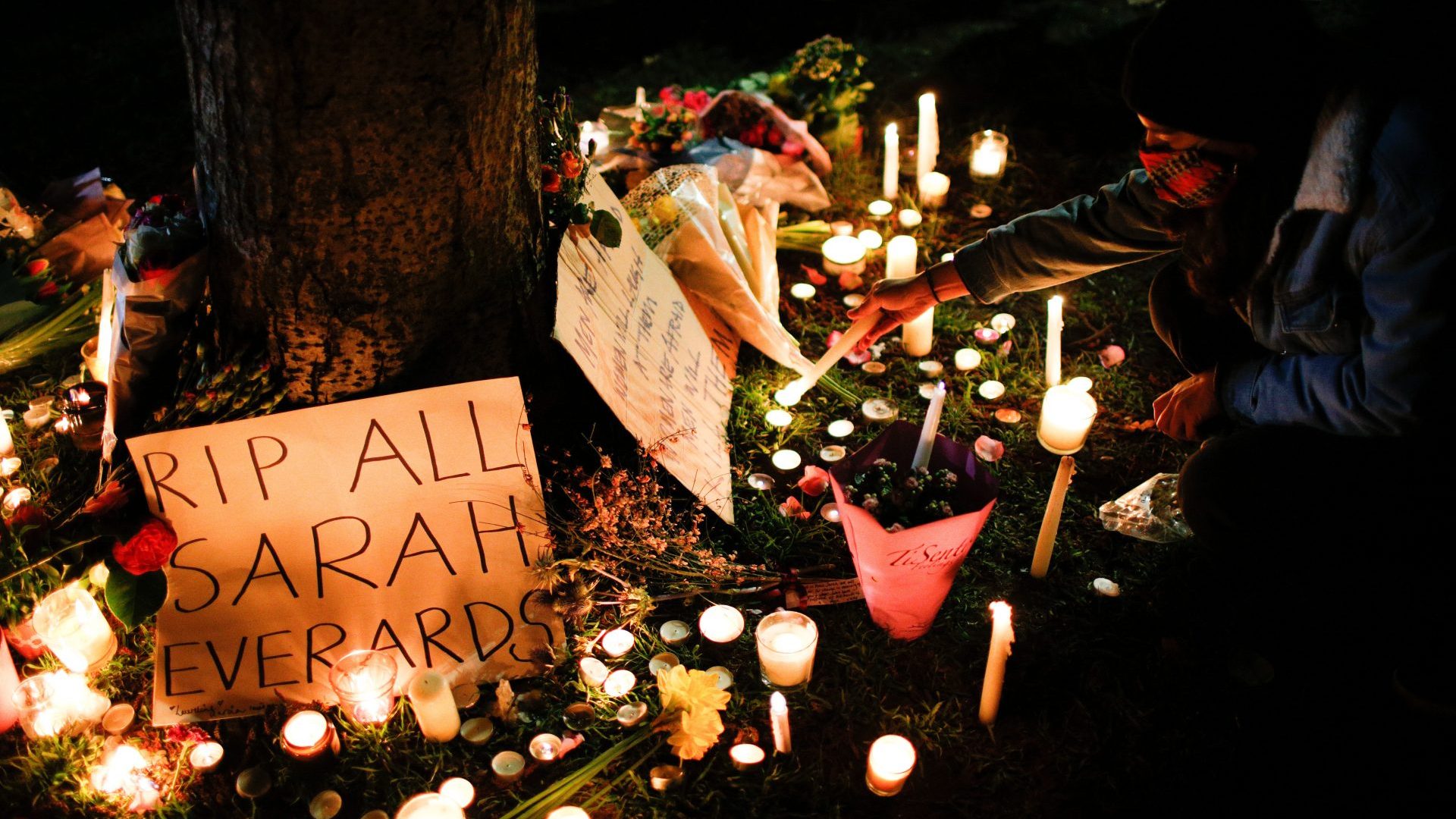
On March 3, 2021 Wayne Couzens, a serving Met police officer abducted, raped and murdered Sarah Everard. When her body was found on March 10, I tweeted about hosting a vigil for her and was quickly put in touch with local women who were doing the same. Soon, Reclaim These Streets was born.
It was the day I became an activist, and five years later, I am still campaigning for women’s safety and police reform.
When Sarah was murdered, we were in lockdown. I had not seen or hugged any of my friends or family who were feeling the same rage that a serving officer had killed a young woman walking home. As an events organiser, I knew how to make a safe space for women to come together and attempted to organise a masked and distanced vigil.
But, instead of allowing us to hold a moment of silence for a woman that one of their own had murdered, the Met antagonistically and unlawfully stopped our human right to protest. We cancelled the vigil under duress and raised £550,000 for Rosa for Women.
At the vigil, the Met violently manhandled Patsy Stevenson and others in front of the world’s media. They manhandled a woman at a vigil I had helped organise about a serving officer killing a woman he was meant to protect and serve. The High Court would later vindicate Reclaim These Streets and find that the arrests at the vigil were unlawful.
Cressida Dick, then police commissioner of the Met, declared it was one of the darkest times in its history. To this day, the Met have not admitted how much money they spent to stop women from peacefully coming together to mourn Sarah.
On the fifth anniversary of Sarah’s death, I cannot comment on the private grief of the Everards, but I can and will continue to point out the failures of the state and Met to keep women and girls safe, even from their own employees.
Do women trust the Met? According to YouGov, trust among women is very low, with studies indicating it is the least trusted police force by women in England. But, should we? No.
Commissioner Mark Rowley’s reforms have concentrated on shifting responsibilities and using AI to track sick days amount to changing your shirt after shitting your pants. In short, the new Met is just as broken as the old Met.
Shuffle, shuffle, shuffle. Business as usual – possibly under a new name.
On January 24th, the biggest police reform in decades was announced, creating what was essentially a British FBI. A White Paper stated that the government was “reforming counter-terrorism (CT) by establishing a new National Police Service, shifting national CT, serious organised crime, and specialist, agency-level capabilities (like the NCA) away from the Metropolitan Police into a unified body.”
Shuffle, shuffle, shuffle. Business as usual. Disciplinaries for absence, but not officers using power for sexual gain.
The Met has also begun “using Palantir’s AI to analyse internal data about sickness levels, absences from duty and overtime patterns in an effort to identify potential shortcomings in professional standards.” They will invest training and funding to deal with duvet days but not recognise that the organisation is fundamentally and systemically sexist, racist and homophobic.
These are the reforms they have chosen to invest in despite the Casey Review and the Angiolini Review specifically giving recommendations to impact the systemic sexism, racism and homophobia in the Met.
In 2023, Baroness Casey specifically detailed that the Parliamentary and Diplomatic Protection unit that armed both Couzens and David Carrick, another prolific rapist that the Met Police employed for decades, was the “dark corner” of the Met.
Suggested Reading

Separate tube carriages for women are not the answer
The review demanded that the unit be disbanded because of the toxic cowboy militia attitudes that were going unchecked and unmonitored. Five years on, the Parliamentary and Diplomatic Protection unit is still the elitist sheriff of the Met.
They shuffled some people and shuffled some paperwork. They added another review, this one called the Leven Review, to address the Casey Review’s findings. The Leven Review came out in 2023 and has no further updates. In December 2025, the second round of Angiolini recommendations was delivered a full year after the first round, and nothing had been implemented to address the first round. Institutional is the word that Commissioner Rowley refused to accept.
Shuffle, shuffle, shuffle. Business as usual.
In the past five years, we have had not one, but two scandals about the horrific treatment of women and female colleagues within the Charing Cross Police Station. One was courtesy of the IOPC and one courtesy of BBC’s Panorama. In the first, officers in a WhatsApp group joked about raping a colleague with chloroform. In the second, an undercover reporter filmed outrageous incidents of misogyny, racism and an officer nicknamed Stompy, stomping on an autistic child.
Shuffle, shuffle, shuffle. Business as usual.
Let me remind you that Couzens was nicknamed “the Rapist”, Carrick was nicknamed “the bastard” and now “Stompy”. These are the nicknames from inside police constabularies. If officers cannot recognise or feel compelled to report someone that is nicknamed the rapist, then how are we expected to enter those constabularies to report our own sexual assaults or injuries?
Shuffle, shuffle, shuffle. Cue a statement about bad apples, business as usual.
Sarah’s murder may have exposed deep and extensive rot within the Met and it may even have cost Cressida Dick her job, but underneath the headlines, very little has changed.
After Couzens was convicted, the Met allowed Cliff Mitchell, the main and only suspect in the rape of a 9-year-old, to become an officer and be given a warrant card. He later continued to abuse her and said no one would believe her. It was only after he was caught kidnapping another woman by members of the public that the original charge was revisited, and he was found guilty.
This new Met hired Mitchell and recruited people drawn to power, not public service. Forgive me if I can’t point out the difference between the old Met and the new.
I’m sorry that the Met has not regained my trust, but they do not deserve it.
 Most popular
Iran war: It’s time for Europe to become a superpower

Yet another Brexit prediction turns to dust

Attacks on Iran: this is going to spread

Dear Matt Goodwin, why are you such a bad loser?