A border guard was searching my bags at Frankfurt Oder, as the 10-hour train from Kraków to Berlin was often a route for smugglers. Since 3pm, my Nokia had been ringing non-stop. Now, in a wavering voice and wobbly Deutsch, I was trying to explain to the guard rummaging through my bags that world war three had started, that I’d just taken several calls, and New York was under attack. He was not deterred.
The reason for the journey? That evening – September 11, 2001 – I was seeing Radiohead at Wuhlheide, an outdoor amphitheatre on the outskirts of Berlin, built on the site of former POW camps. After taking those calls, I was full of the fear in other people’s voices. No images, no screens, just voices of alarm.
In Berlin, I switched to the S-Bahn, and reached the venue just as the band were coming on stage for another date of their Kid A/Amnesia tour. It started to rain. Many people were weeping, or just staring in disbelief.
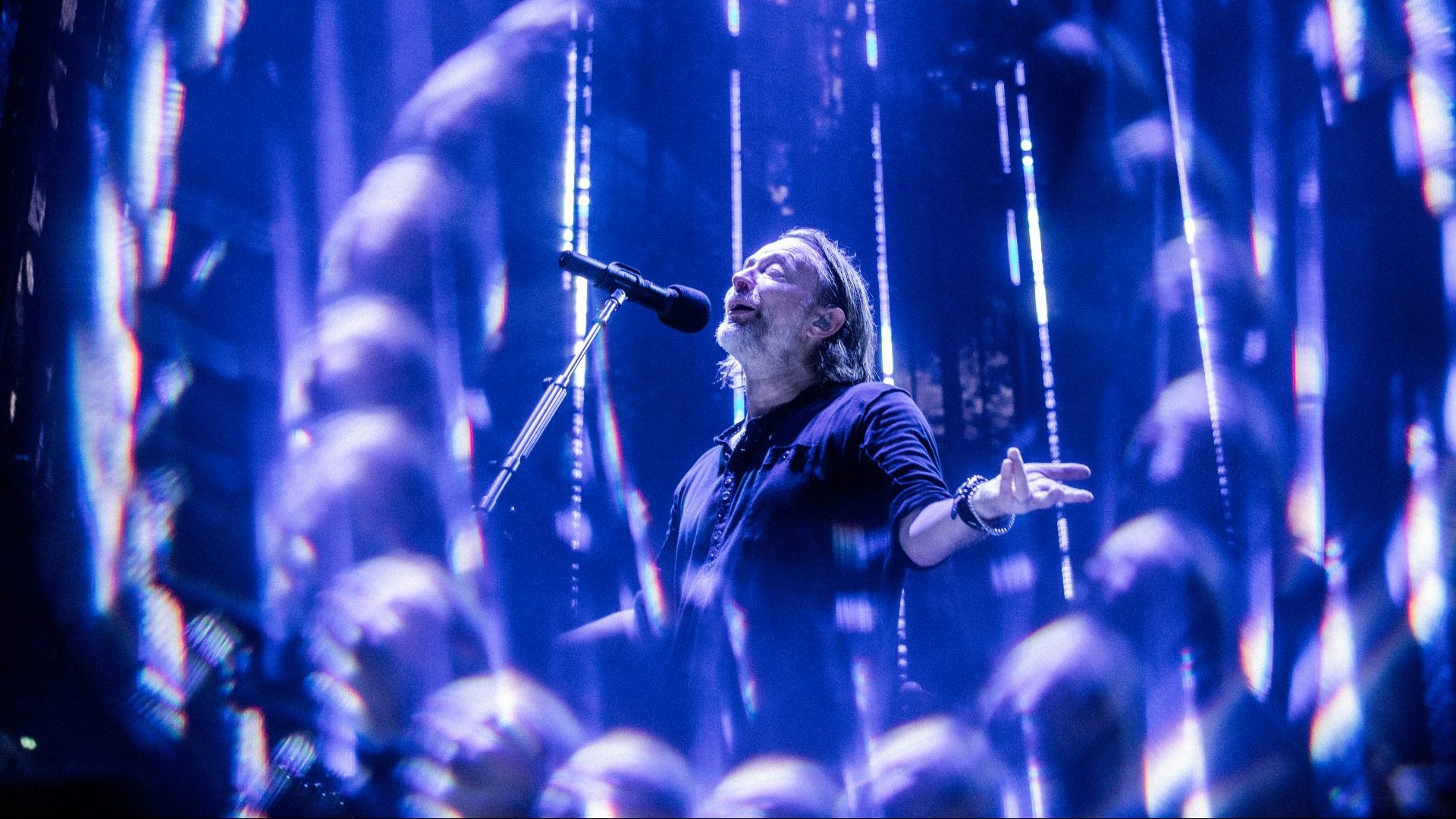
The menacing bass of National Anthem opened a gig that, with its blend of elegy and foreboding, provided a coruscating soundtrack to that day’s despair. At one point, Thom Yorke asked, “Who doesn’t know about it? There were two jets….Three, you say? Four? However many, that’s why we’re a bit mute tonight. This next song is called Paranoid Android.”
Now it’s 24 years later, and the 17,000 fans waiting in Berlin’s Uber Arena for Radiohead’s return are being entertained by what sounds like a Max Richter or Paul Lansky composition. The sparse notes are accompanied by flashing rectangles around the circular stage and by sporadic spotlights on sections of the crowd, who respond by cheering. This big tech version of Simple Simon lasts 15 minutes. We’ve gone from Kid A to Kid AI.
The band enters from a corner of the arena and, by torchlight, are led like boxers through the howling crowd. The circular stage is redolent of the Kaiserpanorama that so fascinated Kafka, where peepholes allowed viewers to watch flickering images, a prototype of cinema. But in the 21st century, it’s the band peering out, and the images are displayed on panels that frequently slide up or down above their heads.
There are close-ups of the musicians (including additional percussionist Chris Vatalaro), or luminous graphics in lilac or turquoise. Yorke dances like a mischievous sprite between three mic stands.
Suggested Reading
2,000 years of punk rock
It’s noticeable that Ed O’Brien does not change position. His harmonising, always pitch-perfect, is crucial to the sound as Yorke sometimes struggles for the higher notes. Following a throat infection a couple of weeks ago, Yorke’s voice occasionally drops to a mid-career Dylan, and no one can hit the high notes forever. But O’Brien doesn’t waver, and very much holds the harmonies together.
Colin Greenwood, who played at the same venue with Nick Cave last year, is content to stay close to drummer, Phil Selway, while Jonny Greenwood, forever thrashing away under his fringe – and with more pedals than a Lime bike station in Kreuzberg – roams between his guitar and a xylophone solo on No Surprises, one of the tracks of the night, and a Hammond for Weird Fishes/Arpeggi, another stand-out song. It’s a thrill to watch him at work.
After solo ventures, collaborations, and a seven-year absence from touring, Radiohead respond to each other’s playing like a well-aged jazz ensemble, and their songs evolve into live variations. There are no straight-up album replicas in this two-hour set of 25 tracks.
They can switch from Penderecki-inspired orchestral and choral magnificence to sheer rock’n’roll thrash-out to near-techno outros to pared-down voice, keyboards, acoustic guitar. They can make these switches from one bar to the next. That’s precisely why they’re the most innovative band of the last 30 years.
In his lyrics, Yorke has guided us from pre-internet to (nearly!) post-human times, and there were moments here when his voice and intensity, like a silvery soothsayer, still managed to transport us to otherworldly realms.
That had not been the case when the first three tracks (Planet Telex, 2+2=5, Sit Down Stand Up) were lost in that dreadful backwash of arena sound that is not at all suited to the band’s intricate compositions. This was remedied by the time they started Lucky with its refrain, ”We are standing on the edge” just as eerily pertinent to the massed and messed-up twenty-somethings in the audience facing climate change, multiple wars, and AI, as it was to me that night on 9/11.
An encore set of seven tracks included a blistering You and Whose Army?, and a lusciously spaced-out Fake Plastic Trees, before ending with Karma Police. By now, Yorke’s voice sounded much lower, and he looked like a genie who wanted to squeeze back in the bottle. But it didn’t matter, such was the vehemence of the sing-along conducted by the latest anxious generation in the pit.
Radiohead’s tour ends in Copenhagen on December 16
 Most popular

Matt Goodwin’s road to derision

GB News Scandal: How Ofcom let GB News corrupt British media
GB News sets its lawyers on to The New World
Matt Goodwin’s new book: The missing chapter