Sometimes, a product stops selling like it used to. For the company that manufactures it, that’s usually a cause for panic – and for action. Focus groups are held, research is done. Sometimes the recipe is reformulated, or else the packaging, or a new advertising campaign is launched: whatever it takes until people start buying it once more.
Politics – and let’s be honest, much of the media, too – works differently from most businesses, though. The public certainly go off the product from time to time. Keir Starmer’s approval numbers prove that: the latest figures show just 11% of people think he’s doing a good job, versus 69% who think otherwise. That’s nothing short of a calamity.
But while a business will see that the public has fallen out of love with an item and realise it’s time to change it, politics has a habit of trying to do something else – all too often, it says there’s a need to change the public instead.
This gets dressed up in different ways. It’s framed as concerns around mis- or disinformation, or foreign interference in politics, or AI, or “bots” – legitimate worries, all of them, but ones that can be taken too far. They are collectively used to explain and justify a crisis of trust in politics, and in society more broadly.
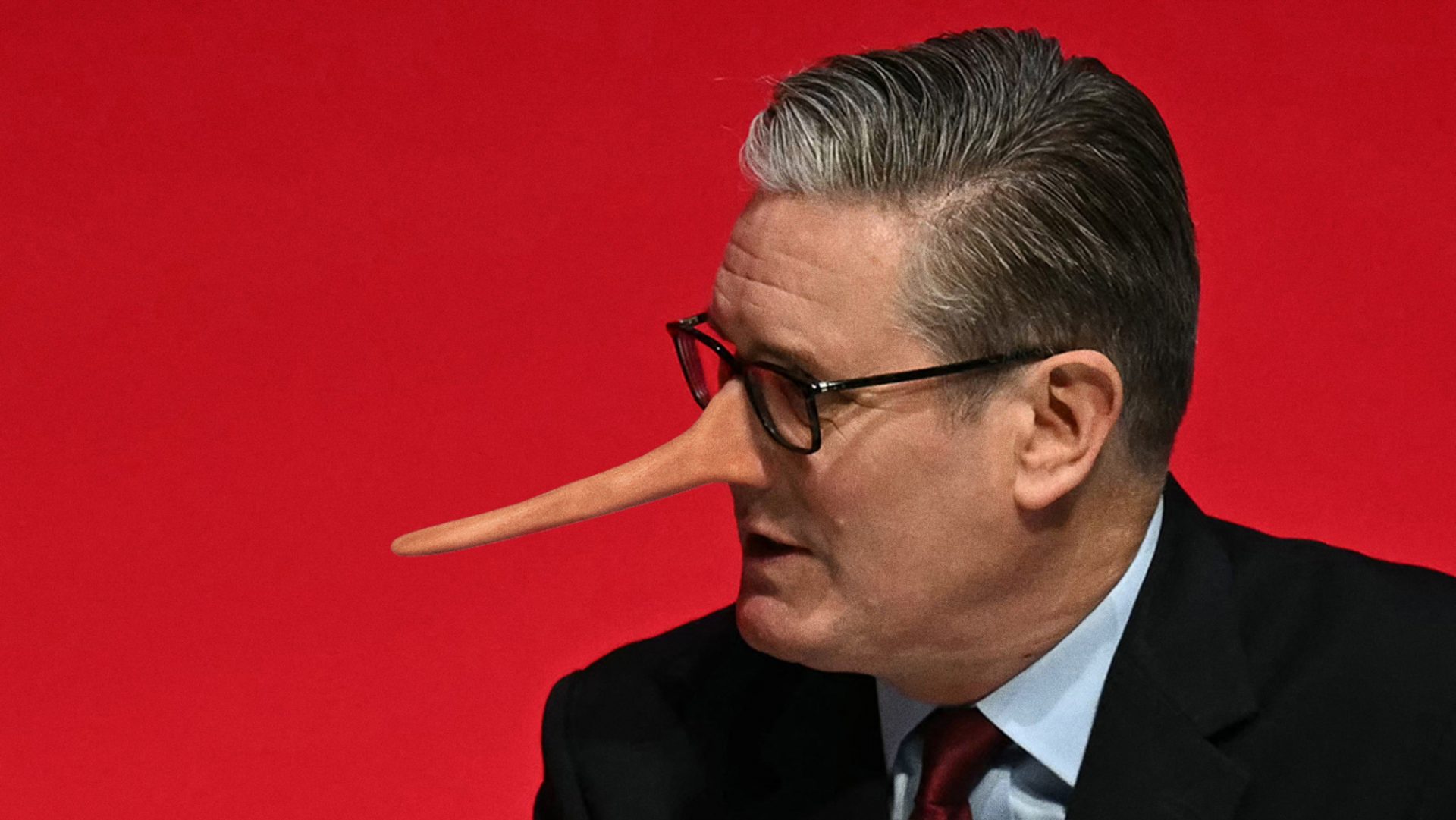
But they are also used to obfuscate a much more obvious reason for a crisis of trust in politics: mainstream politicians lie, all the time. They lie so often that they seem to have stopped noticing that they do it. They certainly do it so often that it no longer seems to occur to almost any of them that people might still notice, and object.
This thought hit, unexpectedly, a few minutes before the chancellor, Rachel Reeves, stood up last month to give her endlessly trailed autumn budget. The prime minister was at the Dispatch Box of the House of Commons, dealing with Prime Minister’s Questions, having been asked about the internecine briefing wars between Downing Street and his cabinet.
“No one in No 10,” he told the House, “has briefed against cabinet ministers.” When he said those words, Starmer must have known he was lying. If he did not, that’s surely worse – he would have to be the most incompetent person ever to hold the office of prime minister if he thought he was speaking the truth when he said those words.
Starmer’s No 10 routinely briefs against cabinet ministers. It had been reported in the media that very week that his chief of staff, Morgan McSweeney, and his health secretary, Wes Streeting, had a blazing row on the phone about media briefing.
Starmer’s operation briefs negatively so viciously and frequently that his No 10 often briefs against itself: his first chief of staff, Sue Gray, was brought down from within, not from outside. The transport secretary, Louise Haigh, was fired after a leak of a former criminal conviction that everyone in Westminster believes came from No 10.
I’m still unsure why the lie stuck with me. It should be a scandal when the prime minister misleads the House of Commons. There are, officially at least, rules against doing so. But in reality, it’s not that unusual, and it’s certainly not confined to Starmer or to Labour.
What struck me at the time was the sheer pointlessness of the lie Starmer was telling. Not even his own backbenchers believed it. One texted from the chamber saying, “well, that’s a lie”, before the prime minister had even sat down. No one in the media would believe it. And anyone in the public paying attention would rightly treat it with a huge amount of scepticism.
This kind of pointless lie has become a part of how we do politics. Reeves and Starmer, and their respective teams, routinely and egregiously lie about the budget, for virtually no benefit.
Suggested Reading

Why are we funding pathetic, vengeful Liz Truss to lie about Britain?
The reality of the budget is that it was a relatively modest series of measures that raised money to give the chancellor a better chance of hitting her fiscal targets, while also raising enough money to end the two-child benefit cap – a move that should lift almost half a million children out of poverty.
But it’s also true that most of the pre-budget “speculation” that the chancellor would go further was the result of direct briefing out of the Treasury. Some of this was officially sanctioned: one off-the-record briefing alongside Reeves’s pre-budget speech was given to journalists from multiple publications.
Once it turned out that the budget did not go as far as Reeves initially planned, she and her team spun the explanation – lying, but politics as usual. They also blamed the media for “speculating” about issues they had briefed the media about in the first place. That’s immensely corrosive – a cynical move that takes voters for idiots.
It’s also what we miss almost every time we talk about a “crisis of trust” in politics. Voters are correct not to trust politicians: they almost never tell the truth. Labour is nowhere near the worst offender on this front, but they are the current government. Starmer doesn’t tell the truth about how No 10 operates, and the way his broader government works requires angels-on-the-heads-of-pins dancing all the time – not least to explain why freezing thresholds, so that people pay more income tax, isn’t a rise in income tax.
People rightly and rationally realise that mainstream politicians aren’t being honest with them, and they become sceptical or even cynical. That in turn leads them to look for something different – often looking towards populists, sometimes on the left but much more often on the right.
The irony is that these far right populists are even more dishonest than anyone in mainstream politics, but they do at least sound different and refreshing. They can adopt the manner of someone who is levelling with the voters, and telling them something that “you’re not allowed” to say. Even Donald Trump voters in America know he lies easily and often – if asked about it, many of them will admit it. They just add that all of the others do it, too.
When we talk about a crisis of trust, we often – perhaps unwittingly – gaslight voters, because we are implicitly suggesting that they should trust mainstream politics, even though everything about how it operates involves routinely lying, all the time. In that context, it should come as no surprise that efforts to restore trust in mainstream politics haven’t worked.
Some of the fix is simply to unlearn old habits. How much better it would have sounded if Starmer had, at the Dispatch Box, said it was obviously the case that someone in No 10 had briefed the media against Wes Streeting, that he didn’t know who had done it, and that he had demanded it stop now, or else he would hold his chief of staff responsible.
Or if the chancellor had just admitted that she had chosen to break the manifesto promise in the national interest? The lobby would gasp and clutch its pearls, but if a government stuck to its guns on this, the public would notice, and I suspect people would like what they heard.
Those of us who cover the information crisis have a habit of getting it the wrong way round. Too often we talk about the dangers of voters – usually voters on “the other side” of an issue – trusting something they shouldn’t. We worry that microtargeting is why Brexit won the EU referendum, or that Russian misinformation was why Trump won in 2016. We fret that people will believe “deepfake” videos.
There is validity to these concerns (even if some are overblown), but they are not the biggest problem. In fact, we’ve got everything the wrong way round. The biggest danger of these things isn’t that people become too credulous, and believe false things. It’s that we stop believing things that are true.
Anything we don’t like can be dismissed as “fake news”, or a “deepfake”. Anyone we disagree with on the internet is a “bot”. Children are already dismissing unwelcome news on the playground by saying “that’s AI”. We have no shortage of reasons to dismiss anything we don’t want to hear.
What we actually have to do is much harder: we need to give people reasons to trust. That means trusting each other, trusting the media, and even trusting mainstream politicians. We can’t do that through fact checking, or blaming algorithms.
We have to build something inherently worthy of trust, finding a way to communicate that feels authentic – admitting our biases, our shortcomings, and when we screw up. If we’re honest, the chances of the prime minister learning this and changing his ways are virtually zero.
But whether Starmer admits it or not – even to himself – he is a busted flush: politicians’ numbers do not recover from where his are. It will be up to a successor to fend off the challenge of Reform at the next general election. If they want to succeed in that task, they need to learn a very new skill in Westminster politics. They need to actually tell the truth.