When, in July 1995, Tony Blair controversially flew halfway around the world to give a speech to Rupert Murdoch and his top executives, he was not doing so to gain the endorsement of the Times. It was the Sun – then the most influential media outlet in the UK, and the tormentor of his predecessor Neil Kinnock – wot Blair wanted to win over.
Blair’s decision to woo Murdoch at the exclusive Hayman Island resort in Queensland, Australia, came with political cost. Murdoch had broken the print unions to move his operation to Wapping, and the Sun’s vile false front page the day after the Hillsborough disaster just six years earlier was still a relatively fresh memory.
Kelvin MacKenzie, who had run the Sun as a feisty, sometimes funny but mostly desperately racist, sexist and homophobic battering ram against Labour, had only departed as editor the previous year. Many within the Labour movement were appalled to see a fresh-faced, electable Labour leader even giving Murdoch the time of day, let alone flying to a private island to see him.
Why, then, was the notably proud Blair willing to both humble himself and risk upsetting his own side? The simple answer is that the prize – a possible Sun endorsement at the next general election – was too great. The newspaper sold five million copies a day, had a claim to be on the pulse of working Britons, and had cultural power no other media institution could compete with. It made loads of money, too.
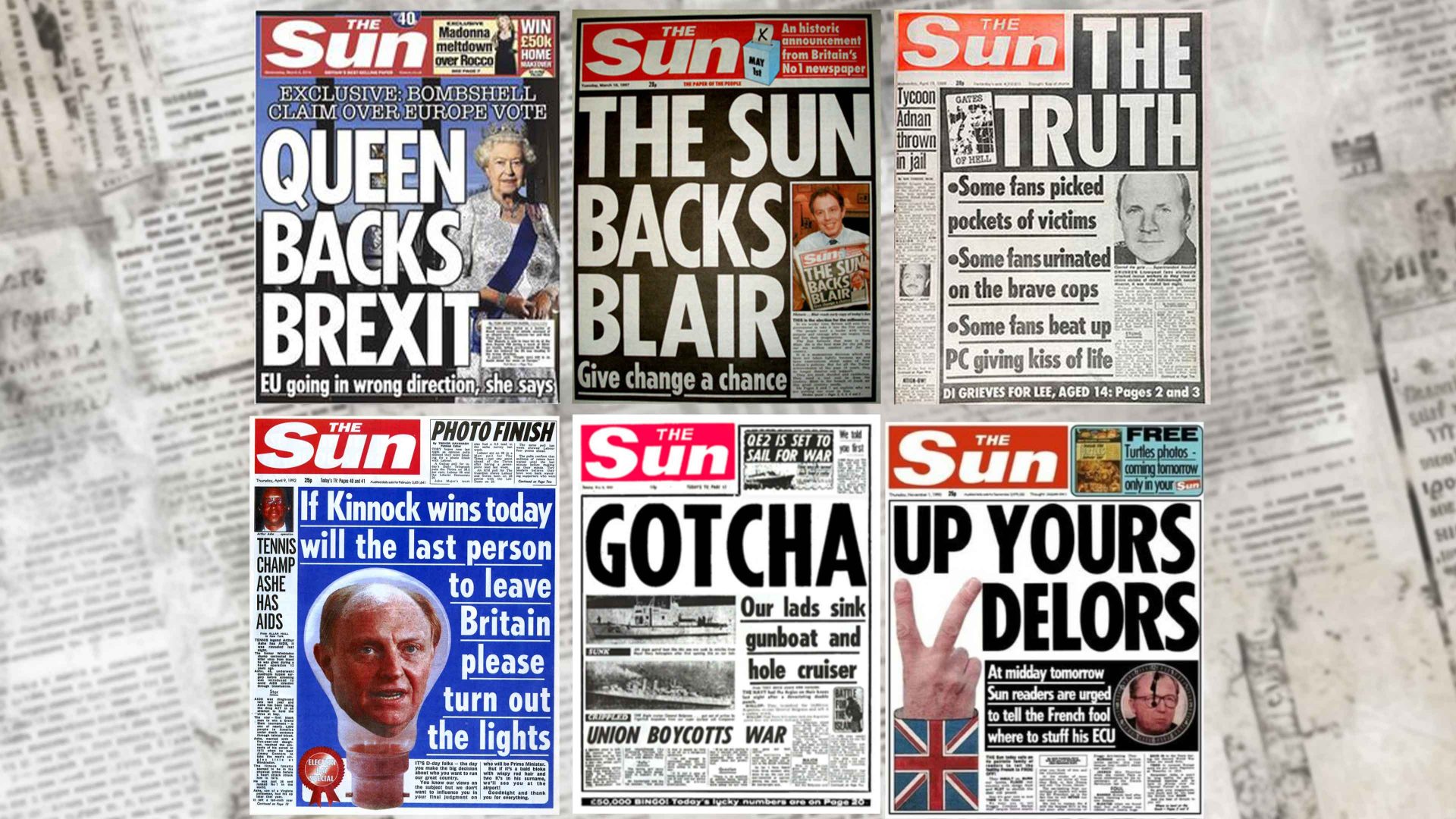
When John Major unexpectedly won the 1992 general election, after the Sun ran a front page showing Neil Kinnock’s head inside a lightbulb next to the headline “If Kinnock wins today will the last person to leave Britain please turn out the lights”, the newspaper took credit – running “It’s The Sun Wot Won It” as its first-edition splash headline the morning after.
Murdoch, though, was reportedly furious – saying later he had given Kelvin Mackenzie “a hell of a bollocking” for it. Some suspect Murdoch was angry because the front page risked giving the game away: normally, the paper’s management would humbly insist that their readers had the power and the newspaper was merely a vessel for their views.
Thirty-four years on, the Sun is surely setting, just like its proprietor. Its readership is much diminished, its political power is all but used up, and it doesn’t even make money any more. Last week it announced losses of £53m in the previous tax year, up from £18m the year before.
Where once the paper was at the heart of the national conversation, it now barely reckons in it. Stop to think for a moment: what’s the last Sun front page that you can actually remember?
The truth is that newspapers as a whole have less power in 2026 than they did in the 1990s – in the internet era, there is simply a lot more competition for our attention. This has shown in their sales: in 2010 the Sun was the UK’s top-selling paper, shifting around 2.9m copies a day, a comfortable 800,000 copies ahead of the second-place Daily Mail.
Throughout the 2010s, though, the Mail closed that gap – not by growing, but because its sales shrank less quickly than the Sun’s. By March 2020, the Sun sold 1.2m papers daily, just 40,000 more than the Mail. After that, we have no idea what happened, though, because the Sun withdrew itself from auditing, meaning it no longer had to publish its sales figures.
We can estimate where they might be, though: the Mail’s circulation has almost halved since 2020, to around 620,000 copies a day in 2026. Industry insiders speculate that the Sun now sells fewer than 500,000 copies a day. That’s still a circulation most publications would kill for, but it is less than a tenth of its heyday.
Of course, in 2026, digital matters more than print – but here, the Sun’s numbers are curious. According to figures released by Ipsos, the Sun reached 20.2 million Brits online in February 2026, making it the UK’s fourth-biggest news brand – behind the BBC, Guardian and Mirror, but ahead of the Daily Mail.
But Ipsos also measures the top UK news brands by how much time people spend reading them each month – arguably a better measure of how influential each publication is – and by this metric, the Sun doesn’t even break the top 10. Even if people are still clicking Sun links in search results, they’re not spending much time on the site.
Its political power just isn’t what it used to be. Newspapers still have an outsize role in UK politics, not least because – as LBC’s James O’Brien told The New World last month – broadcasters use them to set their news agenda and frame their discussions.
However, even here, tabloids are largely left out: the Telegraph and Mail front pages often frame the national debate. The Sun’s front pages, often focused on celebrity news to support sales, are typically left out of the conversation.
Suggested Reading

How to kill a newspaper
Part of the cause of the Sun’s woes is the phone-hacking scandal, for which it is still paying compensation and legal costs more than 15 years after the scandal broke. The newspaper made a profit of £103m in its last accounts before the phone-hacking revelations, but has failed to ever turn a profit since – with cumulative losses totalling £1.3bn over the last 15 years.
Ironically, its stablemate the Times, whose losses it once subsidised, is now comfortably profitable, having made £69m in its most recent accounts, up from £61m a year before. News UK insiders say that sometimes costs are shifted between publications in ways that can flatter some at the others’ expense, but the change in fortune is noticeable: the Times has a bigger online audience (as measured by engagement), makes money, and still has clout, while the Sun loses money and has lost its influence.
The Sun has tried to reshape itself for the digital era. With the Times reinvigorated by Times Radio, a similar effort was made to reshape TalkRadio into TalkTV and tie it to the Sun – but these efforts proved to be a costly flop, and were soon reversed.
Efforts to introduce a paywall for premium Sun content have largely stalled. The Sun has even tried to attract a Trumpian US audience with the YouTube show Harry Cole Saves the West, but viewing figures are underwhelming for such a high-production effort.
The tabloid newspaper was a brilliant form of mass media for the 20th century, and the Sun – hateful though it often was – was better at it than anyone else. Those who focused on the left-hand pages of the paper would get an informed digest of the day’s serious headlines. Most people, though, read the right-hand side, which had outrageous stories, animal pictures, celebrity gossip and – of course – page three.
No one needs a tabloid to package that material for them any more, though. What used to be tabloid fodder is now just a social media feed, and the algorithm can feed you far more of what you like than a newspaper editor ever could. Why wait for the Sun to gather a lurid true crime story or a cute cat pic when X or Facebook can do it better?
Tabloids always did some hard news – and occasionally broke major political stories – but they lived and died by the rest of the package. The power of that is now gone for ever.
For now, of course, the newspaper still comes out every day and the website continues to churn out content. But the idea that a political leader would fight over, or even worry about, the Sun’s political endorsement is the relic of another era.
The question is how much longer the Sun itself lasts. Insiders believe it is safe for so long as 95-year-old Rupert Murdoch is alive – but after that, it could easily be put up for sale, or even shut down entirely.
The odd thing is, though, that would hardly even matter politically: the Sun might still be publishing, but it was eclipsed a long time ago.