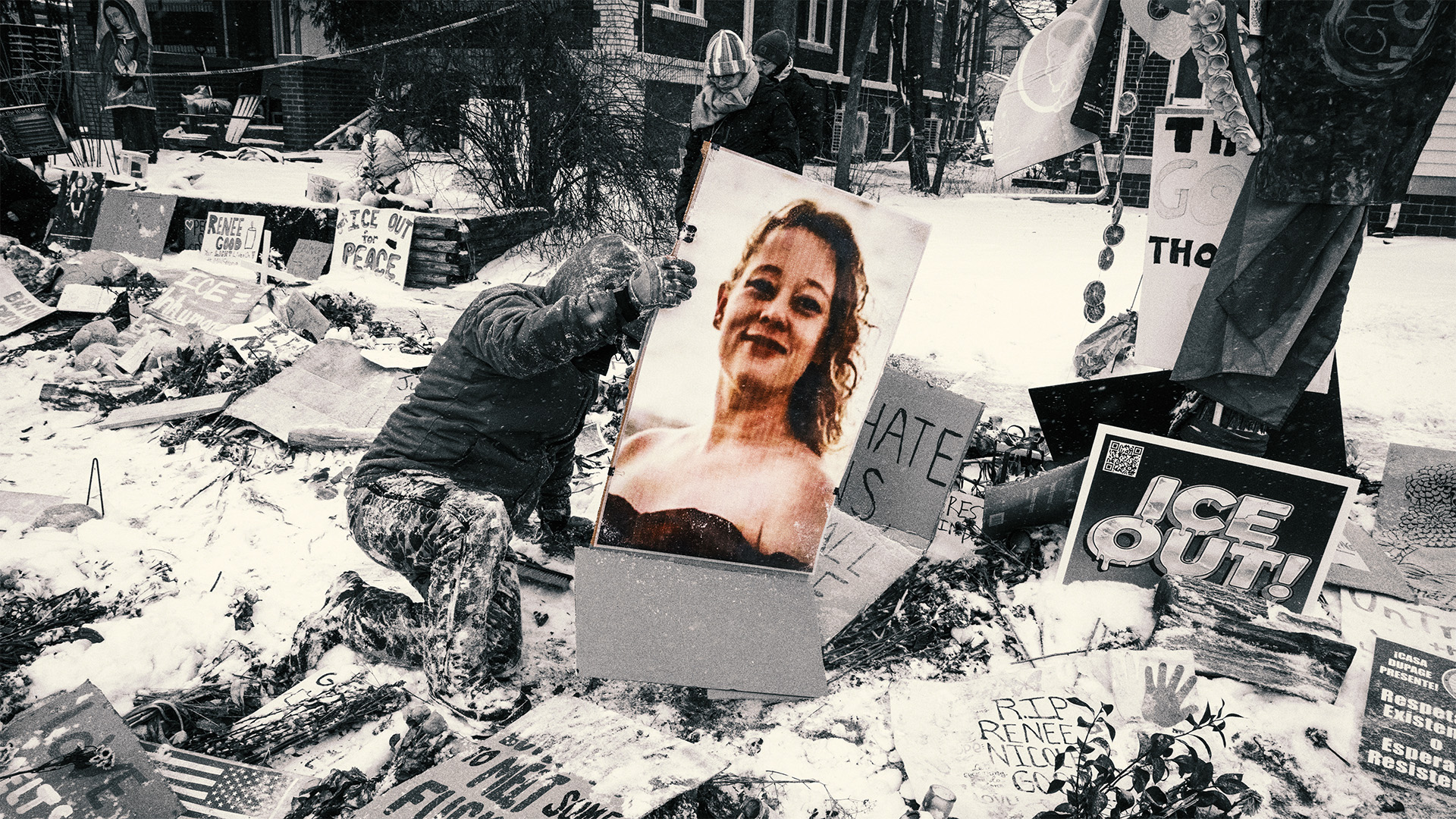
The photographs of bloodstained children’s toys in the glove compartment of Renée Good’s car made the violence of her death almost impossible to ignore.
Good was shot and killed in her car by an ICE agent on January 7, 2026, as her wife sat next to her in the passenger seat. News of her death rapidly spread across the world: a suburban mom in her late 30s was no one’s idea of a violent insurrectionist.
The brutal real-world violence against Good ended her life, but in some ways it was only the start of what was to happen to her. It became a necessity for the Trump administration, charged with defending the indefensible, to paint the mother of three as the aggressor, even in the face of clear video evidence showing otherwise. Administration officials claimed Good had driven her car directly at ICE agents, even claiming one had suffered severe injuries.
All of that was surely to be expected, but it fell on fertile ground online. Within minutes, US online commentators were happy to talk not just about Good, but about the entire class of person she represented, in such a way as to make her the villain of the story.
The Daily Wire’s Matt Walsh dismissed her as a “lesbian agitator”, while Fox News’s Brian Kilmeade claimed, baselessly, that Good was “a trained activist… a warrior leader of anti-ICE operations”. On NewsMax, pundit Carl Higbie condemned Good – who was on her way to pick up one of her children when she was killed – as the “worst mother of the year”, who “should be at home with her kids”.
Some commentators didn’t even need that many details – real or invented – to go on, though. The simple fact of Renée Good being a white woman was enough to dismiss her politics and belittle her death.
Naomi Wolf, a onetime darling of the liberal and feminist left, led the charge on this front. “OK, I’ll just say it. I’ve seen enough videos of the faces of liberal white women in conflict with @ICE, to know what is up,” she said in a post with more than a million views. “White liberal women are disproportionately sexually frustrated… The smiles you see on their faces now say it all: white women long for all-out combat with ICE – who tend to be strong, physically confident, masculine men – because the conflict is a form of physical release for them.”
Wolf’s bizarre psychological projection would be distasteful at any time, but this was posted less than 48 hours after the brutal killing of Good, who was married to another woman – and yet it easily became part of the discourse as if it was just another piece of political commentary.
Eventually, a new label for white women like Renée Good emerged out of her death. Good, they decided, was simply AWFUL – an Affluent White Female Urban Liberal. The earliest use of the term seems to have come from self-styled “Christian broadcaster” Erick Erickson less than 24 hours after Good’s death. “An AWFUL (Affluent White Female Urban Liberal) is dead after running her car into an ICE agent who opened fire on her,” he posted. “Progressive whites are turning violent. ICE agents have the right to defend themselves.”
British commentator David Aaronovitch perhaps caught the reaction of any decent person to reading that post best, with his simple reply: “May you be forgiven”. But repellent as Erickson’s post is, his formulation has caught on. AWFULs are now discussed on Fox News, explained on Vox, and dismissed by online misogynists delighted to have a new term with which to belittle women.
There have certainly been no shortage of those, from all sides of politics. White women have been “Karens” for almost a decade. “Pussy hat liberals” – a term for moderate anti-Trump protesters originating from the women’s march in his first term – have been derided by left wing activists and right wing commentators alike. “White women’s tears” were decried by activists as a form of violence during the Black Lives Matter movement.
The list of examples goes on, and on, an unusual source of unity in a divided America. A country that can agree on almost nothing can at least shake hands on one thing: white women are not to be trusted.
On a superficial level, the phenomenon seems bizarre. White women are the single largest demographic group in America – white men are second – and as a consequence are also perhaps the most politically influential, and yet seem to attract the ire and contempt of political figures from all sides.
One simple answer as to why is sexism. Women still earn less than men, are less likely to get promoted, and women’s issues are still treated less seriously than those affecting men – few of the problems highlighted by Caroline Criado Perez’s Invisible Women have been tackled in the years since its publication.
Suggested Reading

ICE are now murdering people in the street
Women suffer in a world designed by men in numerous ways, from lacking research for auto-immune disorders, to dying in larger numbers in car crashes as seatbelts are designed for men. The world is still more than ready to dismiss women who speak up too loudly.
But when it comes to white women in particular, something more is at play, not least in the way this group is often dismissed or condemned by progressive activists, often led by women of colour.
Particularly in America, the problem here seems to be that no one feels confident that white women are on their side. White women are often portrayed as the crucial swing voters of American politics, but in reality they tend to break fairly solidly for the Republican presidential candidate – even when it’s one as violently misogynistic as Donald Trump.
According to the Edison exit poll, white women voted for Trump over Clinton by a margin of nine points in 2016, for Trump over Biden by 11 points in 2020, and Trump over Kamala Harris by a margin of seven points in 2024. Progressive activists’ suspicion of white women as a grouping is grounded in reality – the majority are indeed not on their side.
At the same time, though, white women are not conservative enough for many white men. Yes, they broke for Trump in the last three elections, but not by nearly the margins of white men, who backed Trump over Clinton by a margin of 31 points, Trump over Biden by 23, and Trump over Harris by 22 points.
White women are split politically at around 55% Republican, 45% Democrat. That’s enough for both sides to look at the group as a whole and see too much that they don’t like. White women aren’t Republican enough for conservative men, and are far too unreliable for progressives.
There is no shortage of other psychological factors we can throw into the mix. Dissatisfied people tend to project on to women. They see the mother that didn’t understand them, the teacher who didn’t see their genius, the girlfriend that rejected them, the wife that turned “frigid”.
White women are a safe target on to which anyone can project their frustrations, not least because almost no one worries about punching down when they target white women. Conservative men generally reject the idea of privilege and “punching down” full stop, while progressive activists will place white women very close to its top, making them a worthwhile target. This is a group that simply cannot catch a break.
None of this is to claim that white women are the most vulnerable or the most hated group in America. That simply wouldn’t be true. But there is something special about the kind of dismissive hate they attract, and the bizarre similarities in how groups with otherwise radically different politics treat white women as a grouping.
Renée Good was, after all, an individual, not a representative of “white women”. She was a poet, an activist, a mother, a wife, and any number of other roles – just like everyone else. Reducing anyone to their demographics is necessarily reductive, but that rarely stops us doing it.
Suggested Reading

Bari Weiss is crying all the way to the bank
The wave of hatred and invective against white women in the wake of Good’s killing came overwhelmingly from the right. AWFUL is a right wing framing that has yet to fully break through into the broader vernacular – though it will almost certainly do so.
The wheel, though, will continue to turn, and in time white women will find themselves vilified by the left once again.
It seems that everyone hates white women, and everyone will continue to do so. There are any number of possible reasons, but at the root of them seems to be one thing: entitlement.
Politically, and psychologically, Americans seem to feel that white women owe them something. Agreement, fealty, acquiescence, or something more – and when that’s not supplied, the anger spills out.
Until that imagined debt is written off, or forgotten, white women will remain in the crosshairs.