
Few things in the world can compete with the Detroit Auto Show for sheer, in-your-face, Americana. Before even entering the show proper, visitors getting out of the freezing -12ºC weather outside (-20ºC with wind chill) are greeted by the iconic 1976 Ford Gran Torino, as used by Starsky & Hutch.
Next to it, and right by the entrance, a Drug Enforcement Agency recruitment stand features a car fully wrapped in the American flag, and a slogan promising a “FENTANYL FREE AMERICA”. Inside, a recruitment stall for the army features a fairground game to test your punching strength, while the marines – “Earned. Never given” – allows attendees to “earn” swag including water bottles, protein shakes, and t-shirts, by doing pull-ups on a metal bar.
There is also, of course, a dizzying array of new cars, and attentive salespeople offering to walk the thousands of attendees through the amazing benefits of each vehicle. Ford, the company who established the global car industry in a factory just ten miles from the auto show, has pride of place on the centre of the floor.
It is flanked on one side by General Motors – owner of Chevrolet, Buick, and Cadillac – and on the other by Stellantis, an international conglomerate formed in the last decade from the merger of Fiat-Chrysler and Renault, which produces everything from the Fiat 500 to the Jeep Grand Cherokee.
The Detroit Auto Show has heritage on its side: the global auto industry was born in this city, after all. Everything about the show projects strength, to the point that it almost seems to be trying too hard. Banners everywhere proclaim that “THERE IS ONLY ONE MOTOR CITY” – but everyone attending must know that’s not true. Detroit isn’t what it used to be. Even Ford only produces one of its vehicles – the F-150 pickup truck – from factories in the town.
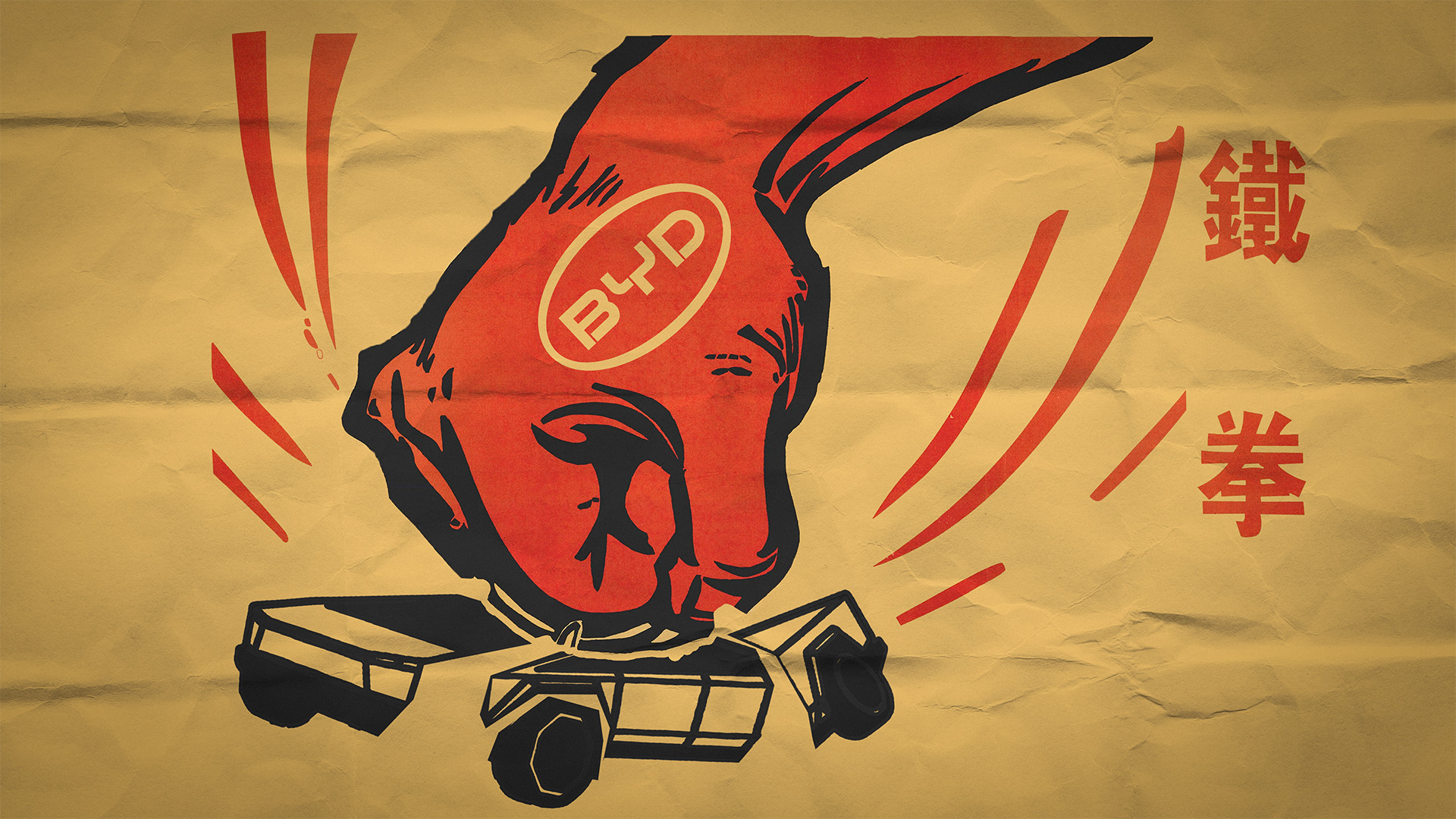
The era of Detroit being the only show in town when it comes to cars ended long ago. But American dominance of the auto industry is – to be kind – under threat, too. This was most obvious in who wasn’t even in Detroit. Tesla, which has dominated the electric car industry for the last decade, has never appeared at general auto shows. And BYD, their Chinese challenger, was similarly nowhere to be seen on the floor. Their absence indicates a world that is passing America by.
The future’s electric
For most of the world, 2025 was a huge year for electric vehicles. In December, sales of new electric cars overtook sales of new petrol cars for the first time ever. The pace of this change is almost unbelievable: as recently as 2022, four new petrol cars were sold for each new electric car. Now, the latter is in the lead.
In China, the biggest single vehicle market after the US (and which is expected to overtake it soon), electric cars already outsold petrol – but by the end of 2025, the sale of fully-electric heavy trucks overtook their diesel equivalents. Trucks carry heavy loads over very long distances, and so were seen as the area least suited for electrification. Chinese makers have shown that’s not so.
Despite the political blowback against net-zero, and hesitation from policymakers on committing to the switch to electric, consumers are voting with their wallets – electric cars are increasingly affordable, look good, perform well, and have the infrastructure to allow people to drive them without worrying about the battery going flat.
At least until we get to America. At the Detroit Auto Show, the big automakers were trying to nod in the direction of an electric future. Front and centre of Ford’s huge array of vehicles was the Mustang Mach-E RTR (“Ready to Rock”), an electric version of its popular crossover SUV.
Jeep similarly had the electric Jeep Recon Moab, the “only fully electric vehicle to be trail rated” for off-roading, as its centrepiece. Both vehicles were accompanied by a mic’d up actor listing their virtues, but both vehicles were largely ignored by showgoers, in favour of the much bigger petrol-fired vehicles behind them.
Stereotypes exist for a reason, and Americans genuinely like big cars. Their roads are set up for them – cities are built on grids, and the interstate network is huge. When everyone else is in a huge car, driving a small car is genuinely less safe – you and your family will come off worse in a crash. A Fiat 500 on display at the auto show was greeted mostly as a novelty, coming off like a toy car compared with pickup trucks larger than some London flats.
Suggested Reading

What the Cybertruck says about Trump’s America
American car culture leans big, and Americans drive in ways that Europeans don’t. Few of us in the UK drive for longer than two or three hours at a time, and even journeys of that length are rare. Americans will drive from state to state for ten hours, twelve hours, or far longer, exactly the kind of journeys for which electric vehicles are least suited. With the right charging infrastructure, electric vehicles can do these journeys, just like they can manage heavy trucking and off-roading – but there is still a huge job to do to convince buyers of that.
More than that, the economics of driving in America are simply very different to the rest of the world. The biggest factor in this is the cost of petrol, or “gas” as Americans insist on calling it. A gallon of petrol in America today costs about £2.35. The same amount of fuel in the UK would cost about £5. In France, it would be £5.52, Germany it clocks in at £5.72 and in the Netherlands a gallon of petrol is £6.67. Even in China – where prices at the pump are state controlled – a gallon of petrol is £2.90, a higher cost in a country with much lower average incomes.
Cheaper gas means there is simply less motivation for Americans to switch to electric cars, a factor compounded by the Trump administration withdrawing a federal tax credit worth $7,500 for electric car buyers last year – meaning that they’re now much more expensive. America is simply out of sync with the rest of the world on electric cars, which makes it all the more difficult for American carmakers to dominate in this area.
The elephant in the room
Except that’s not quite been the case for most of the last decade: the world’s most valuable automaker, and the top seller of electric cars has been an American company: Tesla. Elon Musk, the company’s owner (after he bought it out from its original founders) has spent years telling investors that Tesla isn’t a car company – this is part of why it doesn’t appear at auto shows – but to date that’s still the only significant product it has ever brought to market.
Tesla’s Model Y has been the world’s bestselling electric car for years, and Musk long promised to produce a truly mass-market affordable electric car – a “model 2” that would be sold for $20-25,000 and would be available by 2025 or 2026.
This was yet another unfulfilled Musk promise. As the date got closer, Musk got less and less keen on the idea of actually delivering the Model 2. Instead, he started talking about a fully self-driving “cybercab” that could operate as a self-driving taxi when its owner wasn’t using it.
This, he said, would be the future of the company. Until he changed his mind again. He still says the “cybercab” is coming soon, even though full self-driving is not yet a reality on existing models, but it’s no longer the big idea. Instead, the future of Tesla is robotics. Musk is making big promises that Tesla will eventually sell a million humanoid robots, capable of doing pretty much anything, at a price tag of $30,000.
He claims the first will roll off the production line later this year. This combination of big claims, low price tags, and apparently imminent delivery dates will sound very familiar to anyone who has watched Tesla for a long time.
The truth is that Tesla needs a big idea that isn’t cars because its performance as an automaker is genuinely terrible. The last model that Tesla launched was the widely derided Cybertruck, which despite attracting a small devoted fanbase has generally been a commercial failure.
Otherwise, he hasn’t delivered a new model of car since 2020, and despite promised “refreshes” Tesla’s cars look increasingly dated. Sales of its Model S and Model X slumped by almost 50% last year, leading Tesla to announce last month it would be discontinuing both, with no replacements planned.
Tesla car sales globally fell 9% in 2025, the second year running of falling sales, and a figure that was considerably worse in Europe than in other markets. Musk has become a terrible CEO for an electric car company, with a public image that actively repels most prospective buyers of electric vehicles. Tesla’s margins are being squeezed, and Trump’s decision to scrap electric car subsidies means US sales will likely suffer further next year.
Tesla’s decision to skip auto pageants like Detroit used to look like a show of strength – the company didn’t need to be there, and it knew it. Increasingly, though, it just looks like weakness. Tesla has nothing new to show, and its existing lineup doesn’t compare favourably to newer, better cars. That is particularly true when the competition is from China.
It’s BYD you
Most car manufacturers have around a dozen or so major ranges, with variants of each leading to perhaps hundreds of different models. Tesla only really has two models worth noting – the Model 3 and the Model Y. Even after Tesla’s terrible 2025, the Model Y was still the world’s bestselling car. Tesla, and by extension America, is still number one!
Except… it’s really not. Until 2024, Tesla really was the top dog when it came to electric cars, but now it’s a distant second. Globally, Tesla sold just over 1.6 million cars in 2025. BYD, the leading Chinese manufacturer of electric cars, sold 2.25 million – overtaking Tesla for the first time and then beating its sales by 40%. But because BYD has around 30 different models of electric car, there isn’t a single one overtaking the Model Y, at least not yet.
Suggested Reading

Trump’s next victim: the US economy
China has taken a lead in the electric car race, and America looks to have almost no hope of catching up – Donald Trump’s policies have actively harmed its domestic market, removed incentives for American producers to switch to electric, and otherwise hamstrung the industry. The White House has been left to threaten countries like Canada for signing deals that will encourage Chinese car imports, despite the US having few competitive products to offer.
Review sites comparing Tesla’s Model 3 with BYD’s flagship Seal – BYD generally doesn’t try to compete directly with the luxury Model Y – generally rate both cars highly, but most say that on balance the Model 3 is still the better car. But in 2026, buying a new Model 3 comes with a lot of baggage, given Musk’s unpopularity and his decision to use his money to directly fund Trump.
Many of those looking at the head-to-head choose BYD. Beyond that, while the Model 3 is Tesla’s entry-level car, BYD has smaller and cheaper options available – while Tesla’s “Model 2” never materialised, the BYD Dolphin is a hatchback that’s on sale today, starting at around £25,000. BYD sells smaller, cheaper electric cars that buyers outside America like. Its success is really as simple as that, though Trump’s endless drama over tariffs must surely also be helping. European markets are not exempt from this new wave of competition – in 2025, the number of cars sold by Stellantis across Europe fell by nearly 6%.
Detroit Auto Show can insist that there’s “ONLY ONE MOTOR CITY” as loudly as it likes. Everyone knows that’s just not true any more. Sorry, Donald, but China is just better at making electric cars than you. And it’s only getting better.
 Most popular


How Jon Stewart told me the brutal truth about Trump and Hegseth
Trump is all your fault

The most contradictory identity in America


The Native American punk band MAGA says don’t exist