The conventional wisdom about talk radio – perhaps cemented by the phenomenon of ultra-famous conservative American hosts – is that it’s an inherently right wing phenomenon, playing to the prejudices of listeners who are mostly furious that things aren’t the way they used to be.
For three hours a day, five days a week, James O’Brien proves that this received wisdom need not be true. Over more than 20 years – he took on his current show in 2004 – he has become one of the UK’s best-known hosts, and doubtless the most famous from a left wing or liberal perspective. The formula seems to be working, too: LBC’s latest figures say he reaches 1.4 million listeners every week, and that his reach, audience share and the number of hours we spend listening to his show are all growing.
Yet when we meet a few minutes after one of his shows finishes, it is not radio or even podcasts he wants to talk about, but newspapers. O’Brien is both baffled by and in despair at the state of the UK’s press – especially in relation to Donald Trump’s recent decision to launch a conflict with Iran.
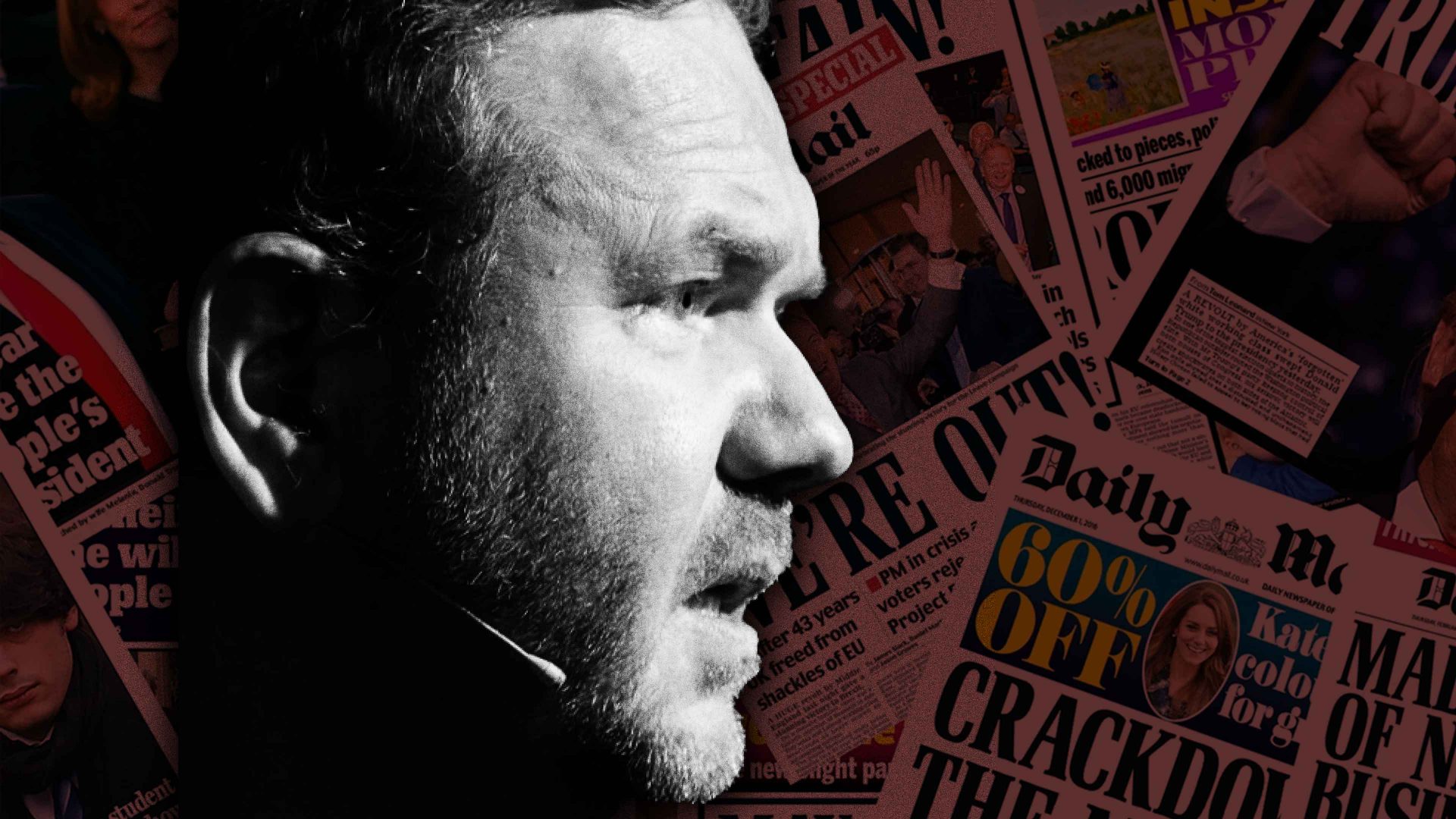
“There’s this phenomenon playing out on front pages, and we are looking at each other every morning saying, ‘What has happened? Everyone has gone mad’,” O’Brien says of his production team’s daily meetings. One standout moment for him was when the Mail ran a front-page splash based on Tony Blair, a long-term hate figure for the paper, criticising Keir Starmer for not backing the US more wholeheartedly on Iran.
“The Mail has pivoted since Chilcot, from coming pretty close to calling him the antichrist,” he says, referring to its notorious “A Monster Of Delusion” front page after the Chilcot inquiry lambasted Blair over catastrophic failings in Iraq. “Years later, they’ve got him coming out against Starmer, and they’re using him as a paragon of guidance and virtue.”
It’s part of a phenomenon he’s noted; that while all newspapers typically try to reflect the views of their readers, and the public more broadly – “Editors don’t do front pages they think their readers will hate,” he says – the right wing outlets seem increasingly entrenched into opinions most of the British public vehemently disagrees with.
Trump is wildly disliked among Brits, there is little public appetite for more action on Iran, and Brexit is increasingly unpopular. You would never guess any of this from most UK front pages, though.
O’Brien has a theory as to why: “It is just simply the fact that Trump’s hideousness, his moral bankruptcy, his obvious incompetence, his serial dishonesty are so huge that in order to avoid admitting the scale of the mistake that you made you have to keep pushing more chips into the middle of the table, because the alternative is to say ‘I’m a fucking idiot. I’m not just an idiot, I’m an idiot of intergalactic proportions.’”
Newspaper editors would rather double down on an unpopular position than try to change course, he believes, because the only people who criticise them for doing so are liberals like him (or me). “It reminded me of Brexit, in the sense that they would rather look utterly ridiculous than look wrong,” he says. “They would rather expose themselves to the hideous ridicule of people that they don’t care about, ultimately.”
But why should we worry if a newspaper goes mad? Print circulations have plummeted in recent decades, from the days when the Sun sold more than 4 million copies each per day and the Mail wasn’t too far behind, to now, when they total about 1.2 million daily copies between them and the most loyal customers are pensioners.
O’Brien gives two reasons: they are still huge online, and the print product still provides much of the raw material for other media outlets, including his own, to discuss. “I get to work in the morning, I don’t know where else to go to get my thoughts on what we’re going to talk about,” he notes.
Even opinion-led shows like O’Brien’s can only discuss stories people know and have opinions about. “Where are you going to go to get a plurality of opinions? You’re going to go to the op-ed pages and the columns,” he says. “And you’re going to have a look at what people who are increasingly unhinged are saying about subjects that they largely don’t understand.”
The harder question is why the UK’s print media seems to be increasingly detached from reality. He initially hesitates when I ask whether he thinks social media is behind it, given the increasing right wing extremism of X since its purchase by Elon Musk in 2022.
Most senior newspaper editors, he wonders aloud, aren’t active social media users. So surely that means it can’t explain their “bonkers-ness”?
As he warms to the topic, though, O’Brien revises his view. Especially on the opinion pages, he notes, editors only have so much influence over what their writers do. “You know and I know that it is not true that the columnists get told what to write. They generally mean it,” he says. “They’ve all joined in so full-throatedly that it means there’s some sort of collective madness going on that’s not explained by bottom lines or profits or whatever…
Suggested Reading


To Trump, Iran isn’t war – it’s showbiz
“The Twitter madness is feeding back into the newspapers because these columnists, but not the editors, are terminally online,” he continues. “They are obsessed with things that most people outside of Twitter don’t really care about and it’s like a doom loop, isn’t it? And then it sets the agenda for what everybody else is talking about.”
Watching this radicalisation of the UK papers has been a strange experience for O’Brien, and a personal one, too. He admits he had long imagined he might one day end up working for the Telegraph, where his father had been a longstanding and respected correspondent. Beyond his family connection, he says he has watched colleagues and even one-time friends change before his eyes.
He returns to the idea of the “doom loop”, of getting locked into a cycle in which you become hooked on the rush of an audience reaction to your articles, and so double down trying to get that high again. “Allison Pearson at the Telegraph is absolutely cock-a-hoop with the reaction she’s getting from all these mad people – and not just online people, but Telegraph readers,” he says.
“They’re sending letters saying ‘you are the only one speaking out on this’. And they start believing it, and then you have to ramp it up again. You have to be even madder next time than you were the last in order to keep the supply flowing.”
This, he argues, means that people can join a newspaper or a TV newsroom as a moderate and find themselves becoming increasingly extreme. “Take Michael Deacon in the Telegraph. I met him a bit back in the day. He used to write lovely waspish columns, and now he’s all in, isn’t he? He’s a fully paid-up member of the bonkers brigade.
“And, I mean, I knew (Mail columnist) Amanda Platell really well. I worked for her on the Express. She came to my wedding, and she now writes stuff that’s off the chart. I think it’s as we’ve established, no one’s ordered to do it, but I think the metrics that social media has created have boiled people’s brains.”
I feel like O’Brien has just plonked an elephant into the middle of the room. Surely if this toxic feedback loop created by audiences and metrics exists, he’s just at risk of falling victim to it as anyone else? He’s got a huge social media audience, a loyal radio listenership, and he regularly goes viral.
O’Brien admits that he worries about this, but says that he keeps himself honest by not looking at the figures – and says he stopped years ago. He assumes his online numbers are fine, he says, because someone would have a word with him if not. Beyond that, he tries not to think about it.
He does acknowledge that broadcasters aren’t free of those forces, though. He thinks there is a “conscious and unconscious” radicalisation effect caused by being a GB News presenter, for example – pulling a politician or broadcaster into a particular studio and online ecosystem that pickles and solidifies their opinions.
O’Brien is an opinionated radio presenter, and his show – like those aired by GB News – is regulated by Ofcom. He quickly admits that he and his colleagues have been bewildered by GB News’s approach to Ofcom, and how they seem to be getting away with it, something highlighted by the New World’s recent investigation of the channel’s output.
Suggested Reading

Helen Lewis: ‘Is Musk a genius? Look at his tweets’
“Many colleagues here wonder what’s the point of following the rules,” he says. “The consensus here is that they insulate themselves from bias problems by having a token lefty on every panel… We certainly thought you could only counter presenter bias allegations with other presenters, not mere panellists. But the big issue, I think, is appetite. Ofcom doesn’t seem to have the stomach for the fight. I think the rules are adequate.”
When it comes to the BBC, O’Brien is clearly frustrated but still believes the corporation is part of the solution to the UK’s current woes, rather than part of the problem. His primary frustration is the BBC’s approach to impartiality.
“It is not balanced to have false equivalence,” he says. “It’s an absolute mockery and an insult to readers and listeners to present two opposing positions as intellectually equal or as enjoying equal support and therefore getting equal coverage.”
He says he would “re-fang” the BBC, and would like to see the ferocious journalistic critique the BBC often applies to its own output during its many scandals applied to the rest of the UK media from time to time. But ultimately, its role as a broadcaster for everyone is, he thinks, essential.
“I think that the BBC should be the jewel in the crown of our democracy, really, and that one guaranteed perennial way through which you can have that central platform of democracy,” he concludes. “To have valid democratic decisions, you need a properly informed population.”
I ask O’Brien if he ever wonders why his show has so few direct competitors. The BBC has a national talk radio station, and News UK operates two – Talk and Times Radio. But no other broadcaster has a show that even tries to take on O’Brien as a liberal firebrand. He insists he’d welcome the challenge.
“I’m getting old, James, I can’t do this forever. I’m going to have to pass the baton on at some point, and yeah, and it would be really good to listen to as well,” he says of a potential rival show. “I have been really surprised. I don’t fully understand it actually. I mean, I know that [News UK CEO] Rebekah [Brooks] hates me, but that doesn’t mean that she has to hate their own version of me.”
O’Brien says it’s not enough to condemn bad media and bad outlets. You need something good too – something you can trust. “At the moment, the population is the least or the worst informed that it’s been in my lifetime,” he says. “And a lot of responsibility for that has to lie with the absence of the antidote. You can’t lay it all at the feet of the poisoners.”
I ask him where he thinks the antidote is. Which UK outlets give him hope at the moment? “I have an inordinate amount of excitement about what people like Jim Waterson are doing at London Centric, and what the Dispatch are doing in Birmingham, and Manchester Mill are doing in Manchester… but they’re tiny, aren’t they?”
He adds another outlet he’s fond of, too. “And I love the New World, you know, I do. It’s got the mix, right? I can learn something from it. I will smile and chuckle when I read some of the stuff in it, and it will also get my juices flowing. It reminds me why we all do what we do.”
The James O’Brien show is on LBC, weekdays from 10am-1pm