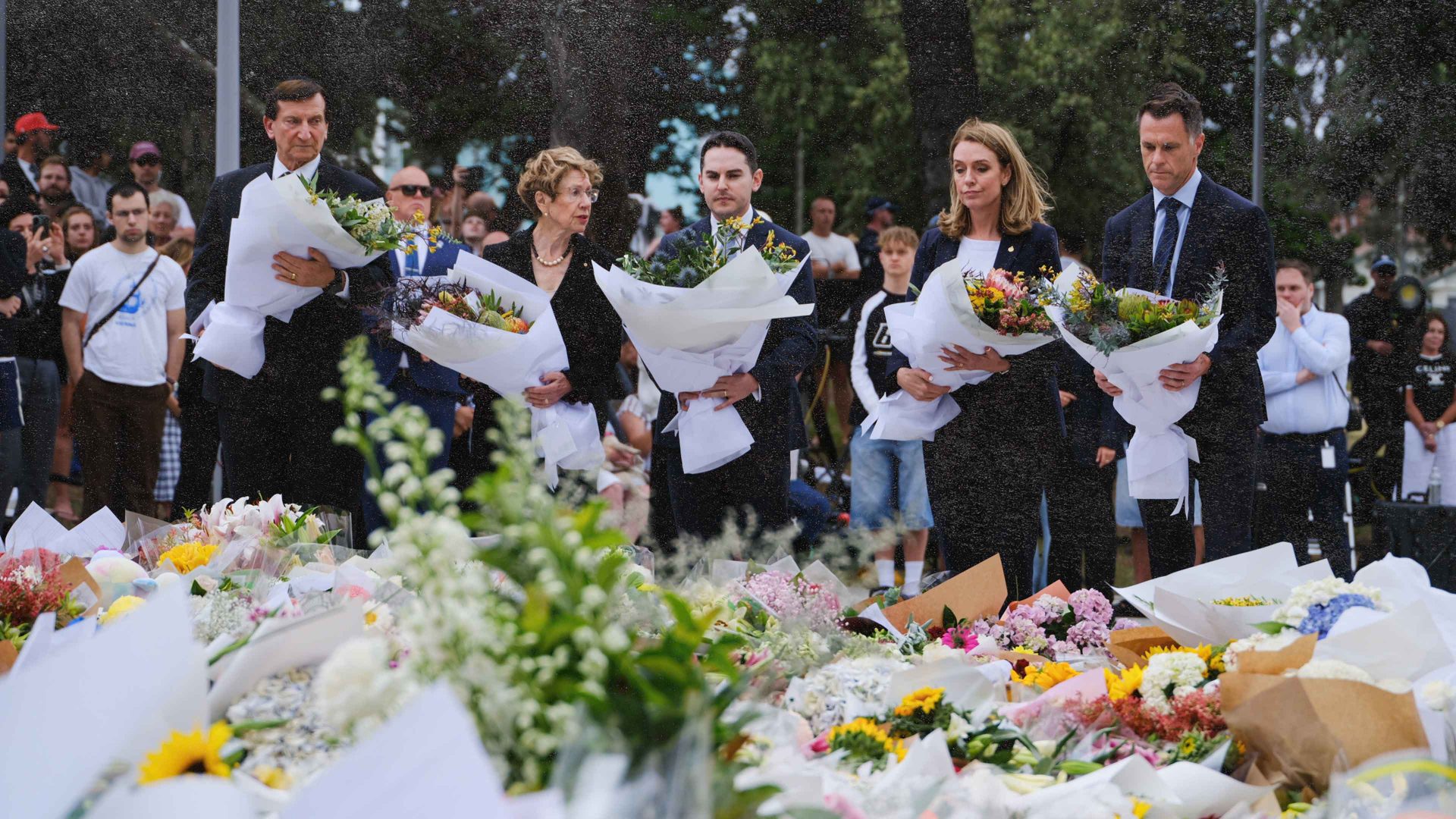
It was supposed to be a celebration. On Sunday, Jews gathered on Bondi Beach – one of Australia’s most iconic tourist spots – to celebrate Hanukkah. At least 12 of them would never make it home, with dozens more injured, many of them gravely. The suspects of the hate attack, one of whom was shot dead by police, were a father and son.
Amid the grief, there will surely be a search for answers, many of which will prove difficult if not impossible to find. How can a family radicalise itself in such a way – how can a parental desire to protect your child become so distorted by hate? How can Jews around the world ever feel safe to celebrate, or even to live as normal? How can they ever be safe?
Inevitably, language will become part of this debate – for some, it already has. When pro-Palestine marchers around the world chant “From the river to the sea” or “Globalise the intifada” most of those either haven’t thought hard about the meaning of the chant, or else interpret them as messages of solidarity, or peaceful resistance.
That is not, however, how everyone means them. It has never been how Hamas nor many of its regional allies mean the slogans, and it is not how some extremists, fuelled by hate, intend them either. It is also not how many Jews across the world hear them. “From the river to the sea” is heard as a call to abolish Israel, and “globalise the intifada” as a call for violence against Jews across the world.
To ignore this, at a time when innocent Jewish civilians around the world are being targeted and slaughtered in terror attacks is a profound failure of solidarity from people who believe themselves above such myopia. It is as wrong to blame Jews for the actions of Israel in 2025 as it was to blame Muslims for the actions of Al Qaeda in 2001. In truth, the slogans probably contribute little to the motivations of fanatics who would kill – but they contribute to the very real atmosphere of fear.
They also contribute to the blowback, and to those who would answer hate with hate on both sides. There are too many people who wish to frame recent events as a clash of civilisations, an existential battle between Islam and “the west” – sometimes defined to include Jews, sometimes very much otherwise.
Sadly, this group increasingly includes mainstream politicians in the UK. Nick Timothy, the Conservative MP and former Number 10 chief of staff, didn’t bother posting any message of support or condolences for the victims of Bondi beach or their families. Instead, he posted a message any Islamist terrorist could easily endorse: that this is the West vs the rest.
“’Diversity is our strength’,” he quoted on X. “As long as we continue these braindead liturgies, the threat will grow. We need to confront and defeat it. And that means being honest about Islamists, their beliefs and the networks that nurture them and spur them on. We must destroy it all.”
Shadow justice secretary and Conservative leadership hopeful Robert Jenrick took a very similar tone, though he managed to find time to condemn the attack as “appalling”. “The cancer of extremism is spreading and too many choose to look away,” he concluded. “Confronting it is the battle of our generation.”
Suggested Reading

The Jewish suitcase is back in the hall
The danger of those who would meet hate with hate, who would frame extremist violence as a problem of Islam rather than a problem of polarisation, radicalisation and hate-mongering, is that if enough people believe their prophecies they will prove to be self-fulfilling.
Indeed, Reform’s student chair, 43-year-old Matt Goodwin, thought he’d seen the proof of that in the footage of a Sydney man heroically tackling one of the Bondi Beach shooters and wresting his gun from him. “There is something highly symbolic in the video of that very brave man taking down the terrorist,” Goodwin posted – again, forgetting to mention the victims of the attack. “I think it speaks to a general mood in the West. We are not going to take this shit anymore. We have had enough.”
Goodwin had not waited to learn anything about Sydney’s hero, or his motivations, before posting – but he was certainly correct about one thing: it is indeed highly symbolic.
The man who wrestled the gun from one of the attackers, and who was shot “four or five times” by the other, as a result – he is being treated in hospital, reportedly with a good prognosis – is named Ahmed al Ahmed, and while he is now an Australian citizen, he was born in Syria and arrived in the country as an immigrant in 2006.
In a media interview, al Ahmed’s parents – who had themselves arrived in Australia just months ago, an example of the kind of “chain migration” right wingers so often decry – explained their son’s motivations. He couldn’t stand to do nothing as he saw people suffering, and did what he could to stop it, they said with obvious pride showing through their concern.
Yes, the attackers of Bondi Beach are believed to have been radicalised Islamists. But the hero of the day is an immigrant with a Muslim background, too. This does not fit the convenient Islam-versus-the-West or Islam-versus-the-Jews narrative that some on the UK’s right and far right seemed almost, perversely, gleeful to fit it into.
Surely the real battle is those who hate, and wish to spread hate, versus those who wish to stop it. Any time a politician or a commentator meets the hate of attacks like this with hate, they have picked their side. We can, and must, do better.
 Most popular


Matt Goodwin’s road to derision


How Jon Stewart told me the brutal truth about Trump and Hegseth

Screen scandal: How Ofcom lets GB News get away with it
The race to save the Beatles