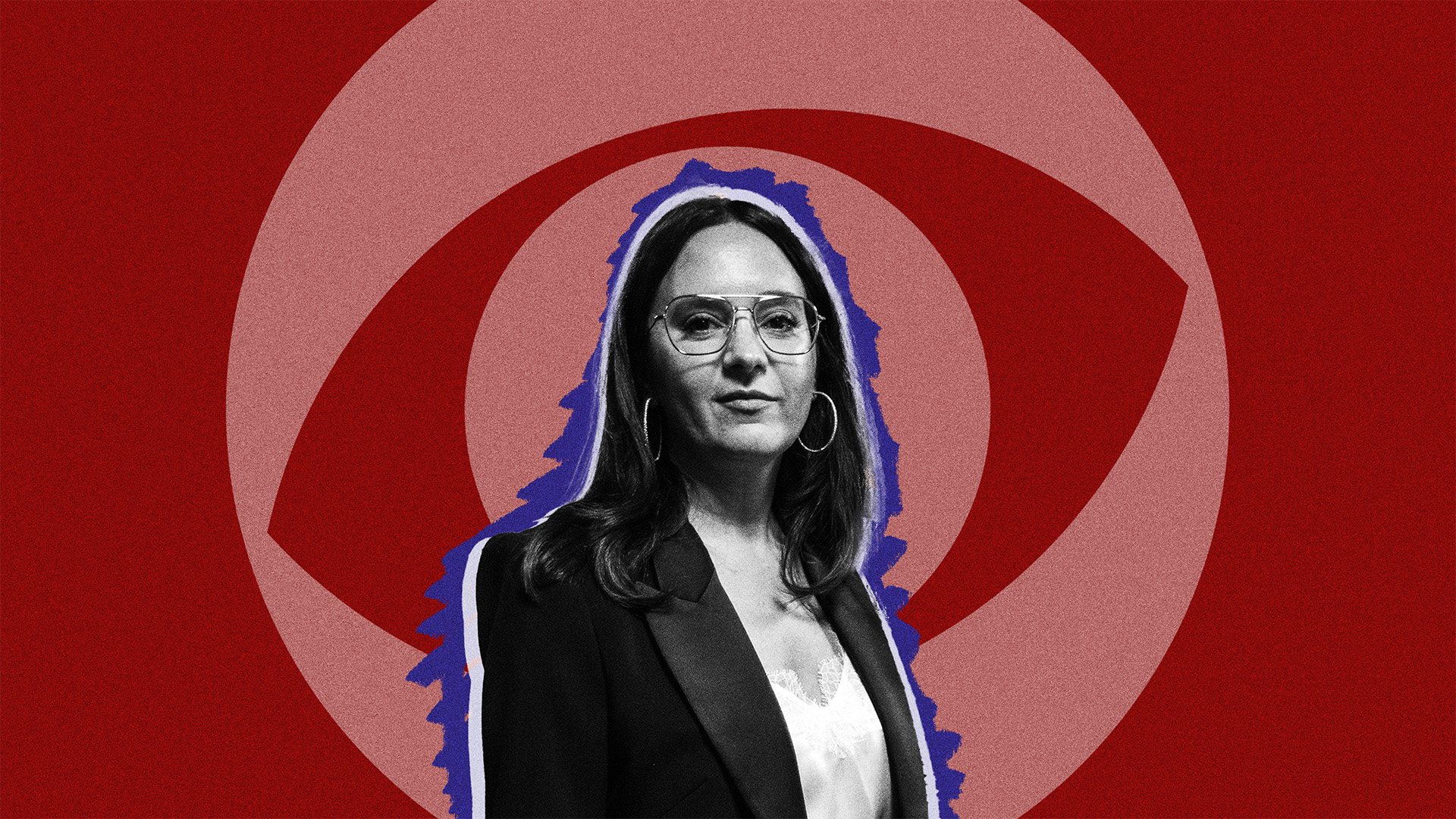
Just over three months ago, 41-year-old Bari Weiss took on what was by far the biggest job of her career to date, becoming editor-in-chief of CBS News. She got the job as part of the acquisition of its parent company, Paramount, by Skydance, a company owned by the tech billionaire and Trump ally Larry Ellison.
Over that time, endless column inches have been filled with commentary on Weiss’s early performance, with particular attention going on Weiss’s controversial decision to delay the airing of a segment on CBS’s flagship show 60 Minutes. The subject of the film was the treatment of people within the CECOT detention facility, the mega-jail in El Salvador to which the Trump administration had unlawfully deported people. The decision to pull the segment, after it had been trailed and advertised, received blanket coverage and condemnation.
More recently, the presenter Anderson Cooper stepped down from his role at 60 Minutes, after nearly two decades in the role. It was yet another substantial change at CBS, again attributed to Weiss.
The overall impression is that Weiss, newly installed in a role overseeing a global newsroom of 1,200 employees, is hopelessly out of her depth. Weiss, it notes, has spent her career working on the opinion pages, not news. She has barely been a news reporter, let alone an editor, and now she is overseeing a large and complex news operation.
She is a polarising figure, having founded The Free Press, a robustly right-wing news and comment outlet, in response to a perceived left-wing backlash against free expression. Everyone in US media has an opinion on Weiss, and her performance, and most of them either want or expect her to fail.
Some of that is doubtless due to her politics, or to the controversies she has courted. Some of it is surely due to her accumulated net worth, estimated at $100 million or more – almost all of it earned, not inherited. So, how did such a figure come to the helm of such a storied, if staid, newsroom? And what is the industry missing about her meteoric rise?
Unlike many who get to the top of American journalism, Weiss did not grow up in its gilded circle. Her parents were affluent but not among the yacht classes of the super-rich. They owned a flooring company in Pittsburgh, rather than a media conglomerate in New York.
That background was enough, though, to get Weiss a place at Columbia University – one of the most famous gateways into American journalism – where she quickly entangled herself in campus culture wars. Weiss, who is Jewish, co-founded Columbians for Academic Freedom, alleging a pro-Palestine professor had intimidated her during lectures. This activism, combined with her generally politically conservative views, made her stand out against the generally politically liberal backdrop of the school.
This in turn led to Weiss having an early journalistic career in conservative media, including a two-year stint at Tablet, a conservative Jewish publication (not to be confused with the British catholic publication The Tablet). Weiss was news and politics editor, her only newsroom position. This was followed by six years at the Wall Street Journal as a junior editor and occasional contributor on the opinion and book review pages.
Even in her early career, one of Weiss’s standout talents was in making powerful friends. Associates, both friendly and otherwise, speak of her “flamethrower charm” in face-to-face reactions, and her phenomenal ability to network. While at the WSJ, Weiss established a friendship with conservative commentator Brett Stephens, one that was to pay off for her career-wise.
In 2016, The New York Times persuaded James Bennett, then the editor-in-chief of The Atlantic to take over the opinion section of the newspaper, where he was also widely seen as a contender to be the newspaper’s next executive editor.
One of Bennett’s early goals for the opinion section was to include a wider array of opinions, particularly conservative ones, leading him to poach Stephens from the WSJ. A few months after his arrival, Stephens convinced the NYT to hire Weiss, too, as an editor able to help the paper reach and publish conservative voices.
Weiss was now part of a conservative minority within America’s most august liberal media institution, a role fraught with a degree of discomfort. Her stint at the NYT coincided with constantly rising temperatures in the culture war.
First, liberals and conservatives disagreed on the response to #MeToo – with one side seeing a long overdue reckoning with abuses of institutional male power, and the other seeing a retrospective witch hunt against once permissible behaviour.
These arguments were merely a warmup for a bigger cultural clash in the form of Black Lives Matter, a surge of anger after the killing of George Floyd by Minneapolis police, leading to protests and even riots. Many acknowledged a long-overdue need for a racial reckoning, but it was accompanied by overblown and alienating language and rhetoric around race which made an easy target for conservative jeers.
The atmosphere in the NYT newsroom became febrile, and came to a head when the opinion section ran a column by senator Tom Cotton calling for the military to be called in to suppress riots. Reporters led a public backlash to the piece on social media, arguing that it harmed the safety of black reporters at the paper. In doing so, they bypassed social media rules barring news staff from criticism of the NYT’s editorial content.
The column led to tense internal meetings at the newspaper and it eventually cost Bennett his job. But Weiss, who was not directly involved in the publication of the Cotton article, managed to make herself a central figure, too, by live-tweeting an internal meeting onto the site then known as Twitter.
Suggested Reading
Trump at Davos: A ‘New Yorker’ profile
Other NYT staff complained she had mischaracterised her colleagues’ criticisms, and abused her privileges as an opinion staffer to post her version of events, knowing that news reporters and editors would not be allowed to challenge it publicly.
Weiss put herself at the centre of a live political debate as to whether the New York Times had become woke and censorious, framing it in a way that made her a darling of Republicans and which gave her whistleblower status.
But if she was looking to be martyred for her conduct, the NYT denied her the opportunity. She was not disciplined or asked to resign. Bennett’s successor on the opinion pages asked her to stay. Instead, she resigned, publicly lambasting the newspaper in an open letter to its publisher.
“My own forays into Wrongthink have made me the subject of constant bullying by colleagues who disagree with my views,” she wrote, before doing a round of every TV show going. Weiss was already deftly turning her own voluntary resignation into a cancellation, and turning herself into a star in the process.
For all Weiss complained about the hostile reception she had received at the NYT, she could hardly say joining had been a bad decision. It had given her a platform as a prominent and – relatively – young conservative voice. While she said she’d disagreed with staff, she met her wife, society journalist Nellie Bowles, and her future deputy editor, Adam Rubenstein, there. And her exit set her off into the stratosphere.
The most effective conservative backlash to #MeToo, Black Lives Matter and to what was for a time a functional effort to tackle online misinformation and disinformation was a pro-freedom framing, presenting conservatives as the victims of a liberal war against free speech.
Weiss’s exit from the NYT set her up as an avatar for that conflict, someone with insider status who could claim to be able to report firsthand on how the enemy thinks and operates. Weiss set up a personal Substack and helped co-found a free speech education institution, the University of Austin – where a bust of her likeness now graces the library.
That personal Substack was soon rechristened as The Free Press, growing into a staff of a few dozen, almost all personally selected and hired by Weiss. The team was fiercely loyal to and supportive of Weiss, who is spoken of as a good boss and a formidable leader. Weiss managed to secure investors into the enterprise, and more than 170,000 paying subscribers – a truly monumental achievement for a startup publication.
Its editorial output was contentious, particularly once Donald Trump returned to the White House and engaged in systematic assaults on the First Amendment. Trump attacked free speech on campus – particularly for pro-Palestine campaigners – and for anyone in the US on a visa. People were fired from federal agencies for their private opinions. The US is introducing social media checks for visitors.
The Free Press has written little on any of these things, instead choosing to focus on the increasingly marginal excesses of the left, or else talking down the kinds of scandals and outrages it would have hyped had conservatives been in the crosshairs. The quality of the publication, as well as its values, have been criticised.
In 2024, it ran a report suggesting that George Floyd had died of a drug overdose, rather than police action. Despite repeated attempts to push for basic corrections, Weiss instead offered one of the article’s critics a guest spot on a podcast to discuss the issue. The appearance never happened. The incident is apparently discussed, in hushed voices, within CBS as a major question mark over the journalistic integrity of their new boss.
It is not clear whether The Free Press could have turned its meteoric early success into a lasting business. The news agenda soon moved on, and the idea of a liberal witch hunt against conservative speech became increasingly detached from reality. However, the issue soon became moot.
Suggested Reading

Sorry America, but China makes better electric cars than you
During its bidding war for Paramount, Skydance became convinced that placing Bari Weiss at the helm of CBS – which had been a constant target of Donald Trump’s ire – would help secure regulatory approval for the deal. Acquiring The Free Press became the way to get this done. Its $150 million sale price is huge in terms of an exit deal for a journalism startup, but close to a rounding error in the context of the $8 billion Paramount deal. The Free Press was bought to get Bari Weiss, and Weiss was bought to help seal the deal.
Weiss’s tenure as the CBS News boss, then, is not so much the fulfilment of some lifelong ambition for her, then, as a requirement of a $150 million deal that has already made her a multi-millionaire. The contractual terms of the sale require her to run this newsroom. She’s not there for fun.
That Weiss was installed as the boss as part of political manoeuvring by the new billionaire owners cannot have escaped anyone involved. Weiss’s success or otherwise in the role may not be measured by conventional metrics – stories broken, awards won, audience growth, or even revenue. What is wanted of her might be as simple as making sure the news division stops upsetting Trump. We simply do not know.
There is also a brutal truth that CBS News was increasingly irrelevant to most of America. It is a celebrated brand name in network news, especially for 60 Minutes, the programme that Anderson Cooper used for present – but its viewership was shrinking, and those remaining viewers are increasingly elderly. CBS has likely been discussed more in the three months since Weiss took over than in the three years previously.
For its owners, Weiss was something of a no-lose bet. She has taken over an operation in decline, with a brief to try something new. If it continues as before, she is still a multi-millionaire, now with strong new boardroom-level relationships to leverage for whatever she does next. If it fails spectacularly, then she can blame it on a backlash from establishment liberal journalists. And if by any metric it’s a success, it’s another triumph to add to that of her startup.
In many ways, Bari Weiss’s critics are right. She is not qualified, by any traditional metric, for the job she holds. She has never reported nor edited a truly major scoop. She doesn’t seem to care much for CBS’s traditional values.
But to judge her against those benchmarks is to miss entirely the game Weiss is playing. She is simply not interested in those old-world goals, or in the respect of her mostly liberal journalistic peers. Weiss is playing a different game entirely – and it’s one she’s already won.
 Most popular

The coercive control of Marco Rubio’s Munich doctrine
Marjorie Taylor Greene: MAGA’s No.1 heretic

The unBrexited Britain that could have led Europe
Trump has destroyed America’s intelligence system