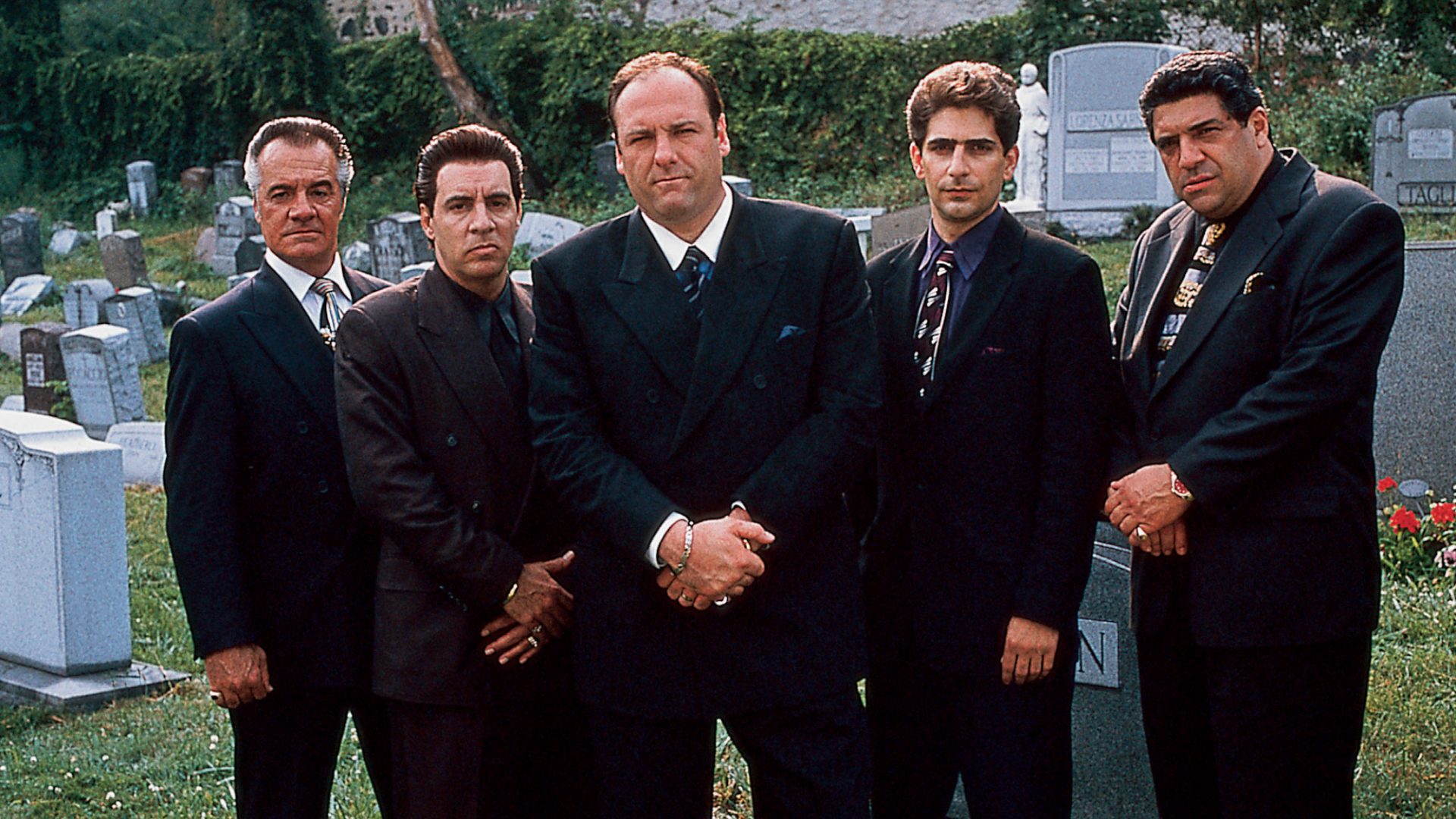
Michael Imperioli is pondering a novel question. As a good-natured frown gullies his features, the man who for eight years portrayed the skittery sociopath Christopher Moltisanti in the crime series The Sopranos has been asked whether he thinks mobsters vote in American elections.
“Do you know what,” he says, “I bet most of them don’t. The idea of them standing in line at some polling place, I can’t really see it.” As I conjure images of rotund recidivists in synthetic fabrics striding around Hoboken sporting stickers bearing the words “I just voted!”, other avenues of suffrage are explored. “Whatever effort it would take to get a mail-in ballot, they probably wouldn’t bother with that either,” he adds.
There is a reason Michael Imperioli is being asked about crime in its organised variety. The 59-year-old is about to revive his vastly popular podcast series Talking Sopranos on a 14-date tour of British theatres.
Joined on stage by co-host and fellow actor Steve Schirripa – who played the good-natured goombah Bobby “Bacala” Baccalieri – the show opens its account on Sunday, February 15 in Belfast. The following week, the first of three nights at the London Palladium will be the closest the English capital has come to the New Jersey mob scene since Frank Sinatra trod the same boards in 1975.
“Carrying the torch [for The Sopranos] is something we’re really proud of,” Imperioli tells me. “When the going’s rough and the world is dark and things are not going well, there’s this place where [fans] know they’re going to feel comfortable. They know these characters. They know they’re going to be entertained. They feel kinda safe there, which is very touching.”
Which brings us back to the question that opens this piece. Never mind Project 2025, 27 years after The Sopranos debuted on HBO, the proximity of its storylines to the monkey business now playing out on the domestic and international stage suggests that Donald J Trump and his administration utilised the show as a blueprint for government. If even a single wise guy failed to cast their vote for the Grand Old Party, at the ballot box in the autumn of 2024, well there’s simply no gratitude in the world.
In Imperioli’s experience, “Most of the guys who are [in the mob] are kind of fans of Trump. They’re Republicans, traditionally,” he says, “which is kind of ironic, because [as a federal prosecutor] Rudy Giuliani, who a lot of the mob guys liked, was instrumental in putting them all away.
“It’s interesting, though,” he adds, “because right now immigration is such a tumultuous thing in America, a tragic thing, so how would those guys, who are all descendants of immigrants, relate to that? I find it interesting to think of them trying to process it all.”
The sight of the president’s name in dishonourable company – 38,000 times, in fact – might also be a stretch. “I don’t know about all this Epstein stuff, because that might turn some of those guys [off],” is how Imperioli rather tactfully puts it.
Evident though they may be, thankfully, the similarities between political muscle in the District of Columbia and a turn-of-the-century crime show from the Garden State take us only so far. If truth can be stranger than fiction, here, it’s merely more banal. David Chase, the creator of The Sopranos, wouldn’t think of minting a character as brittle and insufferable as Trump. As a soldier in Tony Soprano’s army, Paulie Walnuts would slap the fake tan off his face within five minutes.
“Trump is… so repugnant, it makes me want to defend our friend Tony,” wrote journalist Dave Zirin in US magazine The Nation last autumn. “At least Tony had nothing to do with Epstein’s island of pederasts. At least Tony occasionally got his hands dirty. At least Tony knew a good plate of food and didn’t eat ketchup-covered steak.”
Suggested Reading

How Bad Bunny won the Super Bowl culture war
In their fictional form, Tony Soprano, his nephew Christopher Moltisanti, consigliere Silvio Dante, and the rest of the crew down at the Bada Bing! are immune to the tedium of venality in its real-life form. Crafted to the standards of high art, the genius of The Sopranos lies in its ability to portray characters that are hateful on only an intellectual level. When it comes to the heart, you just can’t stay mad at them.
For his part, Imperioli points to “really compelling and really good” material “that is so well written, acted and directed” that its appearance on the small screen would prove revolutionary. As well as pioneering the transfer of power from network to cable television, The Sopranos helped elevate the subscription model to the point where its output now rivals the traditional gold standard of the moving image: cinema itself.
“When we started, not only was TV the poor cousin to the movies, but cable was like the poor cousin to network TV,” he tells me. “So it was even less of a sexy thing. There weren’t any cable series. The idea of a cable show was like the bargain basement of TV. There was nothing prestigious about it.”
Since 1999, of course, everything has changed. Twenty-three years later, HBO, the upstart network which greenlit The Sopranos all those years ago, hired Imperioli to play another toxic character with Hollywood links, producer Dominic Di Grasso in season two of The White Lotus. Again, he was superb.
That performance may be more recent but today, almost two decades after its enigmatic finale, I’m able to cast at least half an eye on The Sopranos several times a week; it seems to be on Sky Atlantic all the time. It’s playing quietly in the background, in fact – live, right now – as I write these words. In a scene that typifies the show’s melding of violence, humour and situational mobocracy, Christopher Moltisanti is seconds away from being beaten up at his own intervention.
Raising my eyes, I’m reminded, too, of the programme’s ability to wrongfoot me even now. Exactly half a lifetime after first making his acquaintance, I still can’t decide whether Moltisanti warrants a shoulder to cry on or a clean pair of heels with which to make the fastest getaway possible.
“I think I’d stay away from him,” is how Imperioli speaks of the character to whom he gave flesh. “The reality of that world is dangerous. If you were in contact somehow, you would keep it at arm’s length because it’s very dangerous, you know. And he was dangerous. He was dangerous to the people around him: to his family, his friends, his loved ones.”
Inevitably, the danger caught up with him. Michael Imperioli learned a year in advance that he’d be leaving the show, four episodes from the end, when Tony Soprano choked his character to death amid the wreckage of a car crash. Ticking like a time bomb for 82 shows, the kid did well to last so long. “It would have been really hard had he not made it [almost] to the end… because I just loved it,” says the man who played him. “I wanted to keep going.”
Seven years later, James Gandolfini had no such warning. The actor’s death from a heart attack, in Rome in the summer of 2013, was a tragedy in all but one aspect. The impossibility of a reunion bestowed permanent purity to The Sopranos.
“I saw him two weeks before he died, and he was really happy,” Imperioli tells me. “I think he finally felt that he’d gotten some distance from the hurricane of The Sopranos. I think he really was ready to start a new chapter, artistically. So, I think we’ve missed out on what that could have been – what that next role was. Maybe there was another role that could have surpassed Tony Soprano.”
For the man who portrayed the capo’s nephew, a schedule busy with fresh projects affords the luxury of enjoying the legacy of The Sopranos without being held captive by its shadow. With his frosted hair and Elvis Costello glasses, these days, the man on my computer screen bears only a nodding resemblance to Christopher Moltisanti, anyway.
Perhaps that’s why my final question for Michael Imperioli is this: how does he feel about living in a country governed in the manner of a television show about organised criminals in and around Newark and New York?
“Sick,” he says. “That’s how I feel.”
For tickets to Talking Sopranos visit livenation.co.uk
Ian Winwood is the bestselling author of Bodies: Life and Death in Music