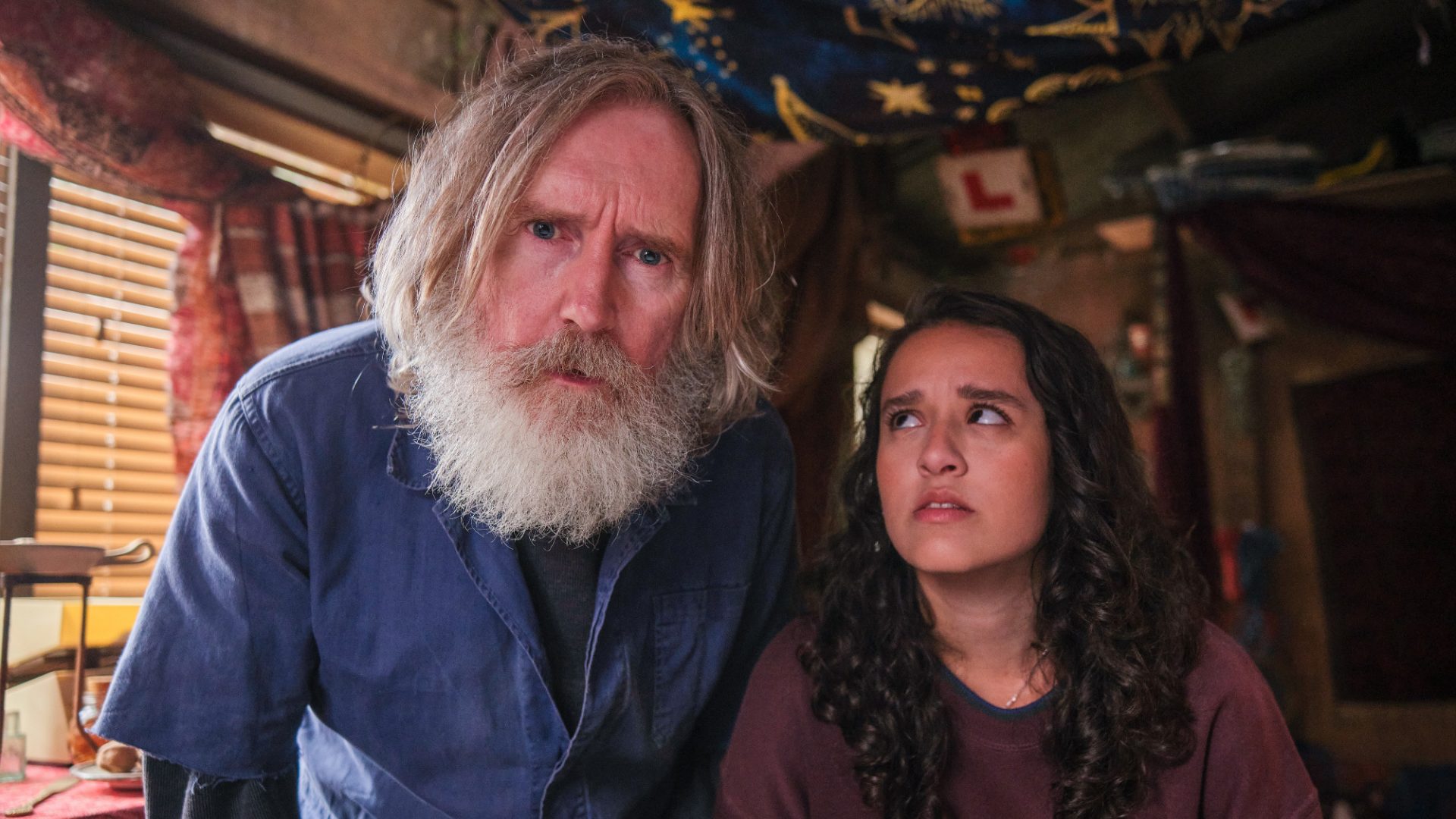
The fourth episode of Small Prophets, the justly praised BBC sitcom from writer and director Mackenzie Crook, features an exchange between lead character Michael Sleep (Pearce Quigley) and his young friend and workmate Kacey (Lauren Patel).
Seated in the back garden of a house at the end of a Stockport cul-de-sac, the conversation concerns Elliot, a teenage neighbour who cycles wordlessly for hours on the pavement out front. Discovering that her host hasn’t spoken to the lad in years, Kacey suggests to Michael that he might try doing so. “Why?” he asks.
“Because, I mean, he’s obviously struggling with summat,” she explains. “He’s like a caged animal riding round and round like that. It’s sad.”
Considering the matter for a moment, Michael decides that “I wouldn’t know what to say”. “Well, you could start with hello,” comes the reply.
In the days since I demolished Small Prophets like a cold pint on a summer night, my mind has returned to this modest colloquy time and again. Apparently peripheral to the action, I hadn’t really considered the presence of an inhibited adolescent cycling listlessly in wide angles and drone shots. In a programme packed tight with quiet lives, I too needed Kacey to remind me that overlooked people harbour overlooked stories.
In a flourish of magic realism, a few doors down from Elliot, Michael Sleep is rearing three omnipotent homunculi in the hope of alleviating his own struggles. Born of a recipe transcribed by his father, Brian – a forgetful care-home resident played with tender mischief by Michael Palin – hope abounds that the prophetic critters will be able to provide answers as to the fate of Michael’s partner, Cleo, whose disappearance on Christmas Eve seven years earlier has left him cocooned in a state of emotional purgatory.
In a characterisation that amounts to a modest disservice, Crook has described his new series as a “gentle comedy”. But while Small Prophets combines the patient kindness of Detectorists with the nonchalant supernaturalism of his remake of Worzel Gummidge, this latest cast of exquisitely crafted characters go about their lives with a noticeably heavier tread. Like the chain of Elliot’s bike, their troubles can be heard clicking away.
There is evidence here of a country nibbling away at the resolve of its assailable citizens. In a rare moment of unguarded powerlessness, Kacey reveals to Michael that she lives alone in a flat begrimed with mould. Scheming away with demoralised intent, Cleo’s bankrupt brother, Roy (a magnificent Paul Kaye) practically undulates with anxiety.
Everywhere you look, abject circumstances render abject deeds. In a fleeting scene, a reluctant mugger explains to his bewildered prey that “I don’t usually do this. I’m just desperate,” he says. “I wasn’t going to hurt you.”
As a man anchored by marriage to a large family of lovingly quarrelsome Stopfordians, from first frame to last, I could only marvel at the believability of it all. So impeccable is the attention to detail that I wondered if the Kentish-born Crook had been living undercover in Marple Bridge or Cheadle Heath.
Certainly, I would like to thank him for his services to authenticity. Watching Small Prophets was like receiving a visit from my in-laws without having to go to the trouble of cleaning the flat.
Certainly, it was like keeping company with people I’ve known for years. As with John and Kayleigh from Peter Kay’s untouchable Car Share, or Ken and Tanya from Early Doors, the elegantly poised (platonic) relationship between Kacey and Michael is tended to with sarcasm and ridicule. In Greater Manchester, the Northern Powerhouse of British comedy, this is how people speak to one another; it’s what my wife describes as the region’s love language. Far from caveating affection, its Mancunian mordancy is the purest expression of endearment.
Suggested Reading

The Sopranos’ Michael Imperioli: ‘The guys in the mob are fans of Trump’
The only blight here is that “in real life” characters of this kind seem to mystify much of the media and political class. It’s why so many expensively educated wideboys feel perfectly at ease thinking the worst of them while claiming to speak on their behalf.
Honking into the vacuum, it’s why chisellers such as Nigel Farage and Richard Tice get away with claiming that people in the north of England spend every waking moment griping about immigrants and transgender people and the European Convention on Human Rights.
Which isn’t to say that Michael Sleep and his cast of fictional friends lack the agency to be a force for tangible good. Eight years after a study by the London School of Economics found that television programmes that “glamourise fame, luxury, and the accumulation of wealth” had a dehumanising effect on their audience – to the point, it was claimed, of encouraging support for “punitive cuts to welfare payments” – Crook’s celebration of the quotidian serves as a counterweight to coarsened attitudes. It might even be an antidote.
For my part, as the sixth and final episode of Small Prophets hoved into view, I began quietly fretting that my supply of restorative medicine would soon be at an end. But I needn’t have worried. As Crook’s crazily-paved story reached its conclusion, onscreen, three words filled the Stopfordian sky.
“To be continued,” they read.
Small Prophets is on BBC iPlayer.
Ian Winwood is the bestselling author of Bodies: Life and Death in Music