
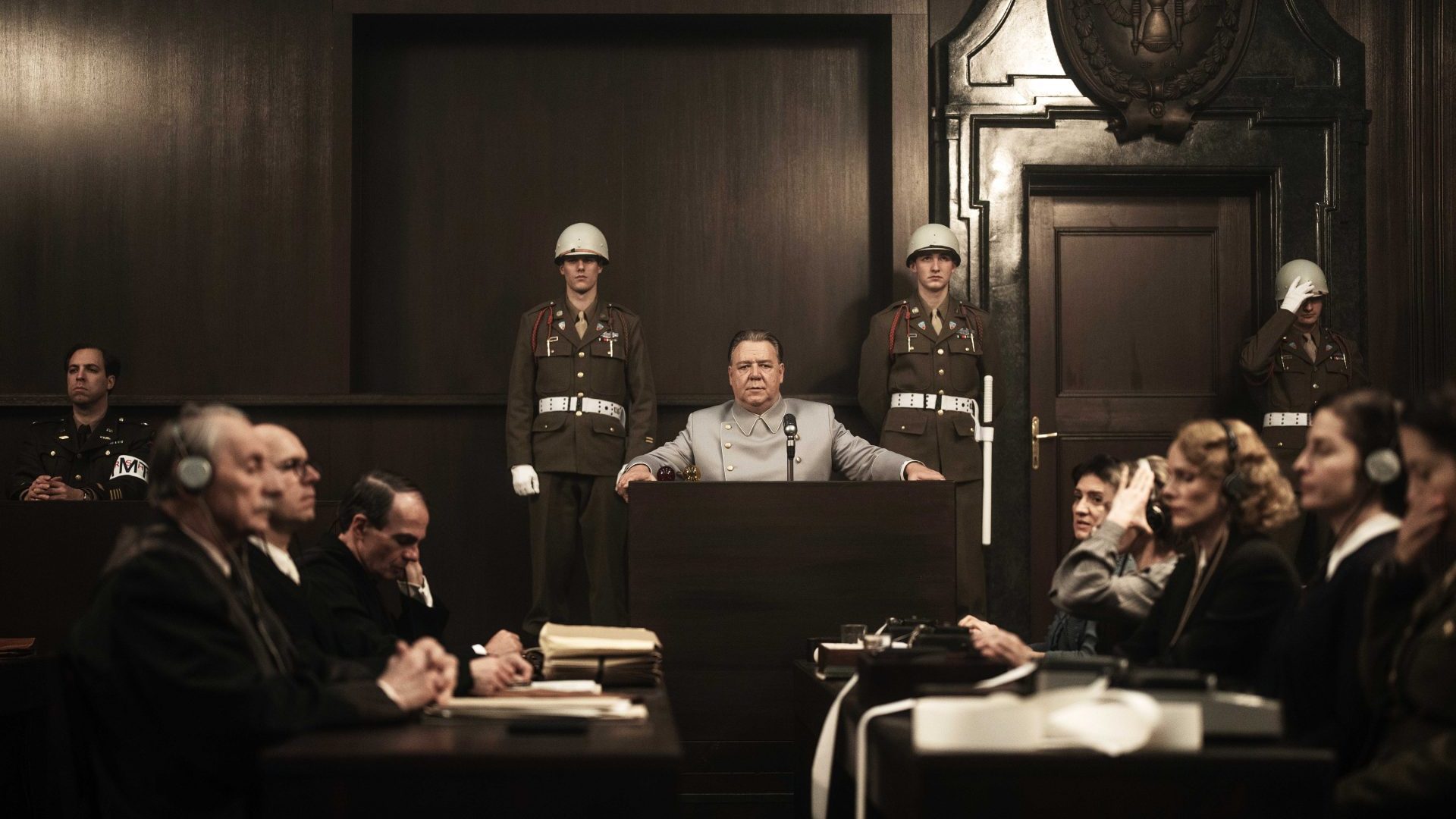
Nuremberg, the star-studded film from director/screenwriter James Vanderbilt, has its critics and admirers. The former tend to be those who are paid to write about it, and the latter those who have paid to watch it.
Nuremberg’s critics are, largely, actual film critics – the Guardian’s Peter Bradshaw gave it two stars out of five (“deeply silly”); the Times (“flawed”), Financial Times (“stodgy”) and Observer (“slightly ponderous”), among others, have been almost as sniffy. It has only a 70% rating on Rotten Tomatoes’ Tomatometer, which compiles the views of professionals.
But on the same website’s Popcornometer, powered by the opinions of amateurs, it is ranked at 96%. Are the public not entertained by Russell Crowe, Rami Malek, Michael Shannon and the suddenly ubiquitous Brit Leo Woodall in a piece of blatant Oscar bait? One that makes space for a courtroom drama, a quarter-hearted stab at the nature of evil, an account of the establishment of international law, and, when the mood takes them, a cast who leave teeth marks on every piece of scenery not nailed to the wall? Of course they are.
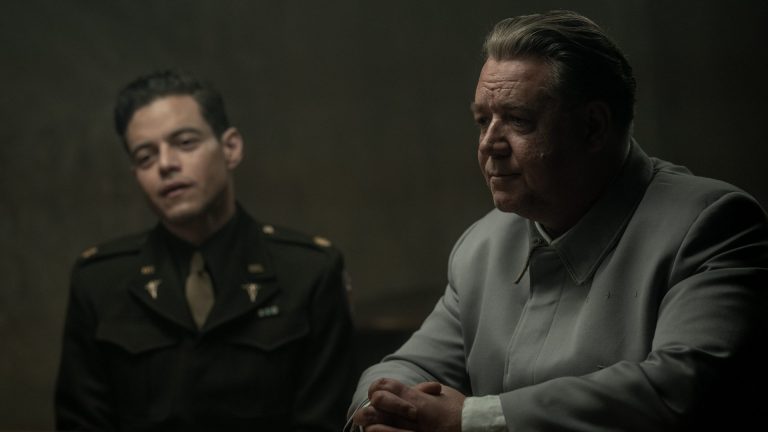
Why this disconnect? It’s not hard for audiences to be seduced by the assembled star power. Crowe plays Hermann Goring, the highest-ranking Nazi still standing at the end of world war two. Malek, the subject of Bradshaw’s ire, is Douglas Kelley, the psychiatrist who will determine whether the bulky fascist is fit to stand trial under statutes written by US Supreme Court justice Robert H Jackson ( Shannon) in ink that has yet to dry. In the thespian equivalent of using a Jaguar E-Type only to buy milk from a shop at the corner of the street, a feloniously underutilised Richard E Grant plays the Tory lawyer David Maxwell Fyfe.
Nuremberg works best as entertainment. While not exactly believable in their respective roles, Crowe and Malek at least seem to realise that their purpose is to inject some flaccid material with enough star puff so that it breezes across the screen. Unrepentant to the last, Crowe’s game of katze und maus with his burdened interlocutor is like Hannibal Lecter and Clarice Starling with a dialect coach. Only one of the two men is fighting for his life, but it’s difficult to know which.
Some of the problems rest with Vanderbilt, a second-time director who wrote David Fincher’s Zodiac but also Scream VI and Independence Day: Resurgence. He has said that writing this script was a challenge because Nuremberg’s story kept expanding. Sometimes it seems to have expanded into the future, such as when Malek says he needs time to “process” yet another piece of shocking information.
Even with material this weighty and important, the two-and-a-half-hour running time feels overblown. In failing to appreciate that a spot of judicious pruning might have strengthened whatever material remained on the page, at its best, Vanderbilt has made a muddle of Nuremberg.
At its worst, it’s as offensive as anything I can remember seeing at the pictures. A scene in which the court is shown real-life footage from Dachau would have been far more effective had the camera registered only the shock and horror of the actors playing the people who were among the first to have seen the full depravity of the camps on film. Instead, Vanderbilt’s insistence that his audience views the images, too, suggests to me that he thinks his movie is a vessel worthy of such desperately precious cargo. It isn’t. The inclusion is pornographic.
Other decisions seem almost as dubious. Nuremberg is a film about men and the female characters that do appear – Lydia Peckham as a honeytrap journalist who doesn’t even warrant a surname; Lotte Verbeek as Emmy, Goring’s all but silent wife – feel thrown into a movie that already has too many moving parts. Elsewhere, the decision to cast a non-Jewish actor (Woodall) in the leading Jewish role is hard to swallow in a film set against the backdrop of the Holocaust.
Much like Vanderbilt will hope to do today, 80 years ago, Douglas Kelley sought to profit – and let’s be generous, to enlighten – from the events portrayed onscreen. But with the universality of evil as its theme, his book 22 Cells In Nuremberg: A Psychiatrist Examines the Nazi War Criminals flopped with the public. Rosy-eyed from a heroic and exhausting victory over Hitler and his ghouls, evidently, American and British readers didn’t care to hear that in future reckonings they might not be the good guys.
Suggested Reading

The urgent and dramatic power of Nuremberg
The shrink didn’t take well to being unheeded. Falling prey to alcoholism and bitterness, the film portrays Kelley as being drunk and obnoxious while plugging his book on PBS radio. Ejected from the studio, a producer offers a few words of unvarnished advice. “If you’re going to talk your country down, you’re not going to sell many books.”
This, I think, is the movie: that what happened there can happen here. It might even be starting to happen now (my colleague Matthew d’Ancona wrote here that “at a time when Holocaust denial and World War II historical revisionism are more mainstream than ever, its dramatic power is urgently needed.”).
Not that Vanderbilt seems bothered by this. If in fact he does hear the past knocking on the door of the present, he hasn’t thought it important to mention in his film.
He barely mentions this, either: On New Year’s Day, 1958, Douglas Kelley died by suicide after swallowing a potassium cyanide capsule at his home in the Bay Area of northern California. Twelve years earlier, in a prison cell in Nuremberg, Hermann Goring had ended his own life in just the same way.
Nuremberg is in cinemas now
 Most popular

‘Operation Epic Fury – as it happened’

Is Star Wars dead?

Morrissey returns.. and heaven knows he’s mythical now


Iran War: Trump has now sealed his own fate