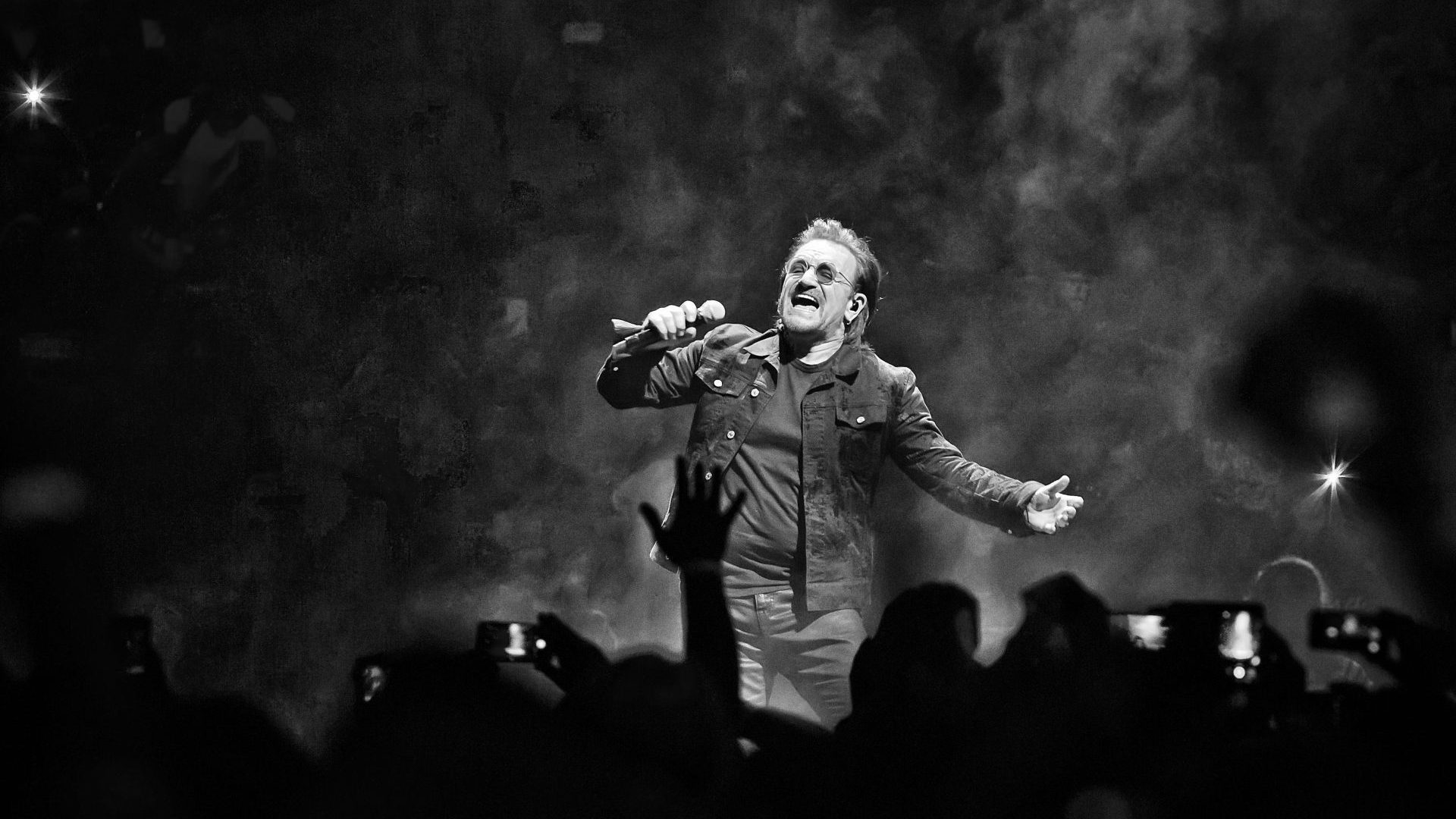
Back in the 1990s, Bono was told a story of the time Dr Martin Luther King Jr hosted a fractious meeting between civil rights leaders and the newly appointed US attorney general Bobby Kennedy. King calmed his fellow activists with the words, “Right, we will reopen this discussion when somebody can find one redeeming thing to say about Bobby Kennedy because that, friends, is the door through which our movement will pass.”
This tale, which was recounted to the singer by Harry Belafonte, happens to serve as a workable precis of U2’s approach to what they might self-consciously describe as political music. In their reluctance to proscribe or to dominate, the group are different from The Clash; in seeking consensus, they’re galaxies removed from Dead Kennedys or Rage Against The Machine. Instead, from their earliest days, the Irish quartet have understood that flies prefer honey to vinegar.
Even so, as a smart band, it’s unlikely that U2 need reminding that 2026 is a lean year for artists who seek to unite. Of the six tracks featured on the group’s recently-released EP, Days Of Ash – the lyrics of which are born of conflicts in Iran, Israel, Palestine, Sudan, the USA, and Ukraine – the first, American Obituary, concerns goings in the self-styled Land of the Free. “This should be good,” I thought. “Let’s see them try and find something positive to say about Donald J Trump.”
But no. Instead, training his gaze on the frozen streets of Minneapolis, Bono appeals to the citizens of the United States itself. “The power of the people is so much stronger than the people in power,” he sings in a soundbite that might have been cribbed from a placard on a sixth-form demonstration. The line “America will rise against the people of the lie” isn’t much better.
“The songs are all reactions to present-day anxieties,” the singer told the music writer Neil McCormick. “Some knee-jerk, some more considered.” He went on to say that he didn’t mind that Days Of Ash, the group’s first release for almost a decade, is “likely to offend or annoy some parties” because “that’s kind of our job”.
As the chief music writer at the Telegraph, McCormick – who went to school with some of the members of u2 – has been writing gamely about the band for years. With a disdain that seems to span the entire political spectrum, below the line, the paper’s readers seem to enjoy being able to respond with equal and opposite zeal. “Reminds me of the old joke,” read one recent riposte, “what’s the difference between God and Bono? God doesn’t think he’s Bono.”
Suggested Reading

What the new Peaky Blinders film says about Britain’s modern far right
As it so happens, this very piece was commissioned by a sceptical editor who I think rather fancied watching me break my back attempting a full-bodied defence of all things U2. Nothing doing, I’m afraid.
For one thing, the group’s decision to offshore parts of their business operation to the then tax-lax Netherlands, in 2006, saw a serious sullying of their copybook. For another, the presence of Ed Sheeran – about whom I feel much the same way as others clearly do about Bono – on the Days Of Ash track Yours Eternally is another serious drag on the anchor.
But I will say this. Forty-odd years after Bono characterised the trend of pliable pop acts writing tokenistic political songs as “rock against bad things”, U2 remain devoutly serious. From a live rendition of Bob Dylan’s Maggie’s Farm, at Wembley Arena on the eve of the 1987 British general election, to American Obituary, they sing from the depths of the diaphragm.
“Mixing pop and politics, they ask me what the use is, I offer them embarrassment and my usual excuses,” was how Billy Bragg once put this task. Believe me, I get it.
Having learned some time back that rock and roll is unlikely to save the world on its own, on uncertain nights, the recent tranche of protest songs about events in Minneapolis remind me of a deft point made by Joe Jackson regarding artists who seem to regard evident truths as if they were radical positions. “You don’t have to be a hippy to believe in love,” he sang in 1991. “That’s obvious.”
But here’s the thing: a quarter of a century on, I’m not all sure that things remain quite so obvious. In a bid to know my enemy, late at night I’ve fallen into the habit of keeping quiet company with a television programme that seeks to assimilate the activities of a government body that shot an unarmed protester in the face with what looks like perfect impunity. At the very least, U2 should be recognised for their efforts in seeking to combat such ugliness. In American Obituary, the slain Renee Good, an “American mother of three”, is mentioned by name.
None of which will change the minds of those who are adamant that Bono and U2 are charlatans and hacks, of course. But those who have picked a side in the battle between right and wrong should also consider the best means of tactical engagement with the enemy. Some of the people who criticise the grand spectacle and earnest sentiments of the Irish superstars are repulsed by the militantism of groups such as Kneecap or Bob Vylan. So tell me, please: which is it gonna be?
One thing, at least, is certain. Never mind that the success with which U2 have imparted political messages has varied over the years, throughout it all, not once have they ever told you a lie.
Ian Winwood is the best-selling author of Bodies: Life and Death in Music
 Most popular
‘Operation Epic Fury – as it happened’
Is Star Wars dead?
Morrissey returns.. and heaven knows he’s mythical now

Iran War: Trump has now sealed his own fate