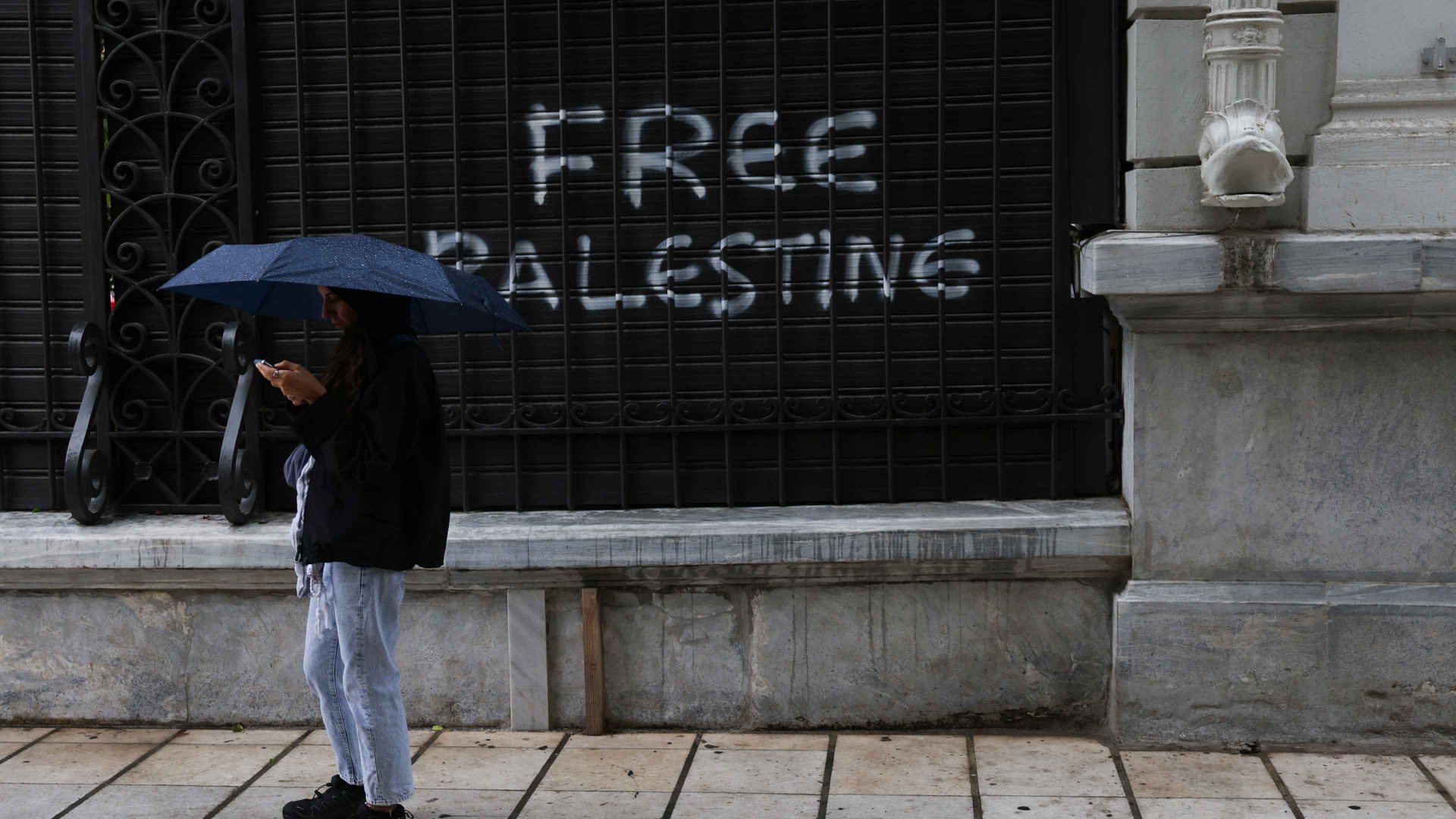
Leaving my apartment building one morning, I noticed new graffiti. “IDF murderers not welcome here” was sprayed in a red scrawl next to the front door. It was only a matter of time; my neighbourhood is already heavily graffitied, and there are many expressions of support for Palestine.
In fact, these kinds of slogans now cover so much of the city that back in August, Israel’s ambassador to Greece even criticised the mayor of Athens, Haris Doukas, for not making more of an effort to have it removed. “We do not accept lessons in democracy from those who kill civilians and children in food lines,” Doukas responded in a post on X.
It’s a sentiment that couldn’t be further from the position adopted by the prime minister, Kyriakos Mitsotakis. He was the first world leader to visit Israel after the October 7 attacks, stating upon his arrival, “I come here not just as an ally, but as a true friend.”
Turkey’s decision to cut economic ties with Israel left Netanyahu looking elsewhere for trading partners in the eastern Mediterranean, and Mitsotakis has been eager to offer up Greece as a natural replacement. He seems to have pulled it off – trade between the two nations has already surged by 41.3% from 2023 to 2024, increasing from $920m to $1.3bn.
What’s particularly remarkable is how much of Athens is now owned by Israeli investors, who have been snapping up cheap properties across the city centre since the financial crisis struck in 2007. Along with the Chinese, they are the biggest investors in real estate here – tempted not just by the potential financial gains, but also the promise of a Golden Visa.
Buyers who spend more than €250,000 on a property in the more run-down parts of the Greek capital are rewarded with a visa that will allow them to live in the country and travel freely within the Schengen Zone. For many Israeli business owners, it’s an important means of securing a strategic foothold in the EU.
Various European countries previously offered this scheme, but many (most notably Portugal) shut it down when it began to wildly inflate their housing markets. Today, only Greece, Italy and Hungary still offer these kinds of property investment visas and Israelis are keen to cash in before regulation changes; there was a rise of more than 90% in Golden Visas issued to Israelis in Greece last year.
Suggested Reading


The paradox of Palestinian protest
Walking through Athens airport the other day, I spotted a poster in Hebrew strategically positioned just beyond passport control. Using Google Translate, I managed to figure out that it was advertising the services of a real estate company called Beta.
“The most Israeli investment house in Greece,” the poster read, superimposed over a photograph of the Acropolis at sunset. A quick look at the founders’ bios on their website proudly informed me that all three businessmen were former IDF commanders.
“I’ve been told that these posters advertising investment opportunities in Greece can be found all around Tel Aviv,” Maria Pateinaki, an architect and urbanism specialist, told me. For years, she’s been working with community groups and collectives to lobby for a more thoughtful approach to Athens’s post-crash regeneration – one that puts locals, and not investors, first. “They are putting a lot of pressure on the housing market, which is over-stretched as it is.”
Last month, Tel Aviv-based newspaper Yedioth Ahronoth described Athens as a “lost paradise” for visitors. “The once beloved city that opened its heart to the Israeli visitor now shows him its angry face.” Perhaps now the worst of the fighting in Gaza is at an end, the situation will change in Athens. But locals here are still not happy about Israeli investment – the writing is literally on the walls.
Hester Underhill is a freelance British journalist based in Athens