Britain is a gift to the world.
Our story begins in 6500 BC when Doggerland is outsourced to G4S, who promptly lose it under the North Sea. Britain is now foreigner-proof.
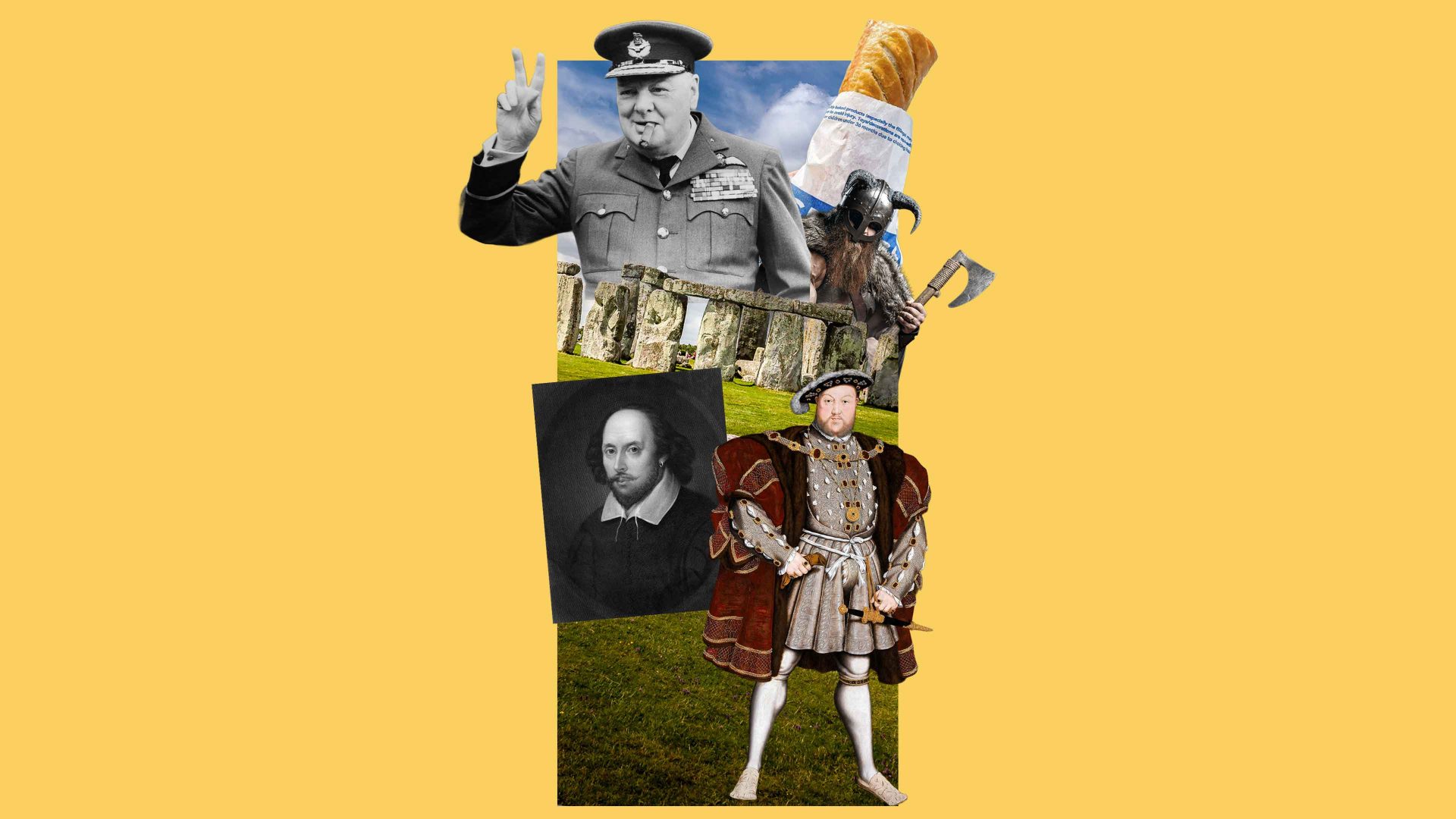
Nothing happens until 3000 BC when Stonehenge is built on the A303 eastbound. Using massage chairs sourced from the Preseli mountains in west Wales, most serious archaeologists now agree that this is the world’s first Moto service station.
While the rest of the planet’s inhabitants are busy reprogramming their clocks from BC to AD, Jesus is born at Dungeness, not Bethlehem as the revisionists argue. By AD 43 England is ruling itself so efficiently that Claudius and the Romans are compelled to come and borrow our roads.
We civilise them so much that in 306, Constantine, recognising that real power flows up past the abandoned Little Chefs on the A1 rather than from Rome, chooses York as the place to be proclaimed Caesar. Having learned enough, the Romans then leave.
Academics name the ensuing era the “Dark Ages” because they see race in everything. In reality, we were too busy getting on with things to write them down.
The only person who does is a man called Gildas, who attributes crop failures and resource wars to man-made climate change caused by Spiritual Decay. He is the first hysterical environmentalist.
Sick of this leftist twaddle, Vortigern puts an advert on Facebook for some patriotic Saxons to get a handle on things. Hengist and Horsa heed the call, and before you can say “What about Arthur?”, everyone is drinking Carling, driving on the left and burying ships under National Trust visitor centres.
Things are so good that Alcuin of York is summoned to the Continent to kick-start the Carolingian Renaissance because Europe urgently needs help with education, poetry and basic thinking.
In 793 a monastery on Lindisfarne is looted by men of fighting age on small boats. The mainstream media euphemistically rename them “Vikings”. Alfred the Great, an outspoken advocate of an Australian-style points-based immigration system, defeats their Great Heathen Army at Edington, but their leader, Guthrum, still manages to game the asylum system by pretending to be a Christian.
William the Conqueror arrives in 1066, granting
98% of the population their PIN numbers and
padlock combination codes in perpetuity. He also demonstrates that Britain isn’t racist and has always welcomed immigration, provided the immigrants are well-armed and immediately take charge.
Suggested Reading
Nigel Farage is hopelessly out of touch with public opinion
A decade later the first recorded outbreak of the woke-mind virus occurs when Saxon bishop Wulfstan proclaims that slavery is wrong. This deranged thinking infects everyone from slaves to English Heritage.
In the Middle Ages, Henry II dismisses Thomas Beckett on the job without the need for a lengthy HR tribunal, and his son King John signs off the Magna Carta. Britain’s foundational document, it is drafted by patriotic barons to stop hairdressers having to obey Covid regulations.
The mirthless Welsh launch a rebellion in 1400 when Owain Glyndŵr, upset about English second homeowners, proclaims himself Prince of Wales, captures castles at Aberystwyth and Harlech and outlines plans for a parliament and universities. The uprising ends when traffic finally clears on the M4 at Newport, and the English army can get through to put it down.
It’s Saturday. It’s 3pm. It’s Agincourt! In 1415 the French have their arses handed to them by a coach-load of Six Nations supporters in gilets, plum cords and pointy brown shoes. Later in the century, William Caxton invents the printing press, ensuring that everyone can read the official version of events, and page three.
Following Henry VIII’s conscious uncoupling from Catherine of Aragon in 1533 a team of management consultants suggest rebranding God. The Church of England is launched, to mixed reviews. Meanwhile, deep state agitator Thomas Cromwell begins dissolving monasteries to free up real estate for the communists at the National Trust.
Shakespeare then writes a lot of plays that nobody really understands. Despite this, he’s the number one name to throw out when people ask “What’s so great about Britain?” Plus, he paves the way for Love Thy Neighbour.
A civil war erupts in 1642 after the king tries to roll out mandatory unconscious-bias training. It is fought between the Metropolitan Elite and the People Who Aren’t Allowed To Say Anything Any More. The silent majority prevails and a strategic realignment of the king’s head follows.
The seeds of Brexit are sown at an Eastcheap Greggs in 1666, when a harassed pastry surgeon drops his Rothmans on a mountain of unnecessary European red tape and the ensuing fire engulfs London.
Then, because Britain enjoys practical solutions rather than talking about feelings, in 1750 we decide to have an Industrial Revolution. This puts the climate change debate to bed for ever, by demonstrating that the laws of physics don’t apply to hydrocarbons when they’re making money.
The 19th century is vintage Britain. Napoleon’s forces are sent packing with a single volley of musket fire; Robert Peel invents institutional racism/the Metropolitan Police; and having spent centuries perfecting the practice of slavery to facilitate its abolition, Britain gets to congratulate itself for ending slavery. Peel also repeals the Quorn laws, but with mixed results as it drives vegetarians underground, where they learn to become extremely irritating.
British history ends in the 20th century (because the 21st is too soon). It hosts two world wars: the first world war, which is like the second world war but with worse uniforms, and the second world war,which is better because it’s in colour.
In it, several million unborn Brits defeat the Nazis at Dunkirk, Pearl Harbour, and Stalingrad. They then get Lancaster bomber tattoos and vinyl poppy car wraps to celebrate.
This is Britain’s history. There are no women in it, but that’s not subjective. It’s facts.