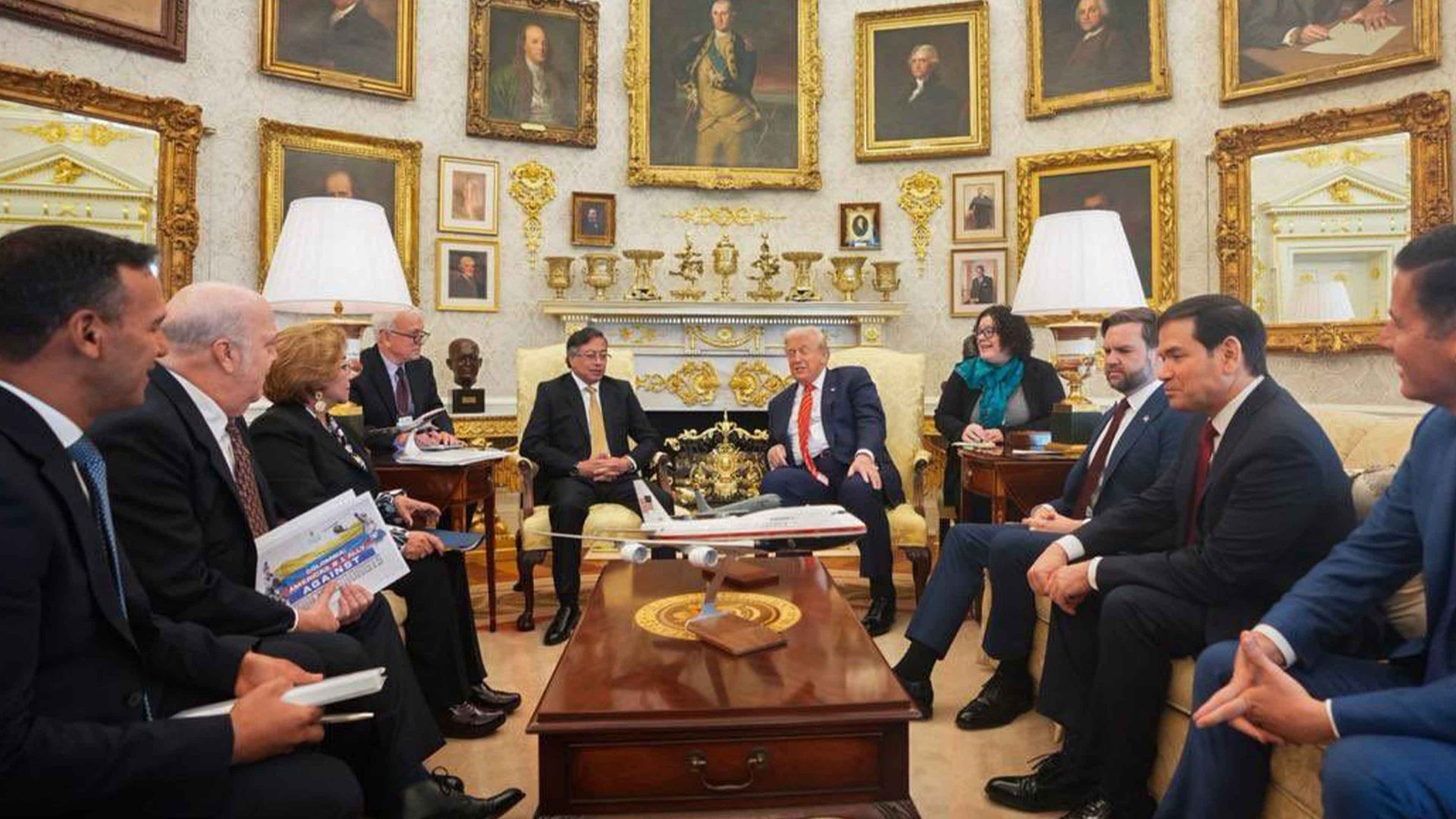
A calm has settled. Maybe. Donald Trump and his Colombian counterpart, Gustavo Petro, finally came face-to-face after months of public insults, threats and diplomatic brinkmanship. Would either of the two famously combustible presidents blow it?
The meeting followed one of the ugliest exchanges between the US and Colombia in decades. Fresh from orchestrating the removal of Venezuela’s president, Nicolás Maduro, Trump publicly mused that Petro “could be next,” branding Colombia’s leader a “sick man who likes making cocaine and selling it to the United States”.
Petro – a former guerrilla, who is Colombia’s first left wing president – responded: “I swore not to touch a weapon again. But for the homeland, I will.”
Aides intervened to halt the freefall, pencilling in February 3 for a first head-to-head. Asked before the White House visit whether he would temper his language, Petro was unmoved. “I have to say what I think.” Trump, for his part, claimed victory. “Somehow after the Venezuelan raid, he became very nice,” he told reporters. “He changed his attitude very much.”
This followed months of escalating insults. In September, Washington decertified Colombia as a partner in the war on drugs for the first time in 30 years, blaming a surge in cocaine production on the “failures and incompetence” of Petro’s government.
A week later, Petro grabbed headlines at the UN General Assembly in New York, appearing with a megaphone at a pro-Palestinian rally, urging American soldiers to disobey illegal orders and “obey the order of humanity”.
The response from Washington was swift. Petro’s US visa was revoked for what officials described as “reckless and incendiary” behaviour – a rare diplomatic rebuke. In October, the Treasury Department sanctioned Petro, his wife, his son and his interior minister, accusing them of ties to the global drug trade.
More recently, in an interview with the BBC, Petro compared US Immigration and Customs Enforcement (ICE) agents to “Nazi brigades” and accused Washington of treating other nations as part of its “empire”.
And yet it was Bogotá – not Washington – that began to shift course.
In the days leading up to the meeting, Petro’s government announced a dramatic reset of Colombia’s drug policy, agreeing to revive aerial spraying of coca crops with glyphosate. This was a controversial US-backed strategy suspended a decade ago over health and environmental concerns. It also reopened the door to US deportation flights, restarting the repatriation of Colombian nationals, which was the original trigger for the January 2025 rupture with Trump.
Suggested Reading

The message to Trump, Putin and Xi: big countries lose wars
Shortly before the meeting, Colombia’s government offered yet another diplomatic olive branch, announcing the extradition of the drug trafficker Andrés Felipe Marín Silva. Extraditions have become a point of contention with the US. Petro has held back some requests that have involved rebel groups, arguing they must remain in Colombia to support peace talks.
Despite these concessions, Petro did not receive a full ceremonial welcome. The meeting, which lasted around two hours, was held behind closed doors, with no press allowed.
Petro’s gifts included Colombian coffee and chocolate produced through crop-substitution programmes. Known for dismissing formal attire, he also donned a dark suit, a break from his usual guayaberas and traditional woollen mochila bag. It appeared he was keen to avoid the kind of sartorial rebuke levelled at Volodymyr Zelensky.
Petro told a radio reporter the meeting had been a nine out of 10 and praised Trump. “I told him he was a good designer. I thought the White House looked more beautiful,” he said.
Later, on social media, Petro posted a photograph of Trump’s The Art of the Deal, which Trump had gifted him. Inside, he had written: “You are great.” Petro joked in Spanish: “What did Trump mean to say to me in this dedication? I don’t understand English very well.”
He also shared images of the two shaking hands, alongside a signed note from Trump. “Gustavo,” it read. “A great honor. I love Colombia.”
Trump, for his part, conceded that although the pair “weren’t exactly the best of friends,” they “got along very well”. He described the meeting as “very productive, fantastic,” and said they would continue working “on other issues, including sanctions”.
Nothing formal was announced, but drug trafficking topped the agenda, alongside Venezuela, oil and US strikes on suspected drug vessels. Both presidents later hinted at serious discussions on security cooperation, counter-narcotics, sanctions and tariffs. For now, the shouting has stopped.
Harriet Barber covers human rights, migration and politics in South America