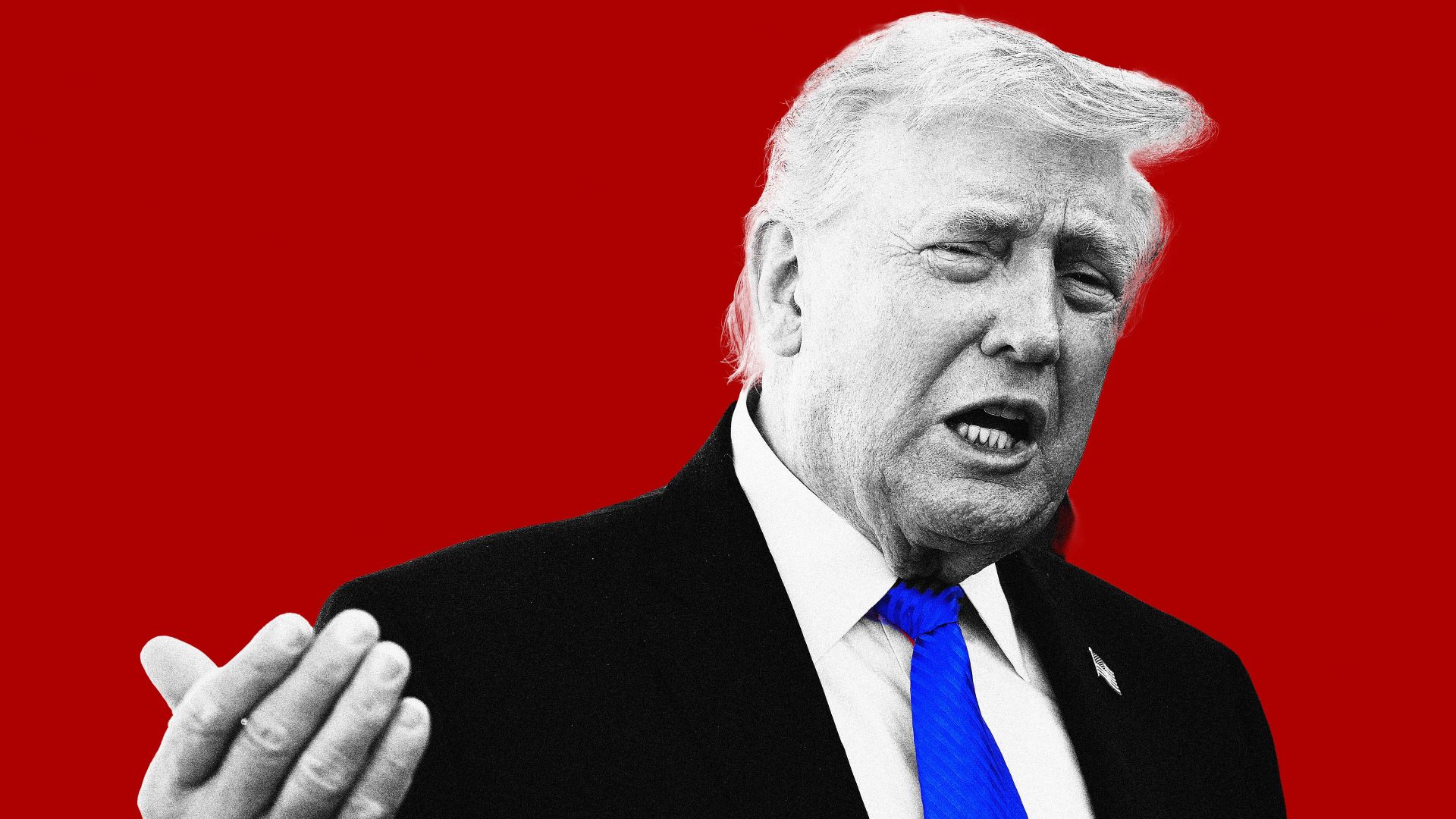
I have spent 20 years on immigration work, advising leaders and UN secretaries-general, running one of the world’s largest philanthropic programmes on refugees and immigration, working with NGO leaders and with people sleeping in camps. I have given my life to it, which is why I need to say something uncomfortable, something I have watched rooms of progressives and former officials resist each time they hear it: Trump is our fault.
I say it gently at private gatherings of former senior officials, under Chatham House rule. A colleague once pulled me aside to say I was the only person in the room who thought this was a useful conversation. Not because I was wrong, but because self-critique, in a friendly setting, was triggering. We could acknowledge, in general terms, that serious mistakes had been made. What we could not do was analyze them, attribute them to specific causes, specific processes, specific people. We had the platforms, the resources, the job security to speak honestly, and too often we chose safety.
That failure to reckon honestly is not new. It is the latest expression of a pattern that made Trump’s re-election possible. This is that story. The capacity to examine our own failures honestly – to course correct when the facts demand it – is the open society’s greatest claim. At this moment, it is also our most conspicuous failure.
Trump’s second term was not the product of Fox News or American racism alone, though those played a major part. It also was the result of two decades of progressive retreat from democratic persuasion. We retreated into litigation, into moral certainty, into what I think of as bilateral honesty, the kind of candor we practice over drinks. There is nothing wrong with discretion. The problem is when it becomes a permanent substitute for the argument that needs to happen in the room.
We mistook moral assertion for political strategy. The caution was not irrational. Immigration enforcement in America falls disproportionately on communities of colour. The unwritten progressive rules about what could and could not be said about (for instance) enforcement without being accused of racism, developed partly as a response to real harm: family separation, deportation of longtime residents, racial profiling.
But a legitimate moral impulse calcified into orthodoxy, and we made it dangerous to say obvious things: that enforcement is part of any functioning immigration system, that not everyone fleeing poverty qualifies for asylum, that broken systems needed reinvention rather than defense. Our refusal to say them out loud did not make us righteous. It made us sanctimonious and irrelevant.
That orthodoxy had enforcers. The progressive mainstream could not defend itself against vocal factions on its own side, not just Twitter activists but members of Congress and prominent advocacy organisations, influential far out of proportion to what the public believed. Abolish ICE, defund the police, positions that collapsed the distinction between idealism and strategy, crowded out or silenced more sensible arguments.
Those of us with the standing and institutional power to push back mostly didn’t. That is what censoriousness has produced: people who know better staying quiet. We deceive ourselves into thinking we are intellectually honest because we do have honest conversations, but only in groups of two or three. Rarely in the room, rarely where it might really count.
Meanwhile, the border became synonymous with chaos. The Biden administration’s enforcement record was genuinely mixed and the political class could not find the language to make a credible case for what it was trying to do. The institutional culture made honest talk about enforcement radioactive.
We have a target-rich environment in Trump and his allies: the corruption, the incompetence, the open looting of public institutions. And that is their greatest trick: being so outrageous that the left rarely has to look inward. Their extremism functions as an alibi for our complacency. The structural forces driving polarization are enormous, from algorithmic sorting to economic dislocation to the collapse of shared media to the concentrated corporate power behind the populist right. But I am certain that our silence made it worse.
Suggested Reading
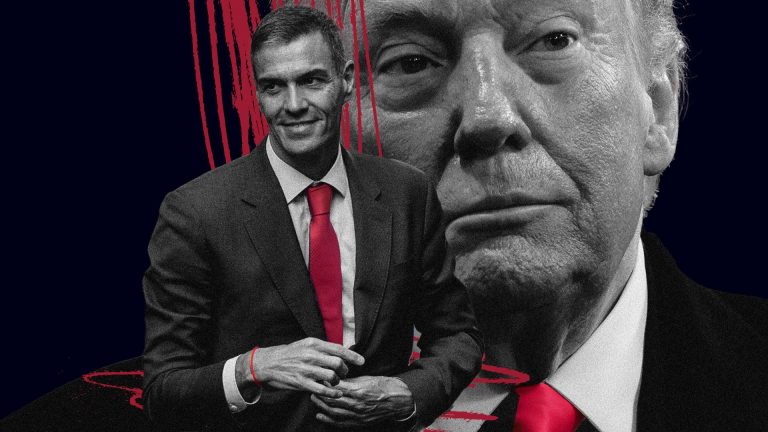
Pedro Sánchez is outclassing Trump with the president’s own tactics
Some leaders have shown it can be done. Spain’s Pedro Sanchez made the economic case for immigration and won, at least for now. Without a strong center, however, such victories rarely outlast the leader who makes them.
The progressive left can build affinity groups. We can assemble coalitions of the like-minded. What we cannot do is build solidarity across real lines of disagreement, the kind that requires tolerating people whose views conflict with yours, not just people who look different from you. There are those who will not join forces with Pope Leo on immigration, where the Catholic Church has been among the boldest voices in the world, solely because of its stance on abortion.
The NGOs, think tanks, universities, foundations, and political parties that constitute the progressive infrastructure have yet to diversify, not demographically, but politically. Uncomfortable voices belong on our boards, in our strategic debates, and around our decision-making tables. These are not failures of strategy. They are the predictable output of incentive structures that reward conformity, good people, operating within systems that produce homogeneity as if by design.
Many believe that ideological uniformity is strength and that in the face of rising authoritarianism, the last thing you do is open the door to disagreement. But institutions that cannot tolerate internal dissent are the least equipped to fight it externally.
The people are passionate, principled, talented and yet the outcome is too often conformity and silence. Our institutions have become good at protecting themselves and affirming their own moral purpose. They fight the crises but rarely the politics that create them. That requires honest reckoning that our institutional cultures resist. But the people inside them are capable of more than the systems currently ask of them.
And the people best positioned to force that reckoning, the leaders with the biggest platforms, the deepest resources, the most secure positions, are often the ones who stay silent. Privilege has not produced responsibility. For years, I was one of them. And when someone who could afford to be honest chooses silence, they are not simply being cautious. They are signaling to everyone below them that honesty is not safe. Elite silence cascades. It sets the terms for an entire ecosystem.
The cumulative effect is an ecosystem that looks, from the outside, exactly like what it is: a set of institutions that have come to prioritize their own stability over their original purpose. Outsiders do not see idealism when they look at us. They see a class protecting its position. And that fuels the populist rage, because at some level, they are right.
Catholic and other religious charities working alongside evangelical resettlement groups, trade unions partnering with business associations are among the few spaces in public life where people of genuinely different political views still meet. These are not natural allies: evangelicals alongside progressives. That is the point. Some of the most innovative work in this space is being funded by philanthropies, like Open Society, willing to take risks.
Governors like Spencer Cox of Utah have built “Disagree Better” into a national movement, standing on stages with Democrats, modelling bipartisan cooperation when the political incentives run entirely the other way.
But the center-right is fighting its own civil war, in which pragmatic Republicans at the state level are being driven out by performative ideologues. The center needs to be built from the right as much as from the left, and progressives who want to repopulate it will have to do more than diversify their own institutions. They will have to show up in other people’s.
Political credibility comes from doing what you demand of others. We demand pluralism and practice its opposite.
Meanwhile, outside our institutions, trust has retreated into hyperlocal pockets — Facebook groups, WhatsApp threads, with few bridges beyond. The populist right, however crudely and dangerously, is linking those pockets into movements. MAGA succeeded not because it had better policies but because it offered symbolic belonging – flags, rallies, a tribe.
The deeper contest is not over policy. It is over loneliness and purpose. More in Common’s research suggests that populism functions less as a policy response than as a mode of engagement, in which people are drawn not to arguments but to movements that feel alive. The generation now entering political life has lived through the financial crisis, a pandemic, the accelerating reality of climate change and now faces the existential uncertainty of artificial intelligence.
Polls show record isolation, anxiety and purposelessness. The political movement that credibly addresses belonging will have an enormous advantage and the center barely exists on this terrain.
The center will not be built by better arguments. It will be built by becoming a place people want to belong to, and by institutions that are rigorous, not just righteous.
In 1922, a young American named Charles Garland rejected a near-million-dollar inheritance, then changed his mind and used it to create the American Fund for Public Service, known as the Garland Fund. Its architect was Roger Baldwin, the founder of the ACLU, who built a board that was deliberately and uncomfortably mixed: liberals and leftists, union organizers and civil liberties lawyers, Black leaders and white radicals. They argued constantly, about everything.
And from those arguments came investments that transformed the United States. The Garland Fund financed the NAACP’s legal strategy that would eventually produce Brown v. Board of Education. It incubated industrial unions that gave tens of millions of workers economic agency. It underwrote the ACLU’s foundational free speech litigation. It did not merely fund progressive causes. It funded the infrastructure of progressive change — the institutions, the legal strategies, the organizing capacity that would reshape American life for half a century.
Now consider the boards of many progressive institutions. Politically aligned, ideologically comfortable, often unwilling to risk the friction that produces genuine innovation. Progressive institutions in democratic societies require productive friction to generate strategies equal to this political moment. An institution that prizes harmony above honesty will not produce them.
Zohran Mamdani, the new mayor of New York City, did something so simple it should not count as revolutionary: he went out and listened. He did not begin with a platform and try to sell it. He began with a question, “what do you need?” and turned the answers into a movement. More than a hundred thousand volunteers joined, because they had been heard first. Listen first and the rest follows. The center will be built by giving people genuine agency over the outcomes that shape their lives — making it a home, not a proposition.
We need politicians who can turn passive recipients of policy into active agents of change. We need institutions willing to diversify politically, in ways that make us uncomfortable. If everyone on your board voted the same way in the last election, your institution is not a force for change, but a club. The political theorist Hélène Landemore argues that our democratic institutions are dominated by the confident and the loud, while the shy majority stays silent. The task of democratic reform is to draw those people out.
The idea of institutions that genuinely tolerate disagreement, that seek out the people who make them uncomfortable, might sound implausible. But the cost of progressive silence is not hypothetical. It is Trump. It is the collapse of public trust in the institutions we built. It is the destruction of programmes that were changing lives on both sides of the Atlantic.
We have the platforms, the resources, the standing to absorb the consequences of honesty. If we will not take the risk, we are asking people with far less power to do it for us. And they cannot.
The center is not an ideology. It is a practice — the practice of building things together with people you disagree with. It has worked before. It will work again. But only if we stop agreeing with each other and instead start building with everyone else.
Gregory Maniatis leads the work on immigration and refugees at the Open Society Foundation, was a longtime advisor to the UN special representative for migration and numerous governments, and a journalist and author whose work has appeared in outlets including the New York Times, Washington Post, and Foreign Affairs
 Most popular

Screen scandal: How Ofcom lets GB News get away with it

James O’Brien says the press have gone mad – and it’s worse than you think

The evidence is growing: Trump’s team are using his chaos to get richer on the stock market

Now it’s official: Brexit was a disaster. Next, we must join a new EU