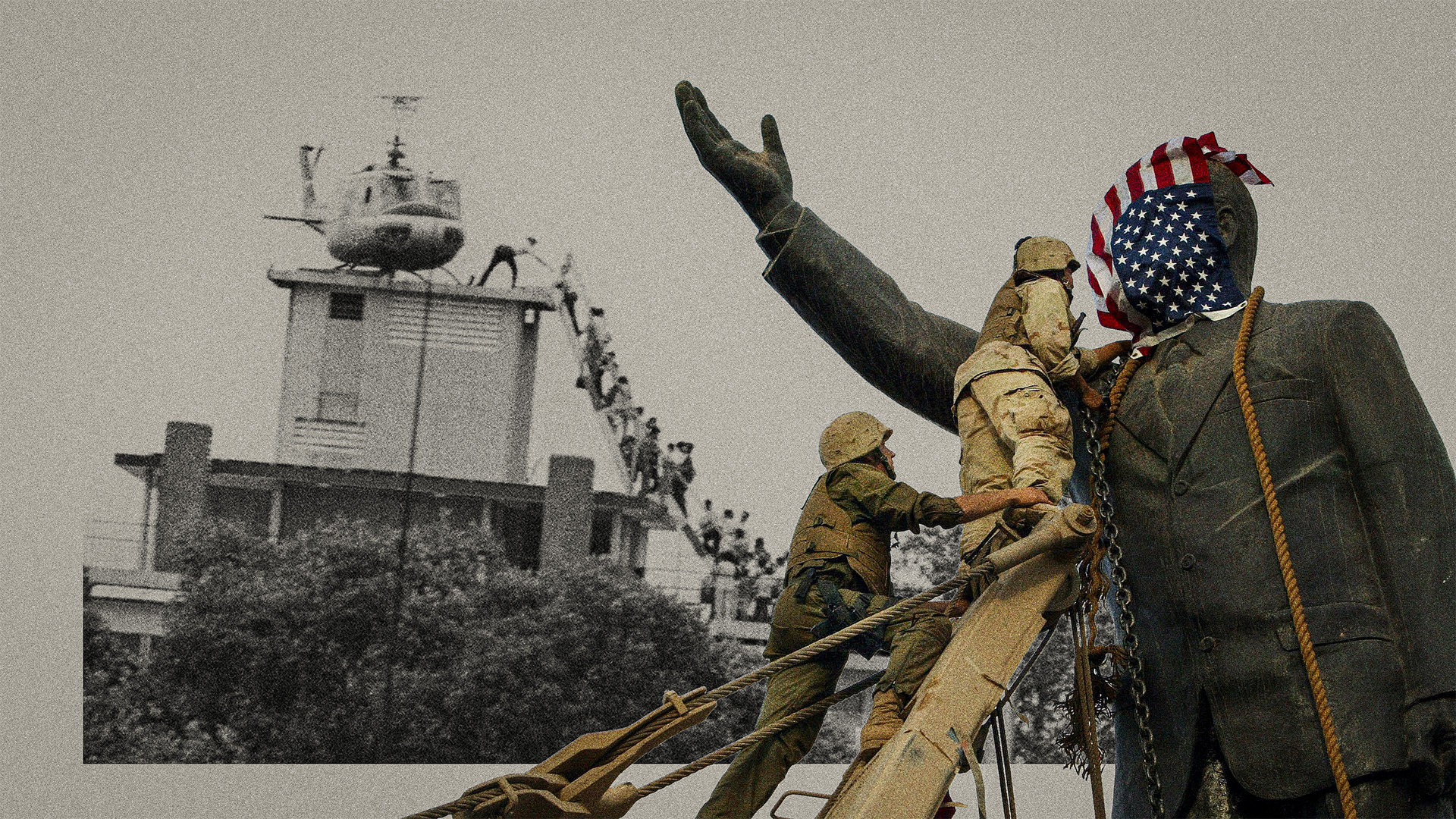
Given that the Trump administration has no strategy in Iran either for how to achieve its stated goal of regime change, or for what might come after, the question is: are we on the verge of repeating Iraq? Is the US heading into the quagmire of a forever war that will be costly in American lives and treasure, and leave the region in worse shape than ever before?
At least the decision to invade Iraq in 2003 rested on a vote of Congress, though one based on flawed intelligence, the infamous National Intelligence Estimate (NIE) on Saddam’s weapons of mass destruction (WMD). Its message was simple – Iraq possessed chemical and biological weapons and was reconstituting its nuclear program.
These judgments were wrong: Iraq had no WMD. International inspectors, having withdrawn in 1998, returned in 2002 and subsequently found no evidence of WMD. There was no imminent threat.
Three trillion dollars and 4,500 dead US soldiers later, Iraq is no better than before. At least, Saddam’s Iraq was stable, if brutal. Iraq today has fragile coalition governments dominated by Shia Islamist parties, many aligned with or tolerant of Iranian-backed groups. Informal militia networks hold the real power.
There was no Congressional vote for the war on Iraq, nor any credible public argument for it. But this time around, with the attack on Iran, it was not that the intelligence was faulty – there was no intelligence.
The president conjured an imminent threat from Iran but presented no evidence. As for the threat of Iran’s nuclear program, the president declared back in June that it had been obliterated. If the concern was Iran’s ballistic missile program, intelligence assessed it was years away from a missile that could strike the US.
If the point was to support opposition forces in Iran, as the President’s “HELP IS ON ITS WAY” posts suggested, then killing huge numbers of Iranians, including young girls at a school near a military facility, seemed an odd form of help.
Indeed, secretary of state Marco Rubio made clear, perhaps inadvertently, that the Israel tail had wagged the US dog. “We knew that there was going to be an Israeli action” against Iran, Rubio told reporters on Capitol Hill. “We knew that that would precipitate an attack against American forces,” by the Iranian regime. “And we knew that if we didn’t preemptively go after them before they launched those attacks, we would suffer higher casualties…”
In Iraq, the US had considerable control. If it had not eliminated both the Iraqi army and civil service, then the US might have produced a better government and faced a lesser insurgency. In Iran it has no control. In that context, calling on Iranian military and security forces to surrender their weapons without indicating how was pure hubris.
Despite the killing of Ayatollah Ali Khamenei and some of his associates, the regime has plans for succession. Polls are questionable, but support for the regime seems about 20%. In the short run, the regime is likely to tack to the right, repressing opponents and to continuing to strike enemies in the region. It may even benefit from a “rally ‘round the flag effect” familiar to nations under foreign attack.
Suggested Reading

Iran war: It’s time for Europe to become a superpower
The question “are we repeating Iraq?” is especially resonant for me because I knew and respected many of the principal officials involved, just as I had known many of the officials who had also made US policy on Vietnam. They were competent men – alas, too few women informed the discussion in both cases, which had something to do with the failure.
What linked Vietnam and Iraq was hubris. In Vietnam it took the form of “it can’t be that hard to defeat these pajama-clad peasants”. In Iraq it was “they will greet us as liberators, setting them free for democracy”. Unhappily, there is no shortage of hubris this time around. Our leaders seem singularly unable to see beyond the rim of power and power politics.
Suggested Reading

The fall of Saigon, 50 years on
We have learned from history that bombing alone will not produce regime change. To think otherwise is yet more hubris. Will the administration take the next step into the quagmire, and put boots on the ground? Secretary of defense Pete Hegseth left open that possibility.
The president has already made the first two Iraq mistakes. He has gone to war for no compelling reason and shunned any timetable for the operation. He has remarked that the Iran war was initially “projected four to five weeks” but added that the US military has the “capability to go far longer than that”.
It can only be hoped that he knows enough about the hoary history of Iraq to avoid a repeat of that disaster. If he does not, then he will turn Iran into the “forever war” that he has twice, in presidential campaigns, promised to avoid.
Gregory F. Treverton was Chair of the U.S. National Intelligence Council until January 2017. He is now Professor Emeritus of the Practice at Dornsife College, University of Southern California, and Chair, Global TechnoPolitics Forum.
 Most popular
Iran war: It’s time for Europe to become a superpower

Operation Epic Fuck-up is the quintessence of this Trump administration


The murder of Sarah Everard made me an activist


The big secret of Small Prophets