America’s war on a presidential whim in Iran is causing enormous collateral damage. Witness the scores of Iranian girls killed by a US airstrike on their school, apparently the result of outdated targeting maps.
What is also being destroyed in this war is any taboo about going nuclear. Surely, Iran will proceed cautiously with its nuclear program, not wanting to give the US and Israel more reason to rain down bombs. But the Iranian regime can only draw the lesson that several of its fellow rogue regimes ignored: the one insurance policy against foreign aggression is possessing nuclear weapons.
Libya’s Muammar Gaddafi and Iraq’s Saddam Hussein did not learn their lesson, and it cost them their regimes – and their lives. Saddam may have had some inkling of the lesson, for in the run-up to the 2003 US invasion, he at least pretended he had weapons of mass destruction. But he didn’t.
By contrast, North Korea’s Kim Jong-un got the lesson long ago. Not only does his nuclear arsenal save him from foreign attack, but when he wants to stir up a crisis to get some attention, he can rattle his nuclear warheads.
For a half century, the United States and its allies have reinforced that lesson for North Korea by making clear over and over that all they care about is their nuclear weapons. The Clinton administration negotiated an agreed framework with North Korea in 1997, and it remains the only time when North Korea’s nuclear program has ever been curtailed, albeit only for several years.
The lesson of the Iran War will not be lost on other states in the region, especially Saudi Arabia but perhaps also Turkey and others.
The other way nuclear taboos are being shattered is more subtle. Trump’s reckless plunge into war with Iran and its oil boon for Russia comes atop his administration’s Europe bashing, skepticism about Nato and to-ing and fro-ing about support for Ukraine.
As Europe continues to ask itself whether it can count on America as an ally, nuclear weapons are on the agenda, most visibly in Emmanuel Macron’s offer to “Europeanise” France’s nuclear deterrent.
Suggested Reading
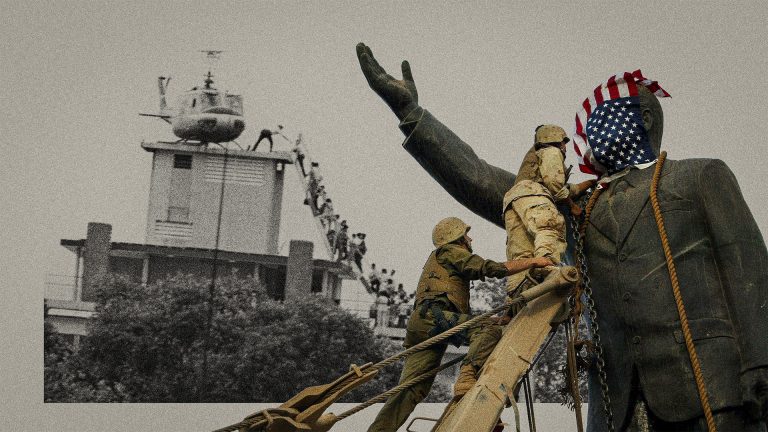
US spy chief: Trump is repeating the mistakes of Vietnam and Iraq
Half a century ago, predictions about the number of states that would eventually be armed with nuclear weapons were dire, and went as high as twenty or even thirty. Even then-neutral Sweden had a nascent weapons program.
Happily, that prediction has not come true, and only Israel, India, Pakistan and North Korea have joined the original club of five – the US, Russia, France, Britain and China. The 1968 Nuclear Non-Proliferation Treaty (NPT), treated skeptically at its inception, has been more effective than expected.
Now, Taiwan and perhaps also South Africa, which began a nuclear program under apartheid, might be added to the list of nations interested in a nuclear insurance policy. Ukraine surely must regret giving up the nuclear weapons on its territory with the end of the Soviet Union, though it never really “owned” them.
Many European states could be tempted by nuclear weapons, both as insurance if they share a border with Russia, and as reassurance if they no longer see the US as reliable. South Korea and Japan might also seek a nuclear deterrent.
Argentina and Brazil were interested in nukes in the past and might be again, given the chaotic world ahead of us. What is striking about many of these richer would-be proliferators is how quickly they might go nuclear. Saudi Arabia could probably buy a weapon from Pakistan – if it hasn’t already. For Japan, the time to create a nuclear weapon is measured in weeks, not years.
We can only hope that the war without reason in Iran doesn’t give countries reason to break the nuclear taboo. If it does, those woeful predictions of a half century ago risk coming good after all.
Gregory F. Treverton was chair of the US National Intelligence Council and is now professor emeritus at Dornsife College, University of Southern California
 Most popular

Screen scandal: How Ofcom lets GB News get away with it

Keir Starmer’s fate – to become Boris Johnson

GB News Scandal: The dossier


Corpses, spacelabs and gravy: The utter disaster of Nicole Kidman’s Scarpetta