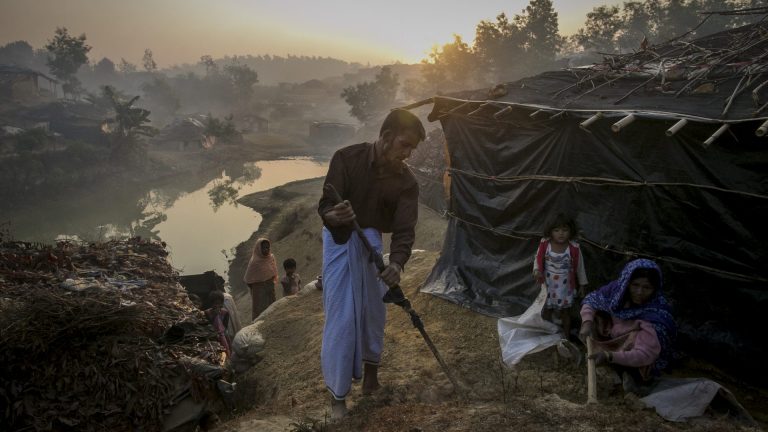
Abdullah Wahed sat cross-legged next to his wife, Sadia, on the dark floor of their windowless shelter in southern Bangladesh. Between them, where the thick air trapped inside is coolest, their two young children lay beside one another, staring up at Abdullah’s large, dark eyes.
“There used to be these endless green fields that stretched as far as our eyes could see,” Abdullah recalled with a boyish grin. His gaze seemed to pass through his son and daughter and settle somewhere far away from the cracked bamboo walls around them.
It was on these fields which rolled through arching hills that Abdullah used to play football with the other kids from his small village in Buthidaung, Rakhine State in western Myanmar.
But that was before the games ended. Before they stopped him from going to school and before the medicine started running out. Before he took his mother by the arm and led her from their family home into dark jungles and across wild rivers to Bangladesh and before his own country’s army burned babies, gang-raped young mothers and executed their husbands across Rakhine, the home of an ethnic Muslim population called the Rohingya, described by the United Nations as the “world’s most persecuted people.”
A peaceful return for the Rohingya remains a distant hope. A carefully-controlled election has taken place in Myanmar, which has been widely disregarded by the international community. But its results will be used to legitimise the junta’s control over the country and further cement their long campaign of genocidal violence against the Rohingya people.
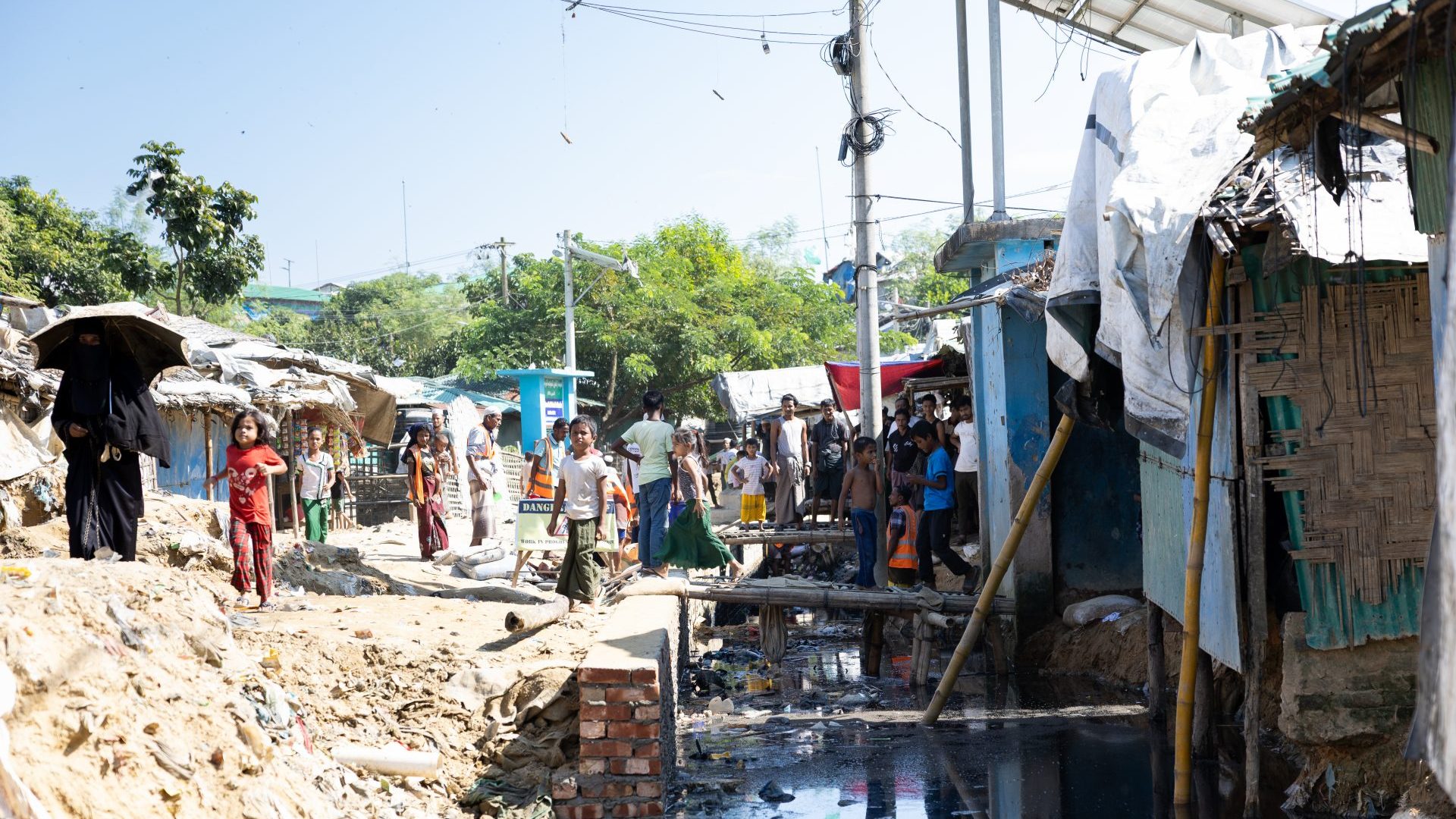
Abdullah, now 25, has spent the last eight years in Bangladesh encased in bamboo and tarpaulin in Camp 4 of the world’s largest refugee camp.
There, in the sprawling network of 33 camps, Abdullah became a man, a husband, a father, and a prisoner, stuck in a fragile limbo between the country that made him stateless and the Rohingyas’ reluctant host nation, Bangladesh.
Over 750,000 Rohingya people fled Myanmar for Bangladesh in 2017 after 50 years of discrimination escalated to horrifying mass killings perpetrated by the Myanmar army, which Human Rights Watch called an “act of genocide.”
Many, including Abdullah and his mother, arrived at the Bangladesh camps beaten, bloodied and exhausted. Bangladesh refused to call Rohingya people “refugees”, but granted them shelter in multiplying camps built across a deforested area near the coastal city of Cox’s Bazar.
In the years that followed, billions of dollars of humanitarian aid poured into Bangladesh. Shelters, education centres, health facilities and makeshift dirt roads were quickly built. Even a Rohingya Cultural Memory Centre, sympathetically designed by Dhaka-based architect, Rizvi Hassan was built on a hill in Camp 18 and filled with artwork, traditional farming tools and tiny model villages depicting the wide fields, snaking rivers and rolling hills. It was designed as a tool for remembrance.
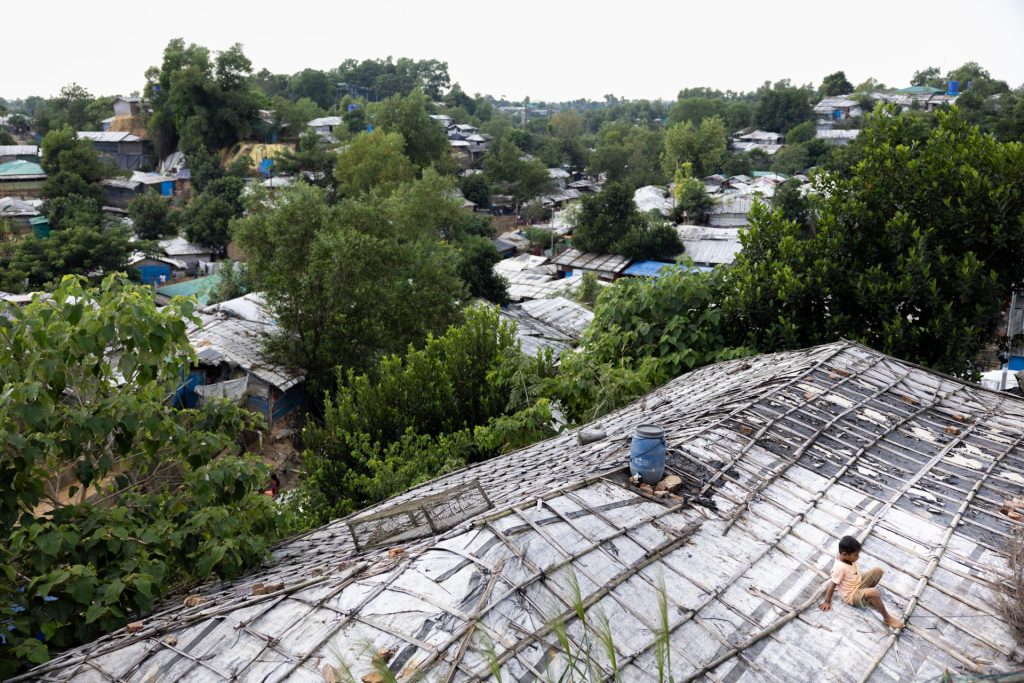
But almost every single building in the camps, from small shelters to hospitals share one thing in common: they were built to be temporary, designed to discourage any feelings of permanence, and deliberately constructed with removable pre-cast columns and nut bolt joints so they could be quickly dismantled when the Rohingya refugees are sent back.
“Even the memory centre was built so it could be taken down in around five days,” Rizvi Hassan told The New World.
33 camps built to be torn down mean the Rohingya refugees – who are forbidden by the Bangladeshi government to work, earn money, participate in formal education or leave the camps without permission – are trapped in a cycle of temporary existence, increasingly vulnerable to climate disasters and entirely dependent on vast sums of foreign aid to survive.
Now that aid is drying up. Only 38% of the $934.6 million needed to maintain life-saving assistance was secured by October last year. In the last 24 months, 200,000 more Rohingya refugees have arrived there as civil war escalates.
Aid cuts have not only exposed the Rohingya to horrific levels of human suffering but revealed the weaknesses in policies of dependence and containment that crop up when a host country refuses to give basic human rights to its refugee population.
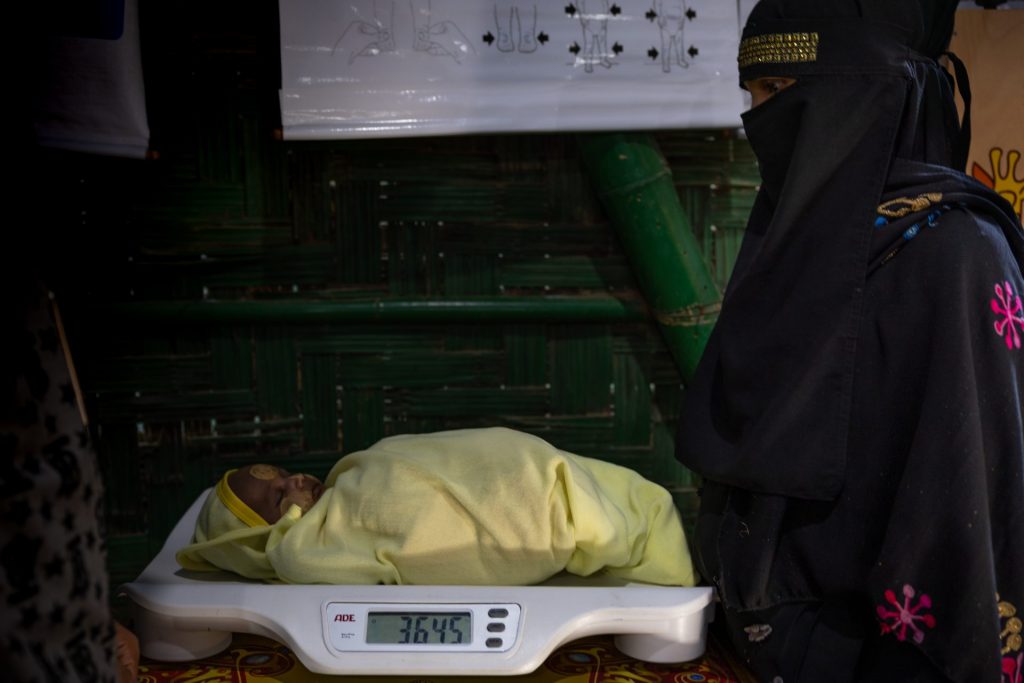
Shortly before 11am in Camp 15, the sound of crying children permeated through most of its tight pathways. But in the queue for life-saving nutritional supplements at a UNICEF nutrition facility, hundreds of babies lying limp in their mothers’ arms were eerily quiet.
“Without funding, 14,500 children will likely die of severe acute malnutrition next year,” Dr. Owen Nkhoma, a specialist at the facility, told The New World.
Severe malnutrition in children under five years is up 11% as of September 2025. Mothers, like Juda Bibi, 35, who propped up her young son on weighing scales, described how “there simply isn’t enough food for everyone right now.”
Others like Romida Alom, 41, who is unable to breastfeed, said her young son, who weighed just 1kg when he was born, would die without the nutritional supplements she collects every week from the facility.
Without additional aid, the UN has warned that by mid-2026 food rations will be halved. Primary health services were either completely shuttered or drastically reduced at 48 health facilities after USAID cuts. 55% of education centres, which keep hundreds of thousands of children away from increasing numbers of trafficking and drug gangs in the camps, were forced to close in recent months following the cuts.
Suggested Reading
School’s out for Rohingya child refugees
The alternative to this dire situation, which remains off the table of current leader Muhammed Yunus, is to grant refugees the right to work. But in his government’s eyes, this would encourage them to stay in Bangladesh. There is also the uncomfortable reality that Bangladeshi communities around Cox’s Bazar already benefit from cheap, informal Rohingya labour. Refugees are working for extra food to supplement a monthly ration allowance of just $12 per person.
Disaster preparedness organisations like Acted, which is funded by the European Union, are also contending with natural disasters that have destroyed large parts of the camps in recent years.
Monsoon rains have caused landslides that snapped through bamboo and cut off access to care facilities. The region is predisposed to cyclones, like the one in May 2023 that damaged 3,000 shelters and destroyed learning centres, health facilities and mosques across all 33 camps.
Frequent droughts dry out the wooden shelters, turning homes and the propane gas bottles within them into a crude bomb. In the hope of preventing mass casualties, Acted has trained almost one thousand young Rohingya women as firefighters. Driving red and white rickshaws to access isolated homes, women like Sahan, 28, are the first line of fire defence in Camp 10.
Even during the usually stable climate in December, the narrow arterial walkways which snake through the camps crumble and break underfoot.
Outside his shelter in Camp 24, Shobul Alam’s large fist is clenched around the flimsy handle of his cane as he takes a shallow, laboured breath which barely inflates his broad, muscular chest.
“Stand up, Shobul” his father barked. “Look, watch this.”
With each pained grunt, Shobul’s jaw jutted out further. His forehead tightened and the veins in his neck bloated. Only a few seconds went by before his burly frame crashed back into the plastic red chair.
Shobul cannot speak or write or use the toilet alone. His brother, Mohammed, who communicates for him, said “he is in pain every minute of every day.”
A few years ago, Shobul fled Myanmar for Malaysia in search of work to earn money for his family in the Bangladeshi camps. There, he was involved in a traffic accident, which he barely survived. Rohingya refugees secured transport for him to the camps in Bangladesh where he was reunited with his family.
“We are more vulnerable in the camps now,” said Mohammed. “The gangs know we are weak and cannot run, so they come for us more than ever before. We are desperate to return home.”
But the chances of a safe return to Myanmar are minimal. Civil war is intensifying between the army and several militia groups. Earlier this month, the Myanmar Army launched a raid on a hospital in Rakhine state, killing and injuring dozens of children. UN rights chief, Volker Turk said the “attacks may amount to a war crime.”
The absence of legal frameworks makes Rohingya people particularly vulnerable to human traffickers operating in the region. This year alone, the UN reported that 600 Rohingya had died or gone missing during maritime journeys in the Andaman Sea and the Bay of Bengal. Since the early 2000s, multiple mass Rohingya graves and human trafficking camps have been uncovered close to borders in Thailand and Malaysia.
China, which shares the largest land border with Myanmar, is also perpetrating a state-backed persecution of a minority Muslim population, which has received little support from neighbouring countries.
In the north-western region of Xinjiang, over a million Uyghur Muslims have been detained in “re-education camps”, some of which reportedly operate with a shoot-to-kill policy for those trying to escape. Thousands of Uyghurs have been forcibly disappeared from Xinjiang, while independent human rights tribunals held in London reported evidence of torture, rape, systematic suppression of births and forced organ extraction of the Uyghurs.
Since the start of the Rohingya crisis, China has repeatedly opposed humanitarian and political intervention in Myanmar, but continues to back their army, supplying them with attack drones and aircraft that have been used to carry out deadly airstrikes across Rakhine state.
Condemning Rohingya persecution would attract further global scrutiny on China’s own crimes against the Uyghurs. It would also alienate a close ally in Myanmar and damage the value of its huge investments in the country.
Instead, China continues to lobby for the repatriation of the Rohingyas deliberately overlooking the lethal threats they would face if they returned to Rakhine state.
At just 19 years old, Abdul Aziz has spent over a third of his life in Camp 16. He is desperate to study and become a doctor, but like most Rohingya people in the camps, he is desperately afraid for his family’s safety if they are forced to return to Rakhine.
At one of the last remaining vocational skills programmes still running in his camp, he said:
“I just want to learn how to build a plane, then fly it far away from here… anywhere, but here.”
 Most popular

Matt Goodwin’s road to derision

GB News Scandal: How Ofcom let GB News corrupt British media

GB News sets its lawyers on to The New World
Matt Goodwin’s new book: The missing chapter