
In 2020, when no politician had ever dreamed of complaining about Winston Churchill being replaced by a badger, JMW Turner became the first artist to be pictured on a British banknote. Had wildlife not taken over, the fame of The Hay Wain (1821) and the popularity of Tate Britain’s superb current exhibition featuring Turner and his contemporary suggest that Constable would have followed. So might William Blake and Barbara Hepworth.
But even when the robins and otters have had their day, and historical figures return to British currency, hell will freeze over before Stanley Spencer (1891-1959) ever makes it on to a tenner.
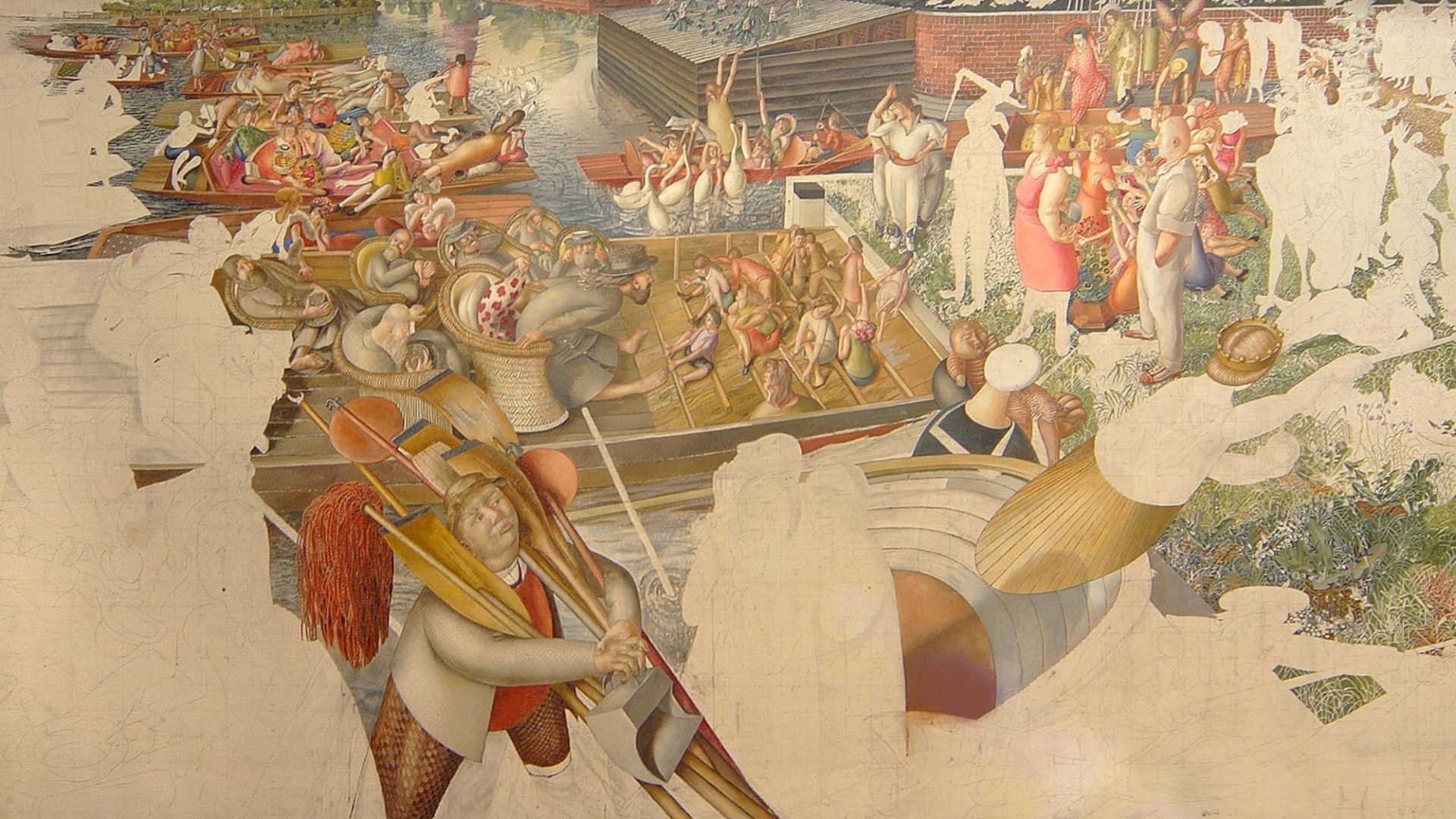
To remind yourself of why that might be, you may still, if you’re quick, be able to get a rare, close-up view of Spencer’s great unfinished painting, Christ Preaching at Cookham Regatta, 1952-59. For the past few months it has been brought down from its usual place high up on the wall of the Stanley Spencer Gallery, Cookham, to allow conservation work to take place in situ, affording visitors the chance to see the surface of the canvas up close, revealing not just brushstrokes, but visible underdrawings, including the ancient technique of squaring up that Spencer used to enlarge and transfer preparatory drawings from paper to canvas.
The painting, which occupied Spencer for the last decade of his life, is a reminder of strangeness and charm. A reminder too of his formative and entirely idiosyncratic relationship with Cookham, the Berkshire village he was born in, and where he remained, for the most part, in the same house until his death in 1959.
Such was his fondness for home that his habit while a student at the Slade School of Art in Bloomsbury, of catching the train back each day, earned him the not entirely kindly nickname “Cookham” – one that Spencer nevertheless adopted himself for a time.
As its title makes clear, Christ Preaching at Cookham Regatta is neither a celebration of rustic life, nor a study from nature. At five metres across, it is closest to a history painting, or a Renaissance altarpiece; the annual festivities of the Cookham Regatta elevated to sacred significance as the setting for a biblical scene, in which the familiar faces and landmarks of Cookham mingle with Christ and his disciples, who are seated in the open ferry dominating the foreground.
Spencer’s project is a category of its own in which he sorts and interrogates his personal history, as the scaffolding for a broader, more abstract and metaphysical philosophy of the self. It was a belief system of sorts that culminated in the “Church of Me”, a never-realised scheme for a chapel organised around his own life, its layout to be based on the streets of Cookham, for which Christ Preaching at Cookham Regatta was intended to be a key element.
Established after the artist’s death, in the Methodist church that had been attended by his mother, the Stanley Spencer Gallery, with all its curious contents, is a monument to Spencer’s vision of Cookham, not as a picturesque tribute to what is now deep stockbroker belt, but as the matrix for a radical process of self-realisation.
Entirely separate from this, his “real work”, Spencer engaged in the very English genre of landscape painting, though apparently grudgingly, in order to earn much-needed cash. “It has always puzzled me the way people have always preferred my landscapes”, he wrote in 1926.
A rather different perspective is presented in Love & Landscape: Stanley Spencer in Suffolk, an exhibition that will shortly transfer from Gainsborough’s House in Sudbury, Suffolk, back to Cookham, where, once it has been returned to its usual spot, visitors will also be able to see Christ Preaching.
The exhibition explores Spencer’s less well-known fondness for Suffolk, which served as the actual and spiritual backdrop for his relationship with his first wife Hilda Carline, and which was distinguished by a small group of landscape paintings.
These reveal Spencer in an entirely separate mode from the visionary statements of religious and sexual love for which he is famous. His Panorama, Wangford Marsh near Southwold, Suffolk, 1924, made while on holiday with Hilda Carline and her family the year before their marriage, is a “pure”, unpeopled landscape, that shows his pleasure in his environment, and the rapture that in other, better-known paintings he would infuse with religious and/or sexual feeling and narrative.
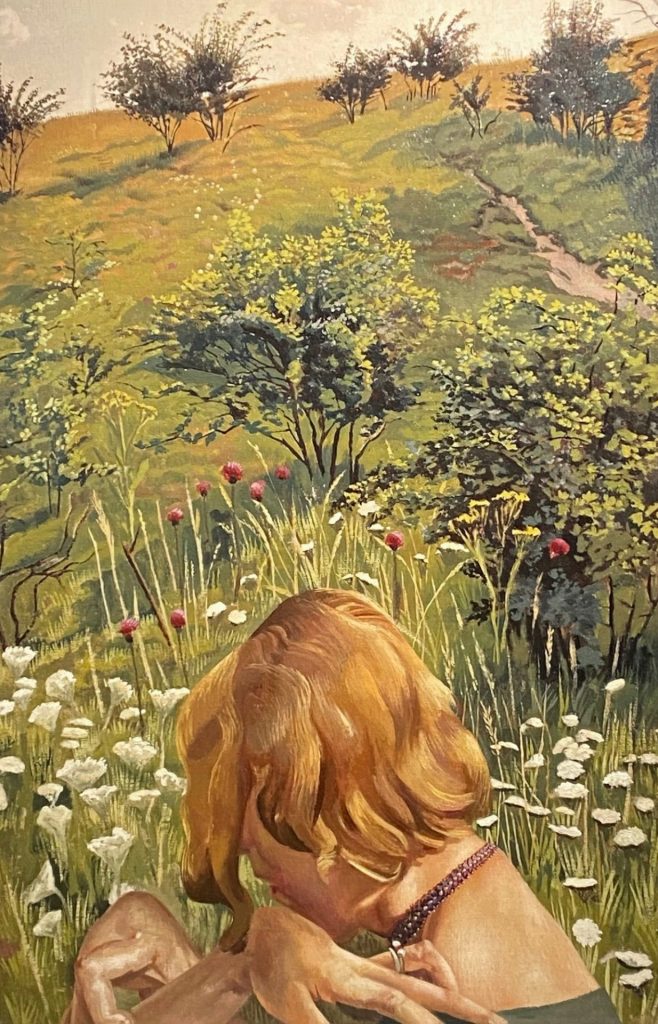
Hilda had been a land girl in Suffolk during the first world war, and, long after their marriage had ended, Spencer continued to associate Suffolk with her. The lush green fields, and wild flowers of Panorama anticipate the setting for his ethereal portrait of Patricia Preece just over 10 years later, a painting in which she, in turn, becomes the embodiment of Cookham. Later, he would make “landscapes” of his nude portraits of Preece, the contours of her flesh rendered in meticulous, awestruck detail.
That Spencer was able to take pleasure from landscape painting in Suffolk may have had to do with the company he kept there. Hilda’s family, the Carlines, were all painters, and Spencer was great friends with Hilda’s brothers Richard and Sydney, best known for their work as pioneering war artists attached to the Royal Flying Corps during the first world war. Before his marriage to Hilda, Spencer joined the Carlines on several painting holidays, where they would set up their easels together far afield, in Bosnia, and Andorra, for example.
It was to Wangford that Spencer and Hilda returned for their wedding and honeymoon in 1925, returning again the following year when he painted Stinging Nettles, and The Red House. Those stinging nettles, painted, counterintuitively, in happy times, took on a melancholy significance a decade or so later, when having realised that his second marriage to Patricia Preece was far from the happy union he had envisaged, and having failed to win back Hilda, he returned to the lodgings in Wangford where he and Hilda had spent their honeymoon.
Suggested Reading

Anna Ancher’s light fantastic
He describes in his notebook walking over the marshland “to where there used to be a clump of stinging nettles which in 1926 I had painted & they were still there. I felt like a ghost.”
Southwold, 1937, was made on the same trip, at first a disconcertingly cheerful scene of holidaymakers on the beach. It doesn’t take long to understand that we, and Spencer, are outsiders looking on, separated from the bathers by drying towels and swimsuits. “I felt a kindred feeling with the bathing suits in the line in front of me,” he wrote.
Spencer’s relationship with the English landscape is uniquely strange. Neither pastoral, nor exactly visionary, his Cookham paintings are too carnal and base to be sympathetic. But in the restrained concentration of his Suffolk landscapes, we can see instances of his unmediated connection to nature, in which he found some of the building blocks of his most ambitious and transformative works.
Revealing Genius, Conserving Art: Spencer’s Final Masterpiece, Stanley Spencer Gallery, Cookham, until March 29. Love & Landscape: Stanley Spencer in Suffolk, at Gainsborough’s House, Sudbury, until March 22, then April 4– November 1, Stanley Spencer Gallery