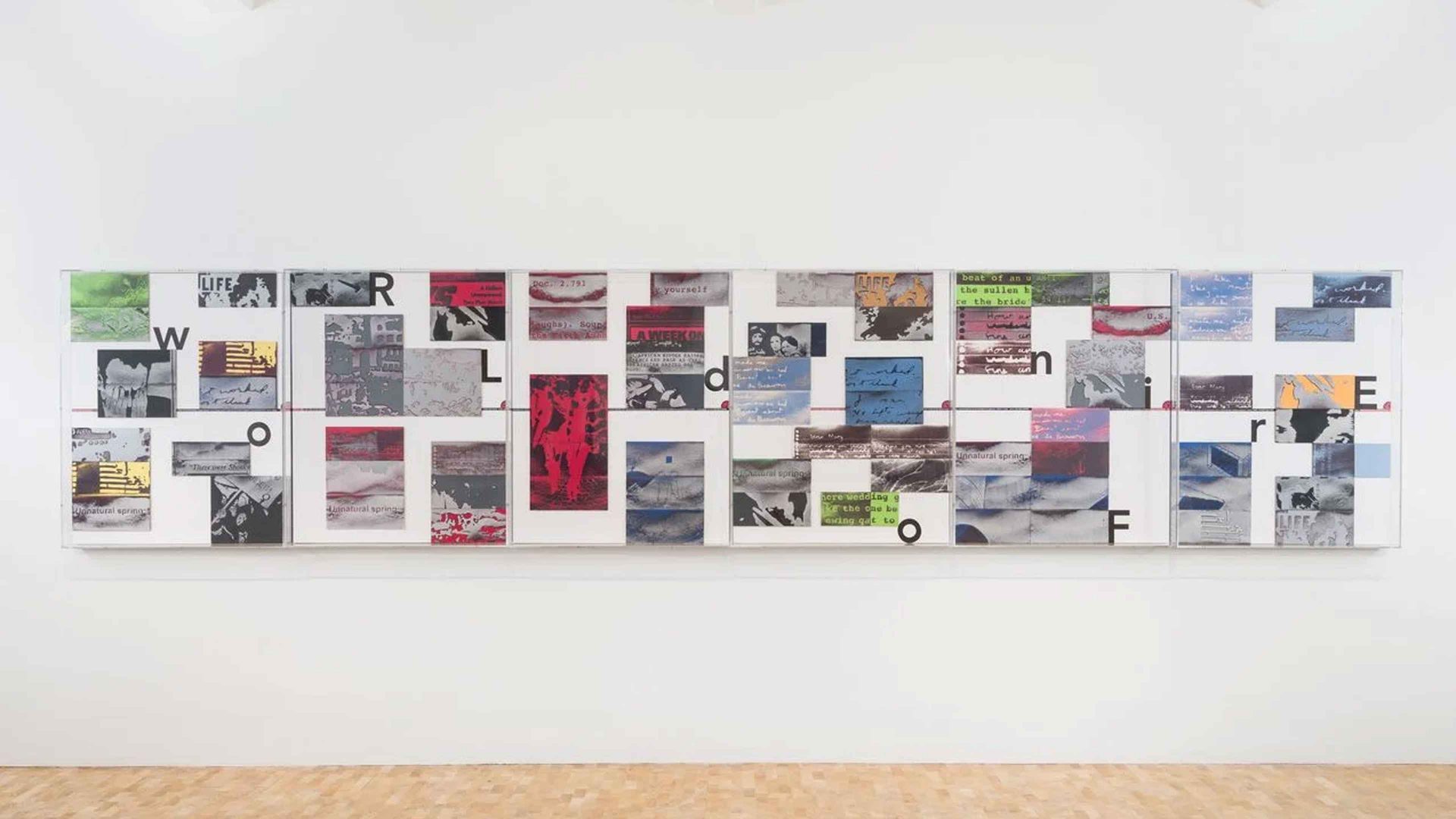
Mary Kelly’s World on Fire Timeline is just as it sounds – a roll call of global catastrophe, beginning with the nuclear arms race, and ending in our current era of climate emergency and heightened nuclear threat. A montage of images derived from newspaper cuttings and handwritten letters, often beginning “Dear Mary…”, is bisected by a ticker tape of events, in which a clock symbol periodically updates our proximity to existential midnight. In 2020, we had 100 seconds until the end of the world – today, it seems fair to assume that there might only be moments to go.
On show in Europe for the first time since it was made in 2020, the piece is a summation of decades of work by the revered American artist and teacher Mary Kelly, whose career as a leading light of conceptual and feminist art is now in its fifth decade.
The timeline is the focus of an exhibition of her recent work at Pippy Houldsworth Gallery, Mayfair. It’s bleak, but not entirely so, insisting on the redemptive power of protest which she links persuasively to meaningful change.
The 1963 Partial Nuclear Test Ban Treaty, signed by the US, UK and USSR, follows the landmark action of Women Strike for Peace, which in 1961 mobilised 50,000 women in cities across America, to march against nuclear weapons testing. It’s in their honour that the exhibition is named – “we don’t want to set the world on fire” is one of their many clever, catchy and effective slogans. The correlation between protest and progress is so strong, that Kelly might even be an optimist.
“I wouldn’t go so far as to say that, no,” she tells me when we meet at the gallery, the morning after the show opens. “I’m showing what I see and what I see is not totally hopeless – there are moments of change, but it ends up in a desperate place, which is where we all are right now. There’s the rise of authoritarianism everywhere, the failure of the Tahrir Square protests, the Trump administration and the right wing waiting in the wings here, in France, Italy. I mean, no.”
At 84, Kelly is as authoritative and impressive a figure as ever, instantly recognisable for the stylish updo that she has worn since the 1970s. Back then, the feminist cry to “make the personal political” saw mothers – not so easy to discredit as fifth columnists – mobilised as a potent emblem for peace, motivated principally by concerns for child welfare, but intersecting self evidently with environmentalism.
Suggested Reading

Carona, the Swiss village where art hid out
At the time, Kelly was the mother of a young child, living in a commune in London. Here, she began the six-year examination of the mother-child relationship that would bring her notoriety: shown first as an installation at the ICA in 1976, Post-Partum Document included everything from dirty nappies to records of first words.
The events and ephemera of her own life continue to provide material for Kelly’s work, and in London, 1974, 2017, a work derived from a letter she wrote to a friend, the struggle to work while a poorly toddler scribbles across the page is viscerally apparent.
Even Kelly’s material of choice, compressed tumble-drier lint, precisely moulded in a process that is nothing short of miraculous, is rooted in the domestic. She trialled the technique in 1999, when she was exploring ways to respond to atrocities, principally those involving women and children, that were emerging from the international war crimes tribunal established during the Bosnian war.
She says: “I wanted a medium that was ephemeral, vulnerable – that was one part of it. There’s also the recognition that the trauma of these events is not just on one side, it’s filtered through the media for us too – we are more than just witnesses, in a sense, we are part of that experience. So the material seemed perfect for that.”
Accumulated slowly, around moulds made from reproductions of images and documents that are then fitted inside Kelly’s drier filter, the medium is redolent of domestic, female labour, evoking solitary individuals all over the world, listening to the news on the radio as they do their laundry, wondering what the future holds for them and their families.
“I’m not just trying to be clever with material”, she clarifies. “I’m looking for the materiality that will speak the concept, because content and form aren’t separate, they work together.”
Repetition, and the slow accretion of material is intrinsic to the lint technique, echoing the generational cycles that recur in Kelly’s work, and the ongoing reverberation of events through years, decades, even centuries. “I was born during the second world war,” she says. “My son was born during the high point of feminism and protests about the Vietnam war; and then my grandson was born exactly the week of the Arab Spring.”
That circularity, the sense of intergenerational overlap, repetition, and continuity is pervasive because it is true: back in London to hang her show, she put up at her old address, and caught up with many of her old commune friends, who came along to last night’s opening party. “There it was, the intergenerational evidence, right?”
Mary Kelly: We don’t want to set the world on fire is at the Pippy Houldsworth Gallery, 6 Heddon St, London until Jan 24.
Florence Hallett is an art critic who also writes for the i paper and the Art Newspaper