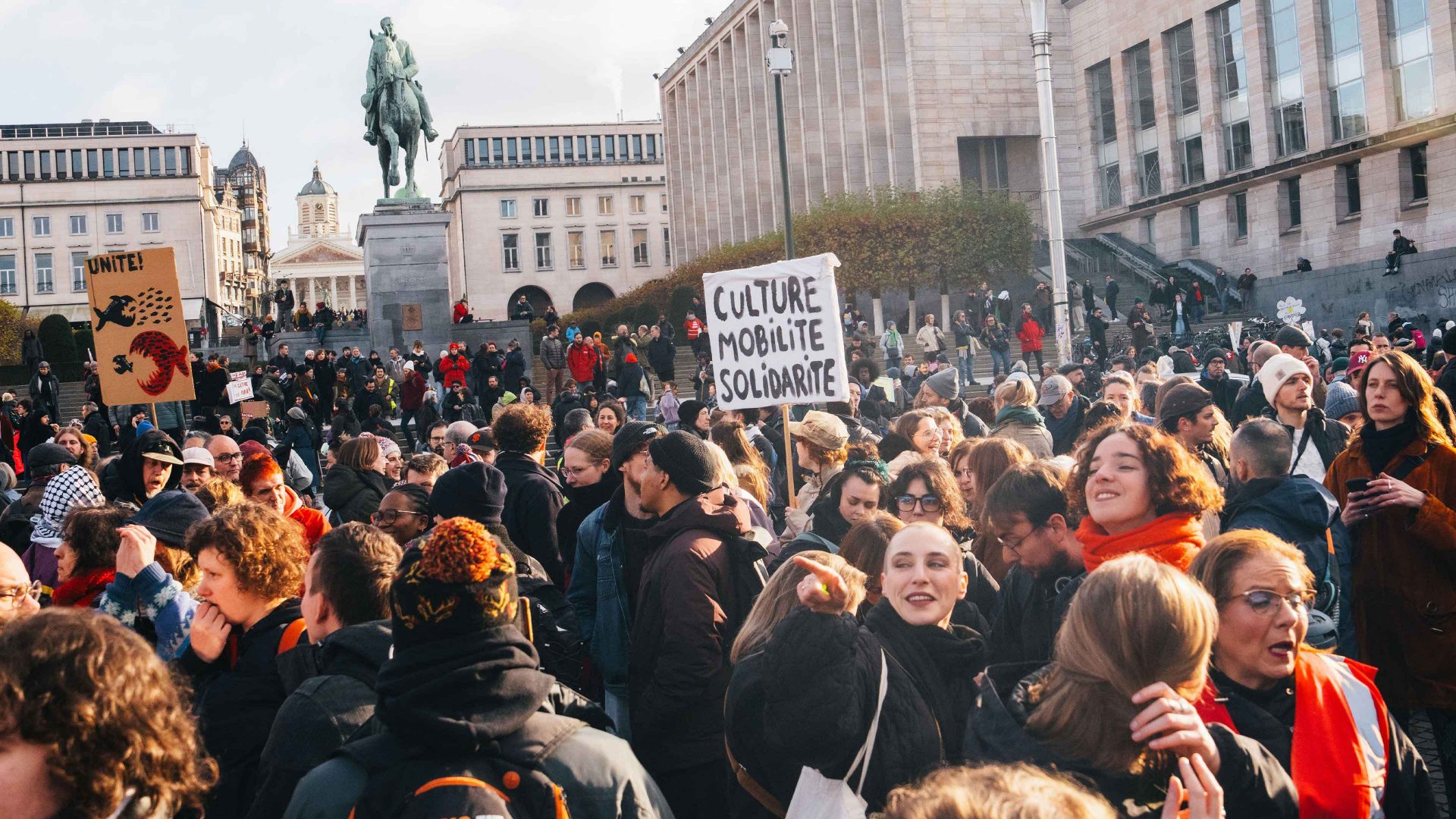
the impact of Belgium’s three-day strike from November 24-26 was uneven in many ways. The strike also appears to be the opening confrontation in what could become a very lively government term for the right wing Flemish nationalist prime minister, Bart De Wever.
Called by trade unions to protest against austerity budget cuts and pension reforms, the strike was more widely observed in Wallonia, the French-speaking part of the country, than in Flemish-speaking Flanders. It also seemed to affect tourists more than locals.
Visitors faced shuttered museums, numerous flights were cancelled and international trains were delayed. Unusually, some Belgians noted that local train services in Flanders actually ran on time for a change. “That was quite unusual,” said one traveller.
More public services and shops in the Walloon region were affected than in Flanders, where many people hardly noticed the disruption.
The strike, the largest in decades, was to protest against what trade unions called the dismantling of Belgium’s social welfare system. The main sticking point is income, the cost of living and welfare and pension reforms. Around this central set of grievances, protesters were also angered by cuts to cultural institutions and an increasing reliance on gig workers.
De Wever’s government, which was installed in February this year and includes social democrats, has vowed to tackle the country’s rising budget deficits and its high debt ratio, which both exceed EU limits. He is also a critic of what he sees as Belgium’s overly generous benefits system and its inability to activate the workforce.
De Wever was previously limited to dominating Flanders, with no influence in Wallonia. Now he governs both halves of the country, and with the Walloon socialists gone, he has set about targeting the more left-leaning Walloon system.
De Wever formed a broad-based government, but he aims both to cut back the welfare system and also to stem what he has often characterised as the flow of money from Flanders to the Walloon region. As a Flemish nationalist, he has also expressed admiration for the more economically liberal and stricter Dutch system.
In September this year, De Wever called for a much more “intimate” union between Belgium and the Netherlands. In a lecture in Amsterdam, the Belgian prime minister said that the division of the low countries was one of the greatest disasters to have befallen both nations.
Suggested Reading

In Belgium, even the dogs protest against Trump
Such talk is unlikely to endear him to the French-speaking part of the country, which, besides the Walloon region, also includes most of Brussels. Taken together with his longstanding and loud antipathy towards the Walloon and national social welfare systems, it’s likely the strikes will go on.
It certainly looks as if the unions are in it for the long run. They have called the recent three-day strike a warm-up, and are already looking at further action in the spring.
Belgians are used to strikes and protests, which are more common here than in other European countries. By one measure, there have been more than 20 strike days in Belgium this year. The pace picked up significantly after De Wever formed his coalition in February, with a large national protest just 10 days after he took office.
The unions don’t like De Wever’s austerity programme and see it as ideologically motivated, and not a way of balancing the country’s books. They have also been antagonised by what they see as De Wever’s refusal to engage with them, accusing him of disrespect. The three-day strike has increased the pressure on the government to re-engage with the unions, but this has not happened yet.
As is the case elsewhere, in Belgium the power of the unions is on the wane. Some analysts say that the unions themselves are partly to blame because they too often fall back on protests and strikes, rather than engaging with employers and the government. But in this, too, Belgian economic liberals seem to look increasingly to the Dutch model, which has a greater role for social insurance payments. The chances that the Belgian unions will take that lying down are low.
Ferry Biedermann is a journalist based in Amsterdam writing on Europe, the Netherlands and Brexit