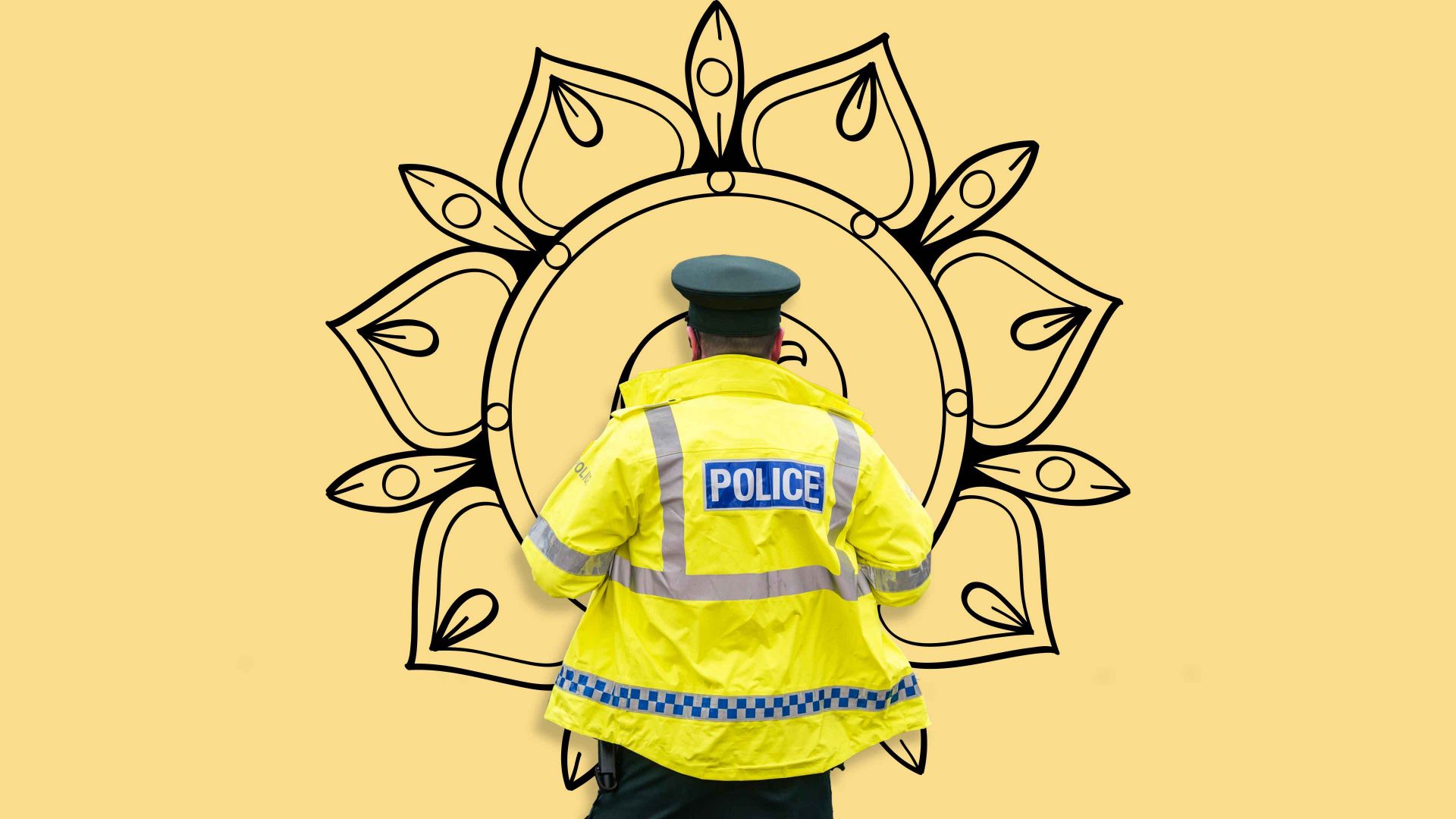
North London is in the middle of a crime wave of car back-shelf theft. Residents of Hampstead, Highgate, Kentish Town and Primrose Hill are waking up to find their rear windscreens smashed and their shelves missing. Thieves shift these on eBay and other sites, where they fetch up to £150 each depending on the make and model.
According to a BBC report, one victim, Sam Phipps, went online to track hers, and discovered an identical shelf for sale the morning after it was stolen. Using Instagram, she located the seller’s address in nearby Caledonian Road. Asked whether she then took further action, she replied: “I just left it to karma.”
This set me thinking. Did Sam really think the universe left to itself would right the wrong?
In Buddhism, karma is linked with the idea of rebirth and the notion that our present actions affect our future reincarnation. A thief might return as a factory-farmed chicken or worse. In Hinduism, too, karma is linked with divine justice and rebirth. People get what they deserve. Eventually.
Some Christians believe that God judges each one of us, and sinners run the risk of eternity in hell. Indeed, that risk is what led Blaise Pascal to make his famous “wager” that a rational agnostic gambler would bet on God’s existence as a kind of existential safety net, as this would maximise possible winnings (eternal bliss at best) and minimise personal risk of loss (which could include everlasting suffering, the worst imaginable outcome).
Our actions may have very long-lasting consequences. Car-shelf thieves and others beware!
In secular terms, though, karma is the idea that what goes around comes around. Do bad things and bad things will happen to you, perhaps materially, perhaps psychologically.
Behind both religious and non-religious uses of this concept of eventual payback is a belief in a system of justice that operates behind the scenes, balancing out good and bad acts – despite appearances to the contrary. Do something evil and it could cost you dear. Not necessarily today or tomorrow. Perhaps in this life, perhaps in a future one.
The tendency to believe that the world is fair, and that the best actions get rewarded and the worst punished is known as the just world hypothesis or the just world delusion, depending on where you stand on the question of whether it’s a description of how things might well be, or a widespread cognitive bias. The psychologist Melvin J Lerner coined the term “Just World Hypothesis” back in the 1960s, but this stance on reality has been around for millennia. It leads some true believers to victim-blame others for having illnesses, disabilities, poverty or other perceived shortcomings. There are important secular versions of it, too.
In a public lecture that became the book Illness as Metaphor (1978), Susan Sontag (who at the time secretly had breast cancer) spoke of how cancer was described in militaristic terms as an invasion of the body that should be met with a rousing call to arms, a fight against the invader that legitimised using modern technological means at any cost to the body, one that might even risk destroying the patient in the process. In contrast, in the 19th and early 20th centuries, tuberculosis was portrayed as arising from an excess of passion, the disease of poets, composers, and novelists.
Suggested Reading
Can philosophy be funny?
Cancer patients were said to have a “cancer personality”, repressing their emotions in ways that led to their condition. This attitude made (and still makes) many cancer patients consciously or unconsciously feel guilty for being ill, ashamed about their disease. In other words, the metaphors around cancer Sontag identified implied that it was a judgment, karma even, with the corollary that not “defeating” it was a moral failing. But disease certainly isn’t a just universe punishing individuals for moral failings.
As a non-religious humanist, I’m convinced the just world hypothesis is misguided: a rationalisation, a surprisingly common form of wishful thinking. The evidence implies something quite different.
Evil people sometimes flourish, and the best sometimes die young. Meaningless suffering is all around us. We should count ourselves very lucky when we aren’t experiencing pain, grief, illness or poverty.
Lucky, that’s all. Not rewarded for good deeds. There’s no guarantee everything will balance out in the long run, none whatsoever. That’s why it’s so important we try and do the best we can, here and now.
Sorry, but there’s no guarantee of karma. A benign universe is unlikely to sort this all out for us.