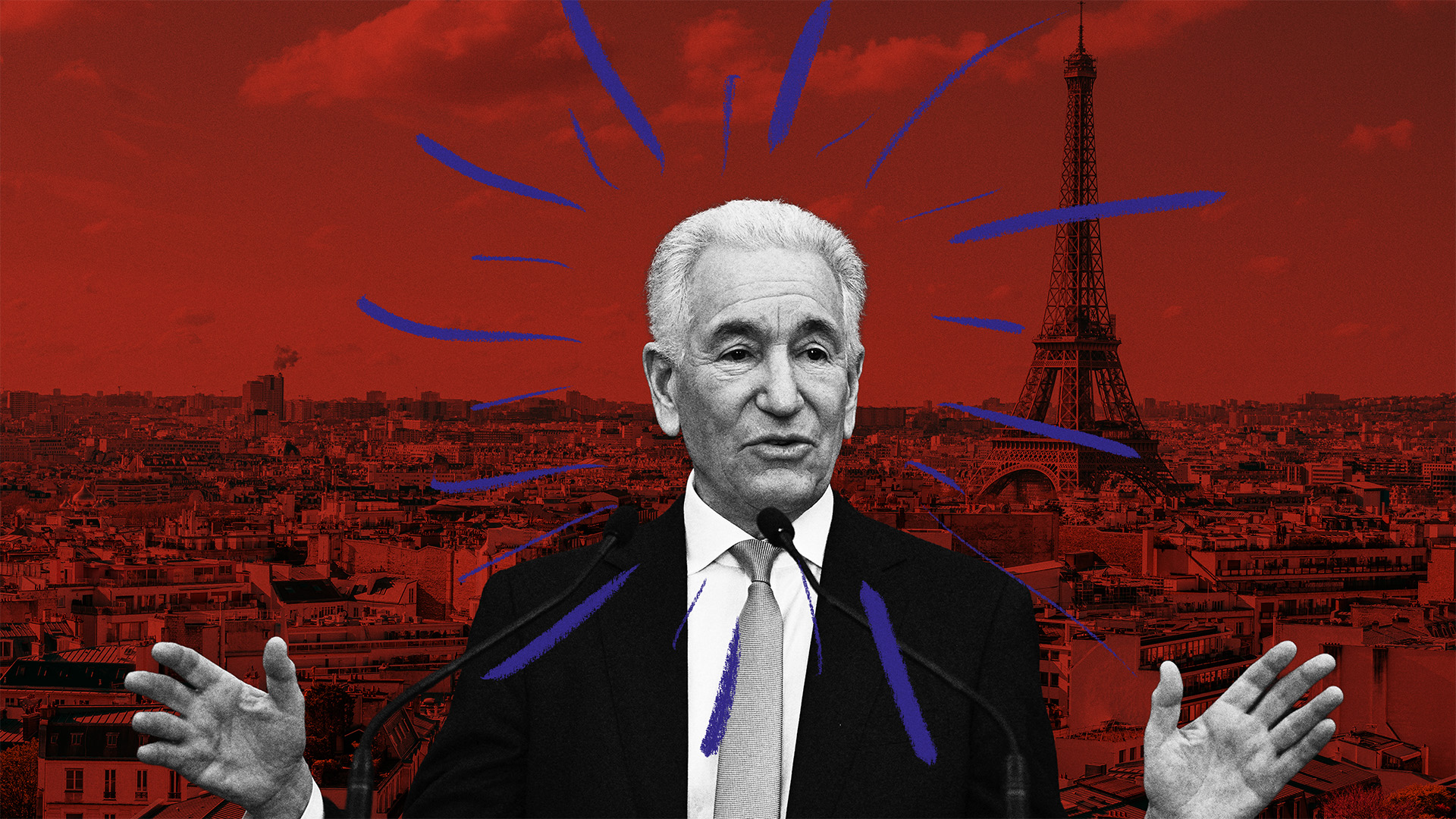
Charles Kushner is Jared’s dad and Ivanka’s father-in-law. He is also a convicted felon, who did two years for illegal campaign contributions, tax evasion and witness tampering. And so of course Donald Trump made him the American ambassador to France, perhaps the least appropriate diplomat ever to occupy the palatial Hôtel de Pontalba on the Faubourg Saint-Honoré.
Just a few steps from Place de la Concorde and a few doors down from the Élysée, this elegant 18th-century mansion was used as a club by Luftwaffe officers during the occupation. Since 1971 it has been home to the American Embassy. It is clearly a much more appealing setting than the Federal Prison Camp in Montgomery Alabama, where Kushner did his time.
“Kush” had notoriously arranged for a prostitute to seduce his brother-in-law, who was cooperating in the election contributions case against him. He secretly filmed the encounter, and had the tape sent to his own sister. He admitted paying $25,000 for the setup. Now Kushner has been rehabilitated as Trump’s ambassador to France, a post formerly held by Benjamin Franklin and Thomas Jefferson.
In August, Kushner angered Emmanuel Macron by claiming that the president was taking insufficient action against antisemitism. He then prompted a second diplomatic incident this week when he deliberately interfered in French domestic politics, by spouting extreme right talking points. When summoned to explain himself to the French government, he did not respond.
Kushner had pounced on a deeply polarising incident that had occurred in Lyon, in which a French nationalist militant named Quentin Déranque was beaten to death by antifa thugs, some of whom were associated with Jean-Luc Mélenchon’s extremist left France Unbowed party.
The 23-year-old was killed on February 14 in a shocking group beating on the sidelines of a speech by the far-left Hamas supporter, Rima Hassan. Footage was widely shared online.
In response, Kushner authorised a post on the official US Embassy account in French decrying “violent leftism on the rise”. And yet, there was no mention of the Nazi salutes, symbols and racist insults displayed by extreme-right nationalists who assembled the following day at a march to commemorate Déranque.
It was a clunky repurposing of the MAGA narrative that followed Charlie Kirk’s assassination. Infuriated, foreign minister Jean-Noël Barrot said France “rejects any political instrumentalisation of this tragedy.”
“We have no lessons to receive, particularly on the subject of violence, from the reactionary international,” Barrot declared, employing Macron’s own phrase. Barrot announced sanctions against Washington’s ambassador, cutting him off from contact with government officials and rendering him a humiliated, lame-duck envoy.
It was the kind of treatment usually reserved for rogue states. In Washington, house foreign affairs committee democrats wrote on X that undermining America’s oldest alliance because an ambassador “can’t be bothered to do the basics of the job” was unacceptable. If Charles Kushner is not up to the task, the administration should send someone who is.
Only afterwards did Kushner reportedly pick up the phone to call Barrot. According to sources at the Quai d’Orsay, as reported in Le Monde, he “expressed his willingness not to interfere in our public debate, and reiterated the friendship between France and the United States.”
Kushner is now expected to meet Barrot in the coming days. But this rift is not over.
Suggested Reading
Marjorie Taylor Greene: MAGA’s No.1 heretic
The precursor to the current diplomatic brouhaha came in December with the publication of the Trump administration’s Heritage Foundation-influenced nativist new national security strategy. It portrayed Europe as decadent and failing, warned of “civilisational erasure,” and made clear that Washington’s sympathies lay with nationalist forces from Orbán’s Hungary to the neo-Nazi-infested AfD in Germany and beyond, all seeking to upend the European project.
Days after this shock document alarmed European capitals, Kushner hosted Marine Le Pen and Jordan Bardella of National Rally at the US Embassy. He posed for photographs and posted them on X.
Meeting the Trump-Kushner clan’s American envoy so soon after Washington had effectively attacked European democratic institutions prompted widespread accusations that the extreme-right National Rally leaders were betraying the French national interest. They were, critics said, endorsing a foreign ideological offensive against French and European democracy.
As the leader of the Place Publique party, Raphaël Glucksmann, who backed French sanctions on Kushner put it: “The Trump administration has made its choice: confrontation with democratic European states and with France in particular.”
“They want to support nationalist forces everywhere in Europe. It is their national security doctrine.”
“This is no longer diplomacy… It is geopolitical, ideological and political interference in the domestic affairs of European nations.”
Kushner’s intervention was neither isolated nor spontaneous. It was a coordinated campaign. Tristan Mendès France, a specialist in conspiracy theories and co-host of Conspiracy Watch’s Complorama podcast on French national radio, documented the disinformation arc. The ecosystem now operates transnationally, exploiting tragedy in one country to inflame another.
Suggested Reading

Face it: Trump’s going mad
Elon Musk amplified the outrage on X, even labelling the mayor of Lyon a “rat”. Alice Weidel of the AfD, conspiracy theorist Peter Sweden and other far-right influencers across Europe piled in. Extreme right influencers across Germany, Italy, the Netherlands and Scandinavia rapidly converged on identical messaging, framing the killing as proof of “left-wing extremism” as the only source of chaos and democratic decay.
They of course conveniently ignored how the far right and far left increasingly mirror one another ideologically, including in violent action. Even Italy’s prime minister Giorgia Meloni inserted herself into the debate. This prompted Macron to hit back, warning foreign leaders against interfering in French domestic politics.
The precedent is disturbing. Musk’s platform amplifies French extreme right nationalist figures. Sarah Knafo, Éric Zemmour’s mistress, has clocked tens of millions of views on X in the middle of the Paris mayoral election in which she is standing, despite having relatively few followers until recently. She now looks on course to make it into the second round of voting.
Deliberate Musk-led algorithmic acceleration is now part of the electoral battlefield. The March municipal elections are widely viewed as a rehearsal for 2027, and France is acutely aware of what a coordinated MAGA-Musk-Moscow-style intervention could look like.
France is now at least the fifth European country in which a Trump-appointed ambassador has provoked a diplomatic crisis. A new study by Le Grand Continent of this “bald-eagle diplomacy” tracks the pattern.
In Belgium, Ambassador Bill White was summoned after accusing authorities of antisemitism. In Luxembourg, Stacey Feinberg suggested she would “humbly educate” leaders on China. In Poland, Thomas Rose warned that criticism of Trump harmed relations; Donald Tusk replied that “allies should respect one another.” In Iceland, William Long joked about turning the country into the “52nd US state.”
Victor Mallet of the Financial Times and author of a new book Far-right France: Le Pen, Bardella and the Future of Europe, described it to me as the ham-fisted MAGA equivalent – perhaps worse – of China’s combative “wolf warrior” envoys. They do not act as traditional diplomats, but are there to antagonise, notably on social networks.
According to the American Foreign Service Association, only six of Trump’s 70 ambassadorial appointments are career diplomats. Nearly 30 career diplomats have been recalled and replaced by Trump loyalists.
For David Colon, professor at Sciences Po and specialist in Russian and foreign disinformation, the problem began with the Kushner appointment itself.
“A convicted felon should not have been appointed in the first place. It was the first of an already long series of offenses to France. While our country is the United States’ oldest ally, ambassador Kushner not only despises us but treats us like an enemy. In my opinion, he should already have been expelled, as he failed to appear at two summonses.”
De Gaulle once asserted French sovereignty over American military dominance in 1966, demanding that US troops stationed since 1945 should finally leave France.
France versus Kushner is shaping up as a proxy war: for French diplomacy, for Macron in his final year in office, and perhaps who comes after him.
 Most popular

Matthew Goodwin’s by-election diary
The big secret of Small Prophets

I’m in Ukraine, a nation let down by America

The Queen, the palace and the media were accomplices in the Andrew fiasco