
In the sweltering mid-July heat of Madison, Wisconsin, the delegates inside the 2024 Republican Convention have found a new chant.
Armed with shiny blue campaign cards that they hold aloft, the crowd bang out a rhythm. “MASS DEPORTATION NOW! MASS DEPORTATION NOW!”
The “NOW” is written in scarlet and punctuated with an exclamation mark. No timewasting here.
Among the fembot skeletons and the MAGA stallions on the floor, there are ordinary-looking families, Hispanic faces, people of colour.
Three days earlier, on July 13, Donald Trump had narrowly avoided an assassination attempt in Butler, Pennsylvania. Yet here he is – the Republican presidential candidate – now wearing a bandage over his injured right ear.
In homage to the one they love, several front row audience members are sporting ear bandages too, as if they were the adoring Libyans who wore sunglasses in the reign of Gaddafi.
It feels darkly comic. The placards, the chants, the ears. Semaphoring a dystopia that, four months out from the presidential election, we never truly imagined would come to be.
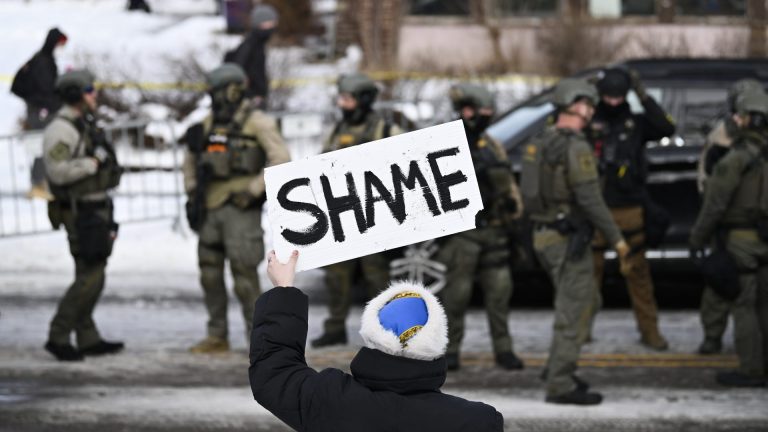
Except it has. There is (NOW!) mass deportation happening across American cities. Not of rapists, drug traffickers and killers, but of brown, black, Latino workers – many in the legal migration system – who’ve made America their home for decades.
This is the story of how it’s happening.

On Sunday morning in Minneapolis, we step outside in minus 11 degrees Celsius. The helpful weather app explains it “feels like” minus 23. But because I have never felt minus 23, I am none the wiser. I just know that each time I breathe out, it freezes in front of my face.
We are told to be ready at 12.35pm, and within a minute a silver Honda pulls up to our downtown hotel and we bundle inside. Our lift comes courtesy of Nick Benson, a self-confessed plane-spotter who has morphed his hobby into a life mission. He wants to create a public record of everyone who disappears from this city on the deportation flights out of Minnesota to America’s detention centres.
Nick is reassuringly specific in his timings. It’s in his plane-spotting DNA. He drives us to Terminal One of Minneapolis Saint Paul international airport, and at the appointed minute pulls into a lay-by, where the ground convoy of two small buses and a couple of vans carrying the detainees crosses our path.
This isn’t some black site, tucked away behind barbed wire and scrubland. It’s a major aviation hub – the place where our own Delta flight from Heathrow touched down days earlier. But this time we are heading to the parking lot of the private jet terminal where, on the 7th floor, Nick will set up his photo lens camera to document – with a bird’s eye view – every single wretched passenger on the plane that will leave here for a detention centre in El Paso, Texas.
“How do you know about these flights?” I ask him. “There’s no actual record of them, right?” Nick explains that air deportation flights have been operating in Minnesota for years, every Wednesday, and would always show up in the public schedule.
“You could look up the charter airline that was operating the flights,” he says. “Suddenly, last April they stopped showing up.”
And that is when Nick got interested. “The number of the flights was increasing and the transparency was decreasing, and the way we know about these flights now is from independent flight trackers that don’t censor their data, don’t follow Federal Aviation Agency privacy lists,” he says.
The flight trackers aggregate crowdsourced data from enthusiasts all over the country, and the spotters can track the aircraft in real time once they’re in the air. Nick has been doing it long enough to know that the flying time of an empty Ryanair-sized 737 from El Paso to Minneapolis is 2 hours 20 minutes. The spotters figure out the ETA and then hop on social media platforms and pool their information.
The flight we are awaiting today, Nick calculates, will be his 27th flight in January alone. His cohort, Minnesota fifty fifty one, reckon they have counted 1,787 detainees leaving the state so far this year.
It sounds a lot. But I’m not here to get dewy-eyed. Barack Obama oversaw more deportations than any other US president – north of 3 million. I’m wary of falling into the liberal trap.
“You mean criminals, right?” I say. If this is just a continuation of the weekly Wednesday flights, then presumably they’re just catching and deporting those found with criminal convictions more quickly?
Nick pauses. “The government would say that they’re ‘the worst of the worst’. In my experience doing community observation these are grandmas and grandpas. And from the statistics the DHS has sent out, most of them do not have criminal convictions.”
Suggested Reading

ICE are now murdering people in the street
The Department of Homeland Security’s own figures on Minnesota deportations – Operation Metro Surge, has labelled 212 deportees as “the worst of the worst”: convicted criminals. In other words, if those figures just applied to the start of this year, some 10% of the actual deportation numbers. The official language of the deportation press release describes “criminal illegal aliens” eliding those with criminal convictions and those with immigration infractions, and many who have neither.
Nick has noticed many airport employees being picked up – people who have been vetted and have passed the threshold to work in high security. It shows, he believes, they are targeting those with legal status already in the system. Critically, there’s no record anymore, no due process of who is being removed.
It’s as he navigates the driving, the parking ticket barrier, and the thread of his own thoughts that his voice starts to break. The plane-spotter Nick of aircraft serial numbers and “oh three hundred” departure times disappears, replaced by the neighbour Nick, reflecting on what daily life for many Minnesotans has become.
“It’s really frustrating and abhorrent and it’s un-American. We’re a nation built largely on immigration and the fact they’re just rounding up people and terrorising our communities is gut-wrenching.
“A couple of days ago, we saw someone who was wearing their Amazon uniform as they were boarding the plane. You know, presumably he was just out making deliveries and now he’s on his way to a detention facility somewhere. It’s terrible…
“I don’t know how there’s possibly time for the due process that everyone on American soil is supposed to be guaranteed. If they’re working in the morning and are shipped off to Texas on the other side of the country hours later. It’s abhorrent.”
He’s personally witnessed a thousand deportations and counting, but recalls the first time he began to understand what he was watching.
“I saw them dragging the shackles and the chains around out of the backs of the airplanes. These big shackle apparatus that’s going to connect your wrist to your waist. It’s a pair of chains maybe a metre and a half long that’s going to go between your legs and your hands and your waist, and that bothered me a lot, seeing them handle that.
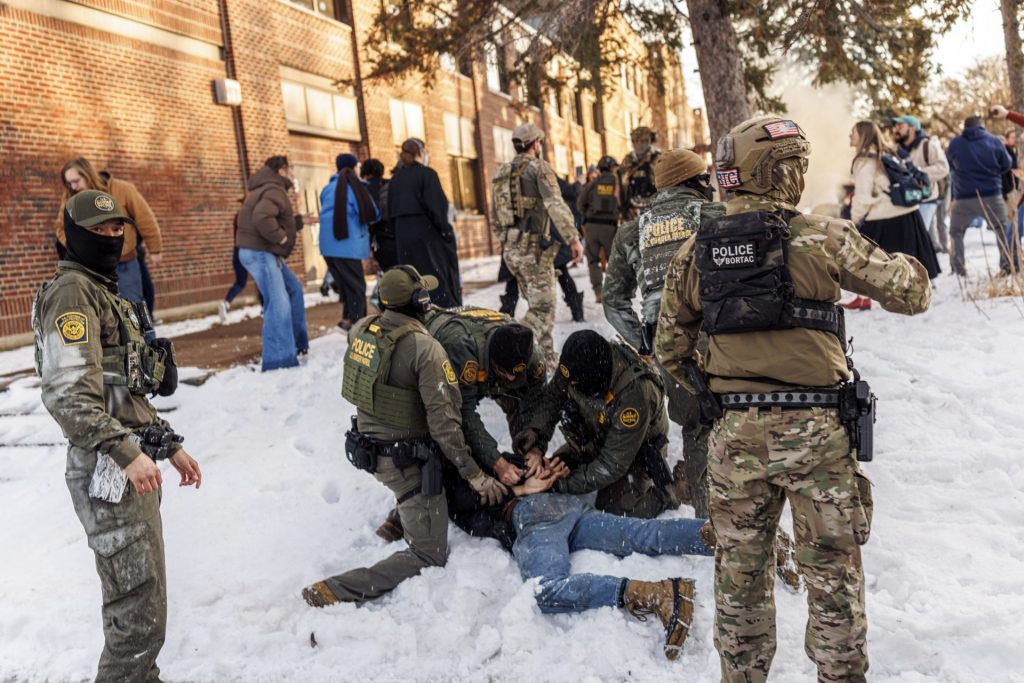
“The other thing that bothered me was when I was doing community observation when I was at an apartment complex. There was a family in a panic and they were driving round in a circle in the parking lot, over and over again. At first I thought they were ICE, they looked so suspicious. But it turns out they were looking for a family member who’d been taken…
“They’re learning a new language, they’re working one or two jobs… they’re doing their best and our government is coming and just taking them and terrorising them for no good reason. They’re not criminals. They’re Americans just like me or they’re working on becoming American just like me. They’re doing things the right way and the government is just ripping them out of our community. It’s so profoundly upsetting.”
But this was what America voted for. I remind Nick of what I saw on the campaign trail, in the convention hall. That if Donald Trump were here now, in this car with us, he’d say, “I told you I was going to do that and people told me that’s what they wanted. I’m fulfilling a pledge.”
And there is no real answer to this. Because it’s true. It may not have been Nick’s vote. Or Minnesota’s vote. Or nearly half of America’s wish. But it was spelled out, in red white and blue. We got the memo.
Outside the car window, it is snowing hard. Nick indicates the freeway and points out a historic site on my right, Fort Snelling. It’s the memorial for the several hundred native Americans from the Dakota tribe who were rounded up and confined to a camp here before being expelled to Nebraska in the winter of 1862. Many died from malnutrition, disease and exposure.
“I strongly believe,” Nick tells me, “we’ll have another monument here commemorating the fact we allowed this to happen. History is a circle.”
We arrive at the airport and begin the slow climb up to level seven, the highest point of elevation for the clearest shot of the tarmac. The temperatures are plummeting and I am nervous that we will be hanging around indefinitely for a flight that may not exist.
It takes a moment – and a metaphorical knuckle wrap – to register the gap between my perceived hardship and the one we’re here to witness. And beneath my 17 thermal layers, I blush.
In the event there is no wait. The anonymous grey Eastern Air Express skims into land, just as Nick predicted. He has set up a telephoto lens – we are still a mile away – and it’s the best chance he will have of making out each separate shackled body.
Arvind, my cameraman, has trained his own lens on Nick and my microphone is tucked into his chest to record his commentary. Tom and Louis – my editor and his deputy – are taking plane footage from a different angle, to marry-up the stills we will get from the long lens.

And then the drill begins in just the way Nick has foretold. The convoy draws up alongside the aircraft. There are long gaps while we wait for the ICE flight agents to clear the plane. The old shackles from a previous flight – heavy Dickensian links of metal are dragged from the cargo hold – as if Magwitch has escaped once again to the marshes.
And then the counting begins. Nick’s eyes rarely leave his lens except to check we are seeing what he sees, understanding what he relays. He calls out the first two or three as they board. It’s slow.
They are being aided up the plane’s stairs by the flight team and from this distance I cannot tell if it’s to hurry them or to stop them falling. Then the counting speeds up. Through the teens. Through the twenties. Thirties.
I hear Nick count to 43. And then immediately retract the last two. “What’s happened?” I call out, alert to his faltering voice. And he describes, with the nearest thing we will come to elation that day, that two people have been removed from the flight. “Perhaps the lawyers did get to a couple on time,” he says.
It is a rare silver lining for a man who has conditioned himself to documenting doom.

Within one hour, the whole procedure is done. The convoy has transferred its chattel. The individual men and women have boarded, many in thin hoodies, hi-vis vests, clothing that cannot weather either a minus 20 degree tarmac wait or the conditions of a Texan detention camp.
The doors are shut. The blunt ending to this exercise comes so swiftly we don’t really know what to do. It feels like we’ve witnessed a funeral, not a flight. A pervading air of stillness and disquiet.
And I have to remind ourselves that we do not know who these deportees are. That among any dark flight that leaves for El Paso, there may be people who have done wrong, harmed others, presented danger to America.
That, at least, was the plan. Yet it’s no longer the reality.
We have seen for ourselves the ordinary communities riven by these purges; children who are returning home from school to find one or other parent gone. Those parents in the car park looking for their builder son. The stall holders in Mercado Central – Minnesotans for the last 40 years – who can’t make ends meet because people are too scared to come out and shop.
“Do you think you will ever see these people back?” I ask Nick, as we are packing up to go. He has his phone out, filing the number he’s just counted in his flight log. The total is now north of 2,000 for the first 20 days of this year.
Nick embodies “Minnesota Nice”, the quality often credited to people here – courteous, reserved. He talks about those removed like they’re house guests he hopes to see next Thanksgiving.
“I sure hope they come back, I hope most of them are able to come back.”
And then his voice cracks. “Who knows. I haven’t thought about that before. It’s too upsetting.”
And for the first time since we’ve met, he falls silent.
Emily Maitlis is a presenter on The News Agents podcast. To donate to Nick Benson’s Dash Cams for Minnesota, please go to https://ottergoose.net/dashcam/