
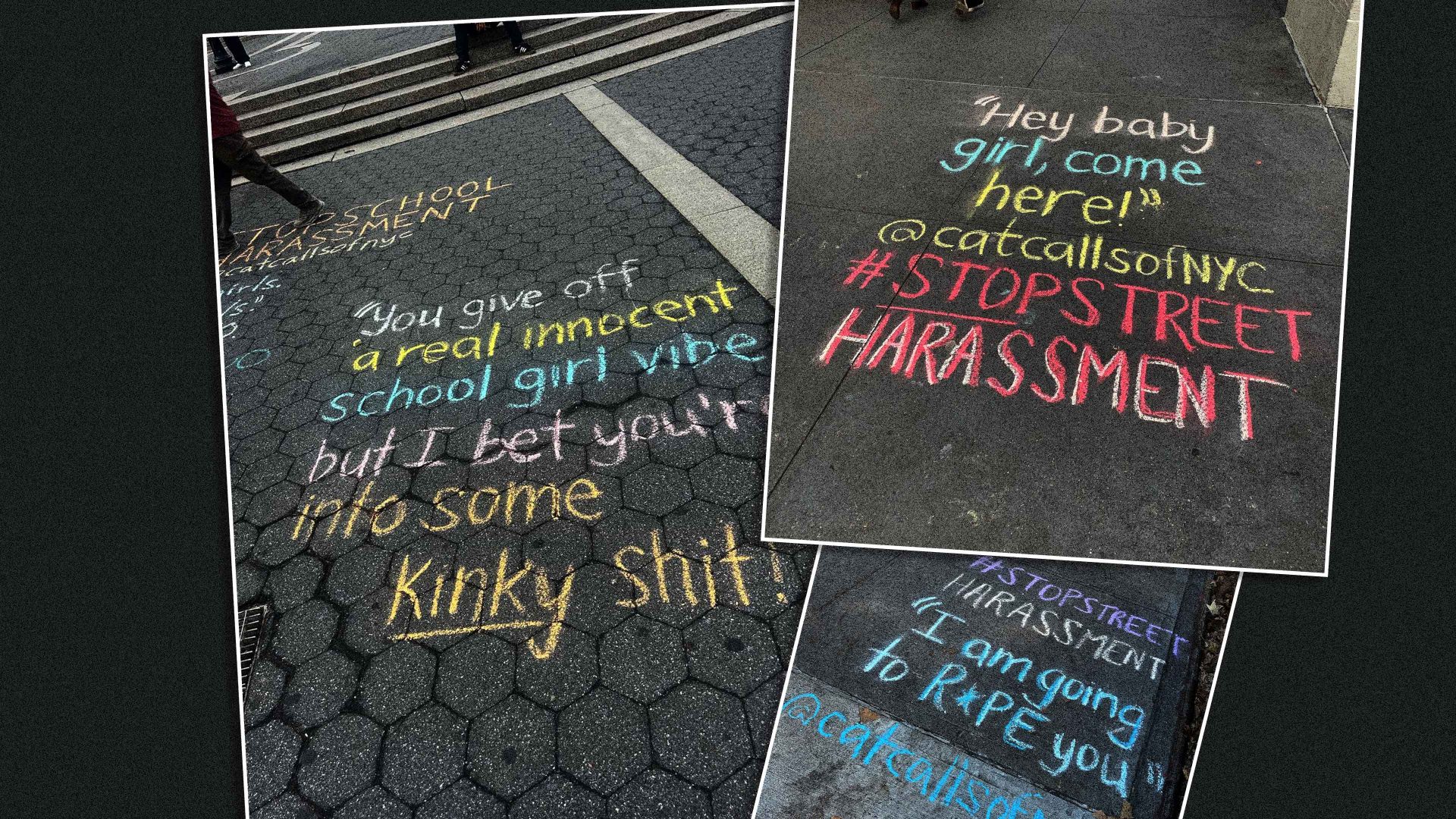
I was 14 when I was first catcalled. It was the summer holidays and I was in Nottingham, visiting a school friend who had moved there a few years earlier.
The whole trip had been full of excitement. I grew up in a hamlet where the nearest shop was a 15 minute drive away, and there was a running joke that the local bus service was a myth. The independence that city life offered for a few days was intoxicating. I almost felt drunk on it.
Then two men harassed us as we were leaving the corner shop one afternoon.
I’d heard them before my brain had registered them. “I’d have a go on you,” one of the men leered, jerking his head towards us as the words left his mouth, as if to signify where his targets were. He turned to his friend, who grinned and offered a nod in agreement, a silent conspiratorial sign of approval. They were easily ten years older than us and, judging by the gossip magazines and chocolates we were carrying, they knew that.
For a split second, I remember, naively, hearing an “at” instead of an “on” (“I’d have a go at you”) and started to wonder what I had done wrong. My friend, my senior in age and street-smarts, was knocked but shook it off. We kept walking but when we got home, I locked myself in the bathroom and scrubbed my face with make-up wipes until it was red raw.
It was one of the first times I had worn make-up, but now the foundation and mascara I’d bought the day before at Superdrug felt nauseatingly heavy on my face. If this was womanhood, I didn’t want it.
But at 14, I was yet to learn that my experience was not unique. In 2021, UN Women UK found that 71% of women had experienced sexual harassment, including catcalling, in a public place. In 2024, a YouGov poll found that 68% of women who had experienced such harassment in South Africa, India, Brazil and the UK did not officially report it to the police, with over half of those women explaining that they believed it would be “pointless”. When I discuss this with Sophie Sandberg, gender justice activist, One Young World ambassador and founder of CatCalls of NYC, a grassroots initiative combating street harassment she remembers a similar feeling.
“It’s funny. I talk about my first experience at 15. But when I look back, it was actually more like 12. I just didn’t understand what it was yet,” Sandberg tells me.
“I had a summer job downtown and I hadn’t navigated New York on my own before. I had a long walk from the subway to my job and every block there was a new catcall,” she adds, recounting how overnight she began to sense this new feeling of being both objectified and sexualised. When she later shared her concerns with her parents, they offered advice that put the onus on her rather than on challenging and changing the men’s behaviour: don’t go out late, cover up more, just ignore it. Sandberg did the opposite.
In 2016, in her first year as a student at NYU, CatCalls of NYC was born out of her sense of frustration and isolation that this behaviour had become normalised. “I just wanted to do something to speak about my experiences,” she says. “Then slowly it just kind of began turning into a bigger thing,” she adds.
Sandberg’s concept was simple yet effective: visit the location where she or her friends had heard the insults and write it down, word for word, on the pavement in coloured chalk. The more Sandberg did, the more passers-by started to pay attention.
Today, individuals send the initiative their stories of harassment and their locations across the city. One of Sandberg’s team will then head to the area, write out the comments with the #stopstreetharassment, and post the images on social media.
Suggested Reading


Separate tube carriages for women are not the answer
Now in its 10th year, the page has amassed a following on Instagram of 150K, has offshoot groups in London, Nigeria and Vienna and has interviewed some of activism’s famous faces, including Malala Yousafzai. It also makes up Chalk Back, a global youth-led movement against gender-based harassment.
“The majority of people who message us are under the age of 18, but we hear from many under the age of 16 or 15. It’s very common for people to share that they’re in a school uniform with their backpack being harassed by a grown adult man,” says Sandberg.
These are just a few submissions CatCalls of NYC has received:
“Are you legal yet? Hell yeah, you are! Run faster!”
“Goddam, she can’t be too young, right?”
“You give off a real innocent schoolgirl vibe, but I bet you’re into some kinky shit.”
Unfortunately, these are far from the most sinister stories Sandberg has heard. She says: “I received a story recently from a woman who was at a pro-Palestine protest in New York. She was harassed by a counter-protester who said to her: ‘I’m going to rape you.’”
At the height of the #MeToo movement, they also received submissions of catcallers telling women they wanted to be their Harvey Weinstein and, in 2023, after a jury found Donald Trump sexually abused writer E Jean Carroll, that if Trump could do it, then so could they.
I joke with Sandberg that in the utopia they’re trying to achieve where street harassment ends, she would be making her own initiative redundant and she laughs, admitting that this is often what success looks like for activism. “We want to see a world without harassment, but in the meantime we want to be able to provide people with tools to fight it. I would also say that the second election of Trump, a lot of folks are feeling discouraged and a lot of people are also feeling censored in their activism.”
Recalling my conversation with Sandberg, I can’t help but think about my journey home a few weeks ago. Leaving my local tube station, a man, drunkenly clutching a can of Fosters and ambling in the opposite direction, clocked me. He presented a smile that churned my stomach.
“Corrrr, I like the look of you,” he slurred, and when I offered no reply, he physically snarled at me before meandering off into the distance.
I altered my route home but arrived unscathed and mostly unbothered. Unlike my 14-year-old self, I have become accustomed to this particular perk of womanhood.
Sophie Sandberg is a gender justice activist, artist, and speaker. She founded Catcalls of NYC and the global youth-led movement Chalk Back, mobilizing over 1,000 activists worldwide. A winner of the PACT! Break the Hate Challenge, her work was recognised globally at the One Young World Summit in Munich with a £5,000 grant to support her work