One autumn evening in 1999, five men stepped out of a taxi on to the stone pavement of Kathmandu Durbar Square. They walked up the worn steps of Kumari Ghar, the residence of Nepal’s living goddess, and began to pry loose a toran, the carved wooden arch that crowns traditional Newari windows.
When bystanders asked what they were doing, the men said the artefact was being taken away for repairs. The caretaker at the temple, Gautam Ratna Shakya, remembers the moment as the slow, audacious stripping of the shrine’s wooden soul.
Over the next few years, more torans disappeared until all six intricately carved windows of the centuries-old temple stood bare.
Power outages at the time made the square an easy hunting ground, and the thefts grew even bolder. At one point, Shakya recalls, a group attempted to remove the temple’s main door. Fortunately a local military unit scared them off.
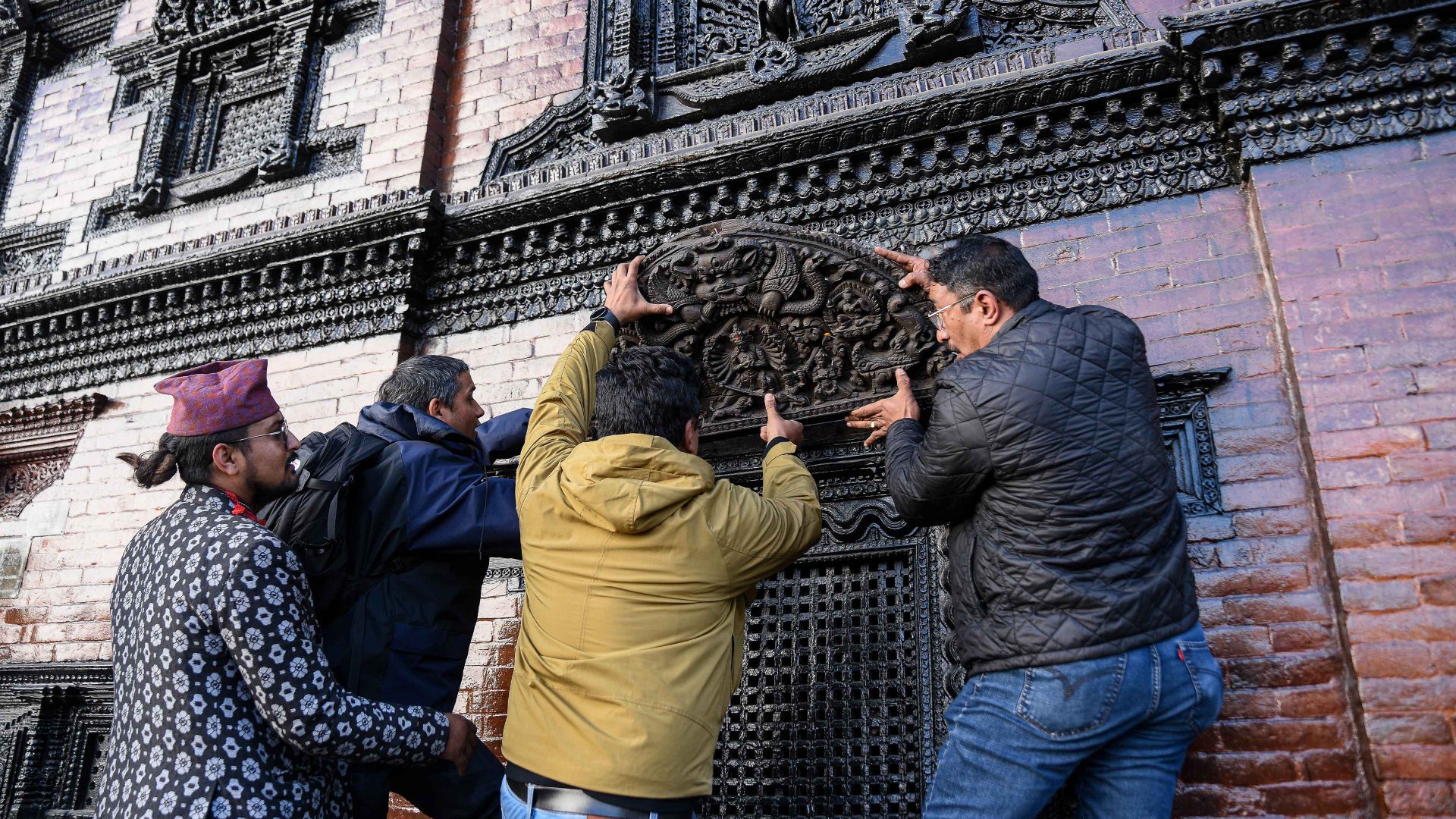
On November 21, 2025, members of the Newar community carried one of the recovered torans through Kathmandu Durbar Square, draped in marigolds and shaded by an umbrella.
The artefact was re-installed at the temple, which was built in 1757, where brick, wood and stone form a living museum of Kathmandu’s past grandeur.
After its theft, the toran had eventually resurfaced at the Barakat Gallery in London, before being repatriated in 2022. It was the outcome of an effort by conservationists and activists who spent years tracking Nepal’s stolen art through auction catalogues, museum collections and private galleries abroad. It’s a slow-moving battle between heritage activists and western institutions, many of which say disputed objects were “donated”.
Around 200 stolen idols and historical artefacts have now been repatriated, according to Roshan Mishra of the Nepal Heritage Recovery Campaign. His group, along with the anonymously run Lost Arts of Nepal, have done the relentless detective work required to bring the centuries-old deities back to their homeland.
The results have been transformative for our heritage. There’s nothing like seeing people celebrating the homecoming of stolen gods and goddesses. A statue of Lakshmi Narayan was returned to Patan in 2021, accompanied by the mass chanting of sacred hymns. The 10th-century stone figure of Uma Maheshwar was similarly retrieved from the Denver Art Museum. Increasingly, Mishra says, western institutions have begun investigating their own collections and returning stolen items.
It’s not all good news. A sacred necklace from Taleju Temple is still in a Chicago museum. Another Uma Maheshwar statue – identified years ago in the British Museum – is awaiting repatriation.
This is part of a broader global reckoning. Cambodia, India, Sri Lanka and several African nations have pushed museums in Europe and North America to return looted sacred objects. For communities like the Newars, these artefacts are not just for display, but are living parts of everyday spiritual and cultural life.
Deepak Adhikari is an investigative journalist based in Kathmandu