“It’s the colour that immediately jumps into your mind when you talk about Van Gogh,” says Edwin Becker, curator of a new exhibition, Yellow. Beyond Van Gogh’s Colour, which has opened at the Van Gogh Museum in Amsterdam. To walk into a gallery of crocus yellow is pure joy after weeks of ceaseless rain and cloud-lidded skies. I feel I need this soak in the sun.
“Everything is concentrated around Van Gogh,” Becker continues. “He is at the centre, like a sun, and from him the rays radiate out to the different chapters of the exhibition.”
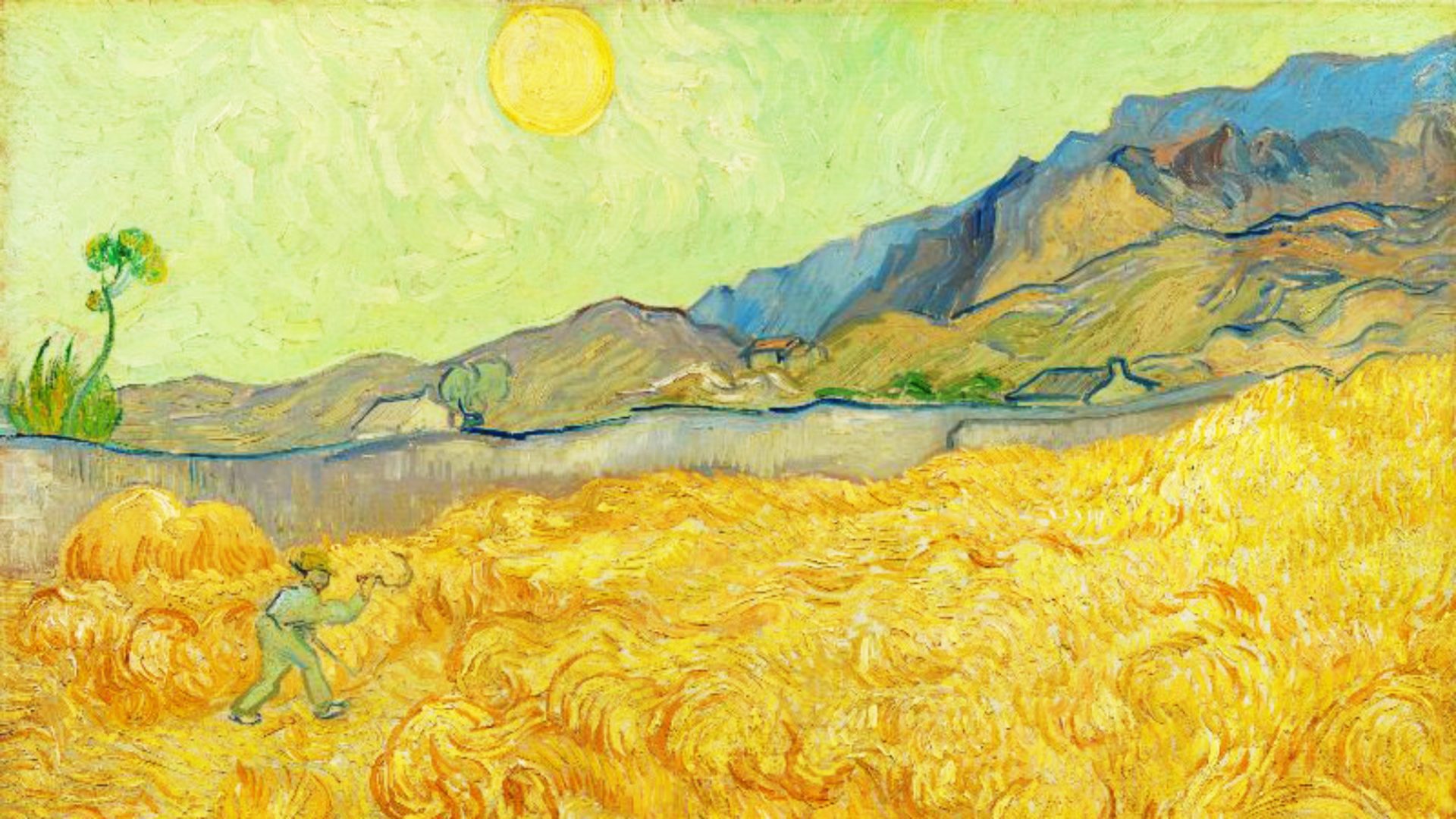
These “chapters” include Van Gogh’s depictions of natural light, as captured in wheatfields ablaze beneath blue skies, set alongside portraits and interiors lit by artificial gaslight. But it is not all Van Gogh. Included throughout are artists of the period. In this first section on light, paintings by Turner, Mondrian, Signac and Chagall are displayed.
The second chapter looks at yellow as a colour of modernity and daring. “It was the colour of the hour, the symbol of the time-spirit,” a journalist proclaimed of the hue at the turn of the 19th century. “It was associated with all that was bizarre and queer in art and life, with all that was outrageously modern.”
Van Gogh’s Piles of French Novels (1887) compete with the greenish-yellow book covers of 19th-century French novels stacked up in a vitrine. In turn, they inspired the publication of The Yellow Book in England, which flaunted its transgressiveness through the provocative cover designs of Aubrey Beardsley.
Advertising posters, a primrose parasol and a soft yellow velvet ballgown from 1895 reveal how new dyes and pigments, and advances in the scientific understanding of light, affected visual culture. Today, airport signage, hi-vis jackets and eye-grabbing branding continue to call on yellow, a colour that reaches out and never recedes.

The final section deals with the subject of the spiritual and divine in the works of Hilma af Klint and Kandinsky, as well as in paintings such as The Raising of Lazarus (after Rembrandt) by Van Gogh. For Theosophists, yellow was the colour of intellect. For Kandinsky, it was the sound of a horn or a trumpet.
For Van Gogh, it was the life-giving force of the sun. “Sunshine, a light which, for want of a better word I can only call yellow – pale sulphur yellow, pale lemon, gold. How beautiful yellow is,” he wrote to his brother Theo from Arles in the south of France.
Van Gogh had followed the sun south, hoping to establish a painting colony, and rented rooms in Place Lamartine, immortalised in The Yellow House (The Street), 1888. It was here that he created his famous sunflower series, of which a later version, Sunflowers (1889), headlines the Amsterdam show.
There are no shadows cast by the petalled heads of these haloed blooms, yet there were shadows aplenty in the 15 months the artist spent in Arles. His sunflowers were intended to decorate the room of his first guest, Paul Gauguin.
In a fever of work, anticipation and excitement, he told Theo: “I am hard at it, painting with the enthusiasm of a Marseillais eating bouillabaisse, which won’t surprise you when you know that what I’m at is the painting of some great sunflowers.” But when Gauguin arrived, the two men did not get on.
At the same time, Theo, on whom he was financially dependent, announced his forthcoming marriage. These worries, combined with Van Gogh’s own physical and mental frailty, led to the painter’s famous breakdown. A year later, on a July day in Auvers-sur-Oise, Van Gogh shot himself, dying two days later. His funeral cortege was steeped in yellow flowers.
Yellow does not always evoke Van Gogh’s nurturing sun. There are shades that convey the opposite: sickness, decaying vegetation, a sense of unease.


American novelist Charlotte Perkins Gilman also suffered from depression, and on learning that she had incurable breast cancer, took her own life in 1935. In 1890, she wrote her short story The Yellow Wallpaper, which has since been made into several films, most recently in 2022; excerpts are shown in the gallery.
A young ailing mother (and frustrated writer) is taken to the countryside to recuperate by her husband, a physician. She is placed in a bedroom with a disturbing yellow patterned wallpaper: “The colour is repellent, almost revolting; a smouldering unclean yellow, strangely faded by the slow-turning sunlight…” she writes. It makes her think of “old foul bad yellow things” and, imagining she sees a woman trapped in its pattern, the yellow wallpaper begins to unhinge her, leading to insanity.
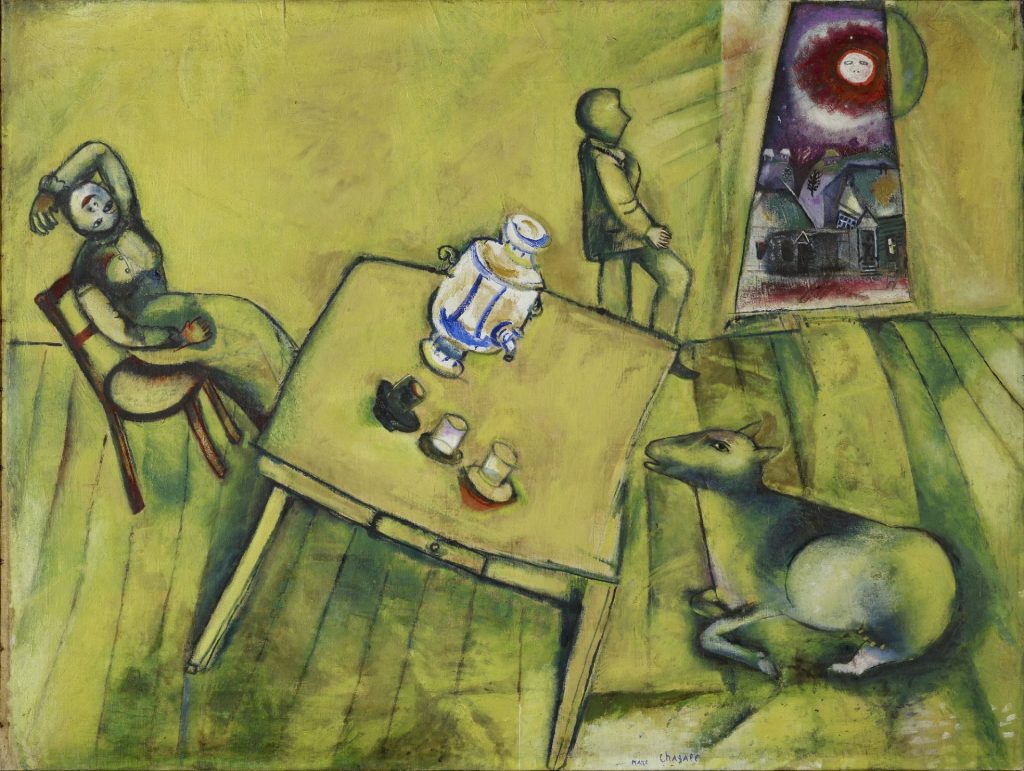
Similarly, the room Marc Chagall painted, called The Yellow Room, is unsettling in its angular perspectives, its upturned table and chair, the topsy-turvy head of the seated woman and the featureless man walking towards an exit in the wall. But it is the green-tinged, sour yellow palette that gives the painting its eerie charge. As a Jewish artist from Belarus, Chagall would have understood the association of the colour with society’s outsiders: Jewish people and prostitutes, and the negative effects of the hue’s stigmatising history.
Suggested Reading
Theresa Hak Kyung Cha: murdered at 31 but revered for ever
There are many delights in this exhibition that broaden out to take in light, sound and scent. Olfactory designers at the Robertet Group have matched the three themed chapters of the show with three different scents. There are musical compositions inspired by the paintings of students at the Conservatory of Amsterdam, and two installations by Olafur Eliasson that play with our perceptions of colour.
However, there were moments when the exhibition felt more like an intellectual curatorial exercise rather than an in-depth imaginative exploration, and I missed the inclusion of night scenes and street lighting, found in works such as Street Light (1909) by the futurist Giacomo Balla, with its splintered yellow outshining the moon, or Camille Pissarro’s The Boulevard Montmartre at Night (1897). These reservations aside, Yellow is a welcome antidote to the season’s blues.
Yellow. Beyond Van Gogh’s Colour is at the Van Gogh Museum, Amsterdam, until May 17