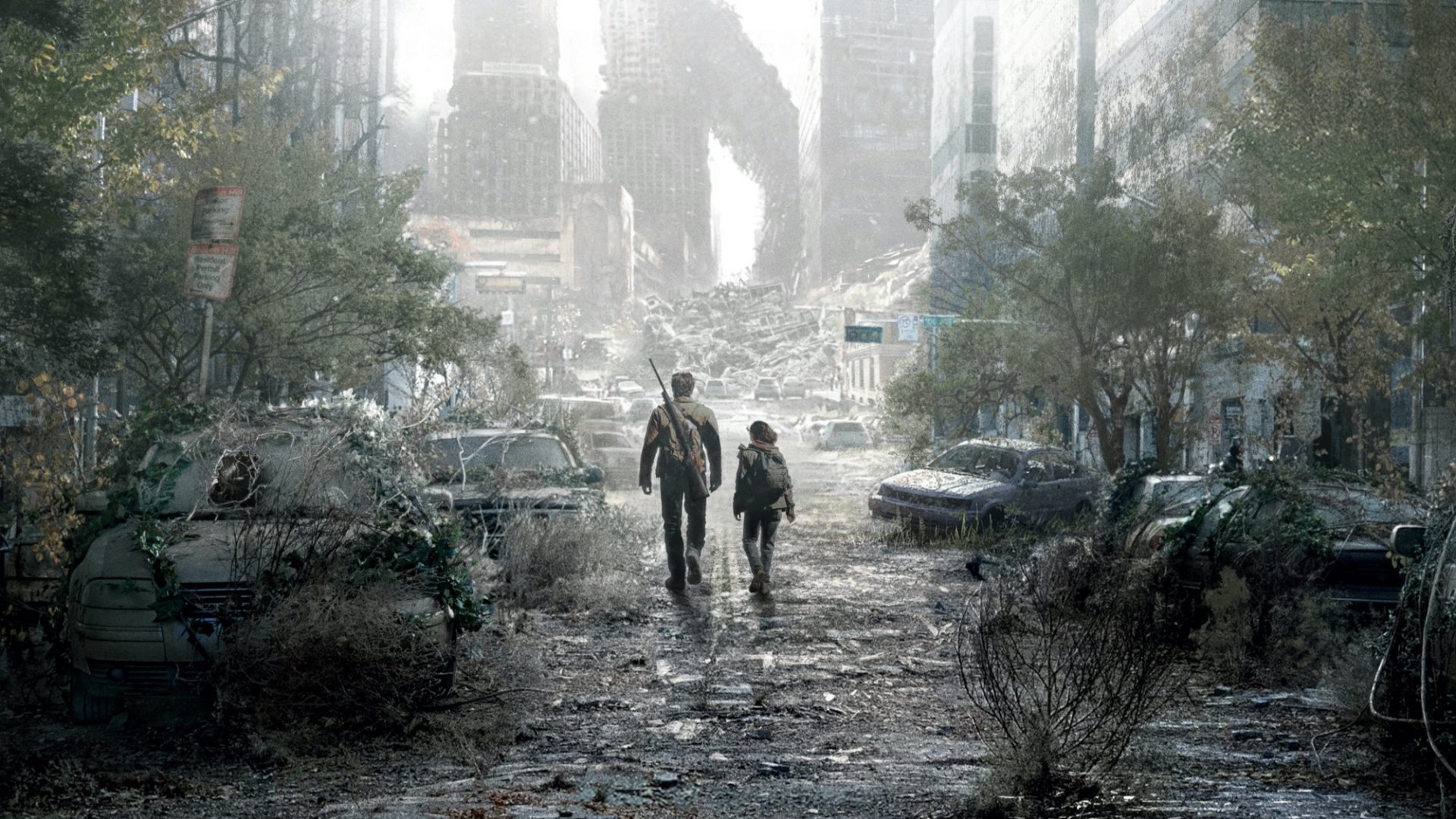
It’s no exaggeration to say that there are a lot of TV shows and films set after one kind of apocalypse or another. Currently available on your end-times screening services are: Fallout, The Walking Dead, 28 Days Later, Station Eleven, Pluribus, Silo, The Last of Us, 28 Weeks Later, The Walking Dead: World Beyond, The Leftovers, Mad Max: Furiosa, See, A Quiet Place, Fear the Walking Dead and 28 Years Later, to name but a few.
For some reason, the viewing public (and therefore the whole human race) is currently obsessed with the end of the world. Turn on your TV or your tablet and as far as the eye can see, everyone is pushing a trolley through a post-nuclear wasteland, running away from zombies, living underground in bunkers, or just staring moodily at the ruins of Los Angeles while stroking a dog.
The fictive apocalypse is nothing new, of course: it’s in the Bible, for a start, and it turns up throughout human history as part of religion and/or art – although it’s only when it loses its religious connotations and becomes a more science-based end of the world that it really takes off as a genre.
In fact, once you have science fiction, you have the end of the world, whether it’s HG Wells’s Martians laying waste to the Home Counties, John Wyndham’s Triffids destroying a world full of blind people, or George A Romero’s zombies destroying the world one mall at a time.
A slight diversion: what is it with zombies? When did they stop being comedy stiffs who ate people’s legs and said “BRAAAIIINNZZZ!” a lot? Why are they in so many films and TV shows? Is it because of video games, which require an endless host of semi-cannon fodder? Are they disease incarnate or just scary? And why can’t it be Frankensteins? Or golems?
It’s easy to label this fascination with the post-end-times world as “apocalypse porn” so I will: people aren’t watching this stuff – all the death and the misery and the sheer grinding, slow hell of it – because they don’t like it. They love it. Voyeurs of utter destruction, to quote David Bowie (author of Diamond Dogs, a uniquely canine take on the work of JG Ballard). And there are, I think, several reasons for this.
One is circular: movies and TV shows are often based on video games, and video games love a bleak, post-nuclear, Terminator-style world, because they feed off movies and TV shows. And one is purely masochistic: we love to see the end of the world and its best friend, the obliteration of the human race, because we think we deserve it.
We deserve it because we invented war. We deserve it because, having invented war, we invented world war, and then we invented nuclear war. We deserve it because we ignored climate change and so we deserve to be wiped out by global warming. We have been bad, as a race, and we have been naughty, so we deserve an apocalyptic slap on the wrist.
Suggested Reading

Morrissey returns.. and heaven knows he’s mythical now
Dorian Lynskey is the author of Everything Must Go: The Stories We Tell About the End of the World, a brilliant catalogue of almost every single book, film, TV show or work of art about the end times. Lynskey’s analysis is epic, very readable and superbly detailed: and fortunately for me, he agrees with my argument.
“That sense of ‘we deserve this’ began with the atomic bomb in 1945 and has grown – not just stories of nuclear war and climate catastrophe, but even pandemics and zombies are likely to have a human origin now,” says Lynskey. “These stories are always a great way to critique civilisation, but that can tip into misanthropy. Elon Musk’s desire to leave Earth behind, the more extreme environmentalists who like to imagine a world without people.
“I think what drives all of those longings is a combination of what you say: people are terrible, and life is too complicated. An apocalyptic or post-apocalyptic scenario solves both of those problems.”
We look at the world we have destroyed and we realise there’s nothing we can do about it, and it’s our fault. In the old days, we could have just blamed a different tribe, or another nation, or dinosaurs, but now it’s pretty much all of us. So we sit down and we watch the world burn, and it’s good.
The other reason, in my view, is it’s all the fault of knowledge.
Knowledge used to be something we could handle. Most of us, once upon a time, could understand how things worked: we could take the back off a watch or open the bonnet of a car and, even if we couldn’t fix it, we could see how it worked. This knowledge and its acquisition were so common that children’s comics contained cutaway drawings of ships and aircraft. And knowing stuff meant we could debunk lies and ignorance: having proved the world was round, we could tackle the flat-earthers.
Now? I don’t know how my phone works, or my car. I barely understand my shoes. We have reached a point where for most of us, science and technology might as well be magic.
And the repercussions of this are everywhere: anti-vaxxers, flat-earthers, people who think ChatGPT is in love with them. We are, as has often been pointed out, living in the 2006 Mike Judge movie Idiocracy, where in the future everyone is stupid 24 hours a day.
(Last week I read Tom Stoppard’s Arcadia again, a play that deals explicitly with science and knowledge, and I was struck by these lines: “The whole Romantic sham… It’s what happened to the Enlightenment, isn’t it? A century of intellectual rigour turned in on itself… The decline from thinking to feeling, you see.” Beside these lines, historians could put an arrow and the words YOU ARE HERE).
I believe that the result of this new ignorance, this panic in the face of a science that only experts understand, is a desire to go back to a simpler time, a time when you could comprehend the world, when science was horses pulling carts and men carrying rifles: a sort of Wild West with radioactive ruins (a lot of these post-apocalyptic shows and movies feature small, homely communities given over to farming and the simple life: it’s as though the world ends not with a bang, but with the Amish.) We want to get back to the garden even if it is a broken garden. We can’t fix what we have, so we dream of what’s coming to us.
Dorian Lynskey agrees: “The uncontrollable complexity of technology enhances the age-old suspicion that the world is an insoluble mess and it is easier to imagine destroying it than fixing it – a great cleansing sweep.”
The revolution may not be televised, but the Apocalypse already has been.
David Quantick is the Emmy-winning scriptwriter of Veep. His books include Revolution: The Making of the Beatles’ White Album and Quantick’s Quite Difficult Quiz Book