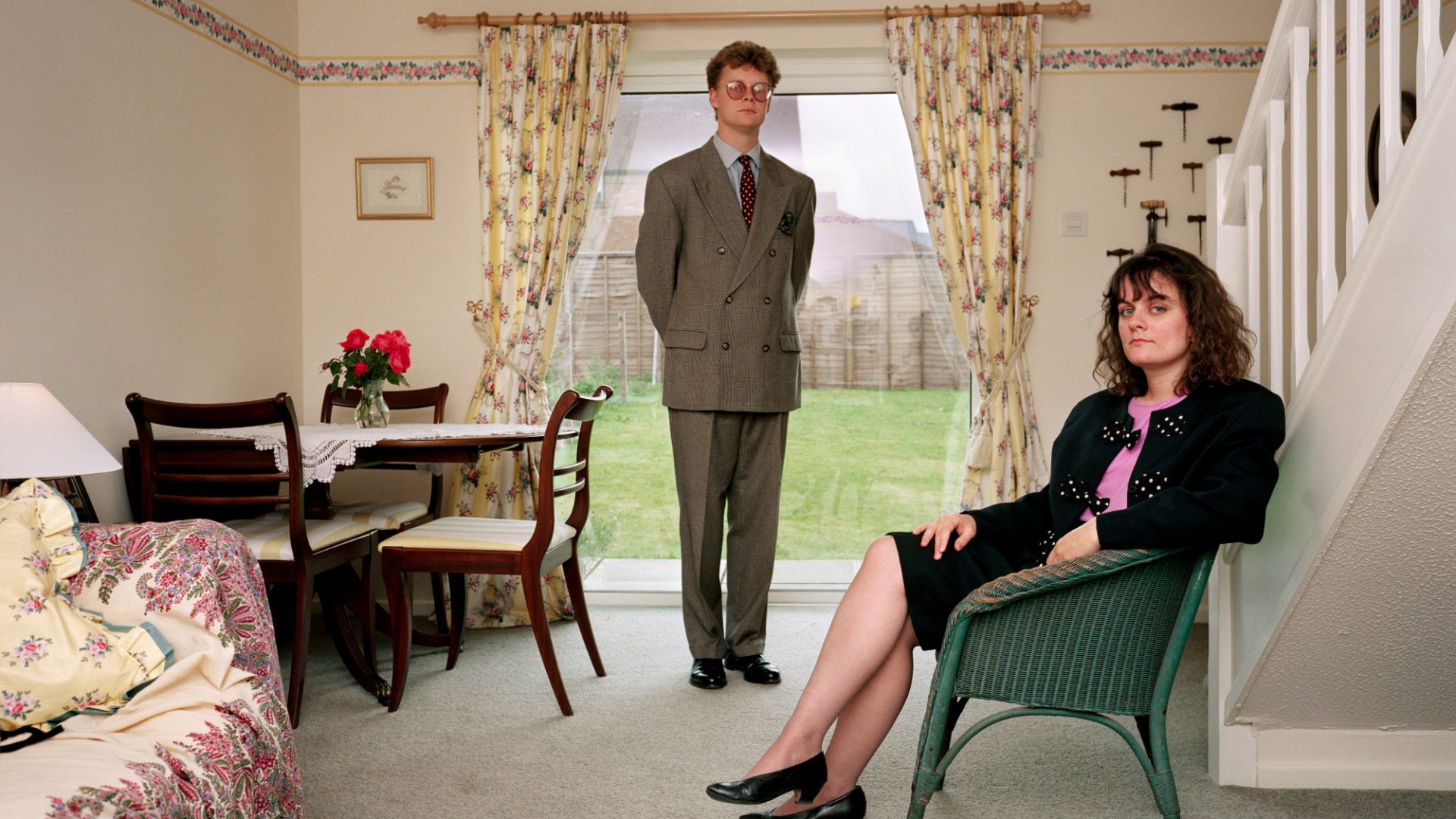
The 1992 BBC series Signs of the Times is one of those documentaries that elicits favourites. The contributors I’m most fond of, and related most deeply to, are Norman and Jean Kerr, an elderly Scottish couple who despise everything featured in their home.
The Kennedy assassination carpet, taste-wise, edges towards a war crime, looking like paella thrown up in space. The Kerrs attempt to offset this abomination by adding more and more elements into the room, coffee tables in particular (they have many) hoping to provide some sort of distraction. But every new item just seems to make things worse.
“We don’t invite people into the house because other houses are much nicer,” Norman says, sounding remarkably like dour Scots poet Ivor Cutler. “We go out for walks at night because it’s not nice to sit in here for any length of time.”
This is people talking about their own house. Though, from the body language and the way they interact with each other, there is obviously much more going on with the Kerrs. They are just one of around 50 couples or individuals featured on Signs of the Times, a groundbreaking series that attempted to delve into contemporary British tastes by interviewing homeowners in their surroundings.
Given extra poignancy by the death last year of photographer Martin Parr, who was part of the team that made the show, it’s a remarkable document, that feels both achingly familiar and completely alien. This was a time before smartphones, reality TV and social media, where the contents of people’s homes could only be witnessed first-hand or in blurry snaps. For this reason, the show was a revelation, peering at the British in a way not seen before.
“It was a watershed moment when it hit the screens in the early 90s,” Nicholas Barker, who devised and directed the show, tells me. “The BBC didn’t know whether to sack me or give me a promotion.”
The look and feel of the series felt revolutionary. Long slow pans displaying holiday souvenirs, inexplicable ornaments, carriage clocks and candlesticks. The stockpiled detritus of life. Then the participants, interviewed on their sofas, interspersed with frozen tableaus, showing them stock-still and staring at the camera as if they are being held against their will.
“We’d had a very sort of slow, static vocabulary, which people found strange,” Barker explains. “And the films actively encouraged viewers at home to judge other people, to exercise their prejudices, their preferences. But the aim of each film was to impale the viewers on their prejudices, because at some point they would see somebody like themselves, somebody with their own tastes.”
Watching the show, one question that immediately springs to mind is “why anyone would want to be exposed in this way?” Lucy Blakstad is an Emmy and Bafta-winning director who was series designer on Signs of the Times. She was tasked with finding and interviewing many of the contributors in a variety of different dwellings, dotted around the country.
“What hadn’t been done before, is that the minutiae of people’s lives could reveal so much about Britain and people and attitudes,” she explained to me. “I used to drive around Essex and other areas where I knew there were sort of flashy houses. I’d stop outside ones that had added pillars. I’d jump out, put a leaflet through the door or ring the doorbell.”
Participants were also sought out via radio ads, Ceefax and local newspapers. 2,000 were interviewed before being whittled down to the 50 seen on screen. The whole process took a number of years. “I think we chose the houses on the politics of what was going on inside their heads, the storytelling of what was happening,” Lucy says.
Each edition of the series focused on a different set of circumstances. People who felt they had singular taste, couples with violently opposed tastes, those with a vintage aesthetic, daughters who hated their mother’s taste and, memorably, people who chose to live alone (including a man with cardboard curtains who seems to subsist entirely on champagne).
These were completely ordinary people, your neighbours or work colleagues, who all displayed completely extraordinary tendencies. So many lines and quotes from the show feel like they could have been penned by Alan Bennett or Victoria Wood.
Suggested Reading
In an AI age, how can you tell if fiction is human?
It’s often very funny and, like the work of Parr, it was criticised at the time for looking down or mocking those featured. But as Lucy explains, the meticulous nature of the project and the research undertaken, tried to avoid this.
“Nick was very clear with the contributors, just how they fitted in. This is the portrait we are planning on painting of you. And that was nice for us, because it’s difficult territory. You don’t want anybody being laughed at. There were no complaints from any of the contributors, as far as I’m aware.”
“My great kindred spirit was Martin Parr,” Nicholas Barker says. “Martin, like me, was really interested in the middle classes. The great middle classes have not been considered sufficiently exotic enough to warrant camera inquiry. I was really interested in what was going on with the bulk of the population.”
One of the more memorable Signs of the Times interviewees was architect Henry Harrison. Among the chintz and ruffles of many of the houses seen on the show, Henry presented a minimalist drive, abhorring clutter in the sleek west London home he built himself, much to the chagrin of his long-suffering wife Helen, who desperately wanted a splash of Laura Ashley around the place.
“One day the doorbell rang and there was this young lady from the BBC,” Henry explains to me. “She said the house was very intriguing. We had this long chat and one of the things she picked up was that my wife didn’t like the house. And she said this to the researcher. She hadn’t said this to me, by the way.”
Henry’s forthright feelings about interior design, and his wife’s obvious resentment, made him the poster child for the series. Literally. To advertise the show and the accompanying book, an image of Henry’s home, taken by Parr, was used.
“It was in every tube station. And I’ve got one in my flat now and it looks incredible to this day,” he says.
But the reaction to Henry’s appearance, once the reviews came in, was… mixed to say the least. “After it was televised for the first time,” he recalls, “all the television writers were saying, ‘that architect, that Nazi’. They used horrible phrases to describe me. ‘He’s the most unpopular man since Dr Crippen.’
“I was looking at these things saying, what the hell is that about? Well, luckily, I just don’t care. I’ve got a good sense of humour and any publicity is good publicity.”
Henry went on to have quite a surprising career after Signs of the Times. Struggling after the housing crisis, he pivoted to rock’n’roll. Alongside his son Blaine (who features, as an infant, shooting his dad with a biro in Parr’s Signs of the Times book) he formed the acclaimed band Mystery Jets.
“We started writing our own songs when he was about eight years old, very young. And playing in local bars and stuff. The band has done really well. We’re just doing our seventh album.”
Despite the criticism aimed at him, Henry has fond memories of the show. “You absolutely could not do it now,” Henry says of the series. “It was kind of a little revolution at the time. And it was a great work of art and of social history.”
Without knowing it, the series perfectly documented a radical moment of change in British society. Some of the decor looks ripped from the 1950s. Others are imprinted with the first vestiges of the aspirational personal expression that would dominate the rest of the decade.
Soon to come were Changing Rooms, Grand Designs, Location, Location, Location, Ikea, Wallpaper* and smartphones, swiftly followed by the rise of social media and “curated-post-envy”. Displaying a strange synchronicity, the current, hot interior design trend on TikTok is #90sdesign.
We all see into each other’s lives now, all the time. We look and judge and leave. Signs of the Times is a strange portal to our past selves, surrounded by Artex and flock wallpaper and dancing Coke cans. It’s a more innocent Britain that’s left us. And it’s so much fun to revisit.
As Nicholas Barker explains: “I was interested in finding comedy and finding truth in very small domestic details. I was interested in whether there was a story about mug trees. Nobody had ever heard a conversation about a mug tree on British television before.”
Signs of the Times is available on BBC iPlayer now.
Dale Shaw is a TV and radio writer, journalist, musician and author of books including Painfully British Haikus