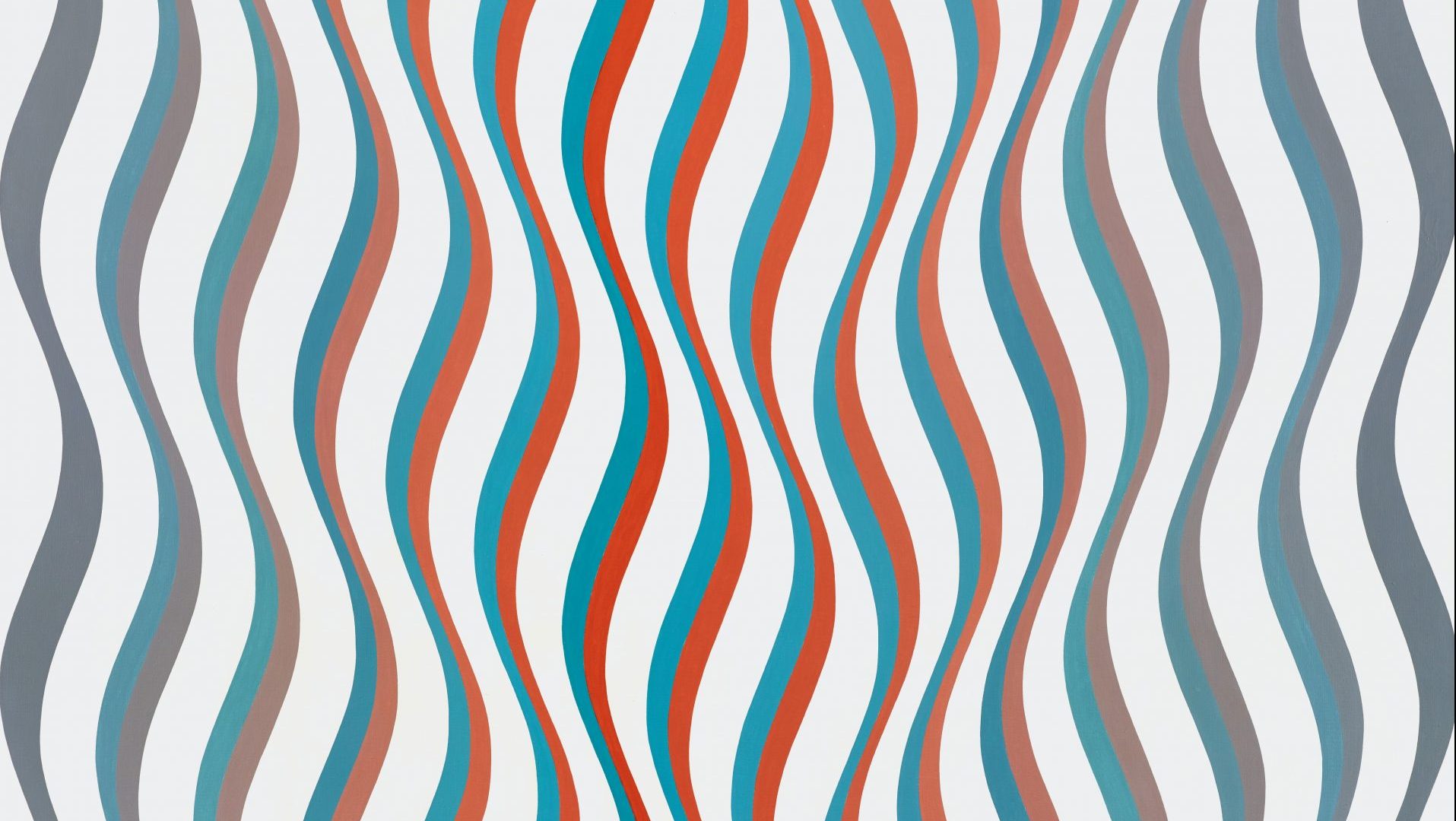
You have to feel a certain pang of sympathy for any artist attempting to exhibit on the upper floors of Turner Contemporary.
Before you reach the galleries, patrons pass by the magnificent Sunley Gallery windows, probably the best vantage point in Margate to view the bleak majesty of the North Sea. On the day of my visit, it was really putting on a show; broiling, spitting, quaking and soaking the hardy passers-by on the coastal path. It’s like being on the prow of a ship or stuck in a lighthouse somewhere, drawn to standing and watching the changing tides for hours, mesmerised. JMW Turner would have loved it.
There are few artists who can compete with that. But Bridget Riley is one.
Turn from the windows and Riley’s Bolt of Colour (2017) confronts you, the first piece in her new exhibition Learning to See. While the real horizon is lost among the spluttering waves, the work offers a cool, calm and collected set of alternative horizons, thin bands brandished in blues, reds, whites and yellows. On a different day, with the North Sea serene, this wall painting could appear fiery and provocative. This is why it’s necessary to return to Riley’s work again and again. It all seems so simple on the surface, but dig down a little and the reality gets far more complicated.
Riley herself returns to her own work to the point of obsession. Old ideas are re-explored, old thoughts rearranged. Another piece in the exhibition, entitled Final Study for Burn, dates from 1964. It sits next to a 2025 piece called Current: Dark Colours 7. Both feature similar shapes and forms, as if the work from 60 years ago still had some distance to travel. But despite this insistence on exploration, Riley never feels like an artist trapped in the past or stuck in a loop. It’s more like there’s a knotty problem to solve, a problem of her own devising, and she will keep returning and reworking until a solution is found.
She constantly probes and picks apart, focusing on certain shapes and colours, then moving away before reassessing. This new major exhibition at the Turner is devised to highlight these returns to forms. Rather than take a chronological approach, motifs such as curves, stripes, triangles and dots, from every era of her career, are displayed together, revealing the evolution of her ideas.
Riley visited the Turner’s galleries when they were empty, falling in love with the huge open rooms, the light and proximity to the sea. Utilising the space, the paintings are given room to breathe and sing. Riley’s work can soothe or completely bamboozle in quick succession and feels overwhelming if you’re suddenly confronted with a crowded wall of her eye-popping paintings. The exhibition features 26 artworks: drawings, paintings and wall art, presented in a way that doesn’t feel congested, providing stark, dramatic counterpoints.
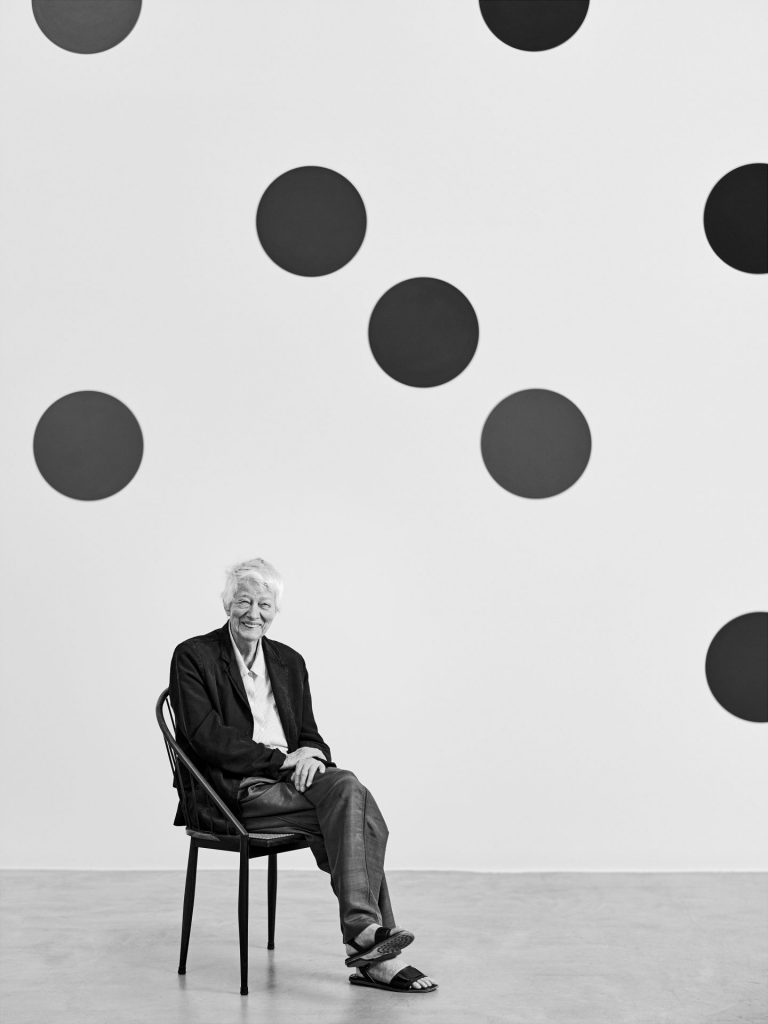
“The galleries have offered her a unique opportunity to show some of her largest canvases alongside wall paintings,” Melissa Blanchflower, the show’s curator, tells me. “I’m looking forward to people experiencing the scale of the wall painting Dancing to the Music of Time in the final gallery. This constellation of large discs painted directly on to a wall is both monumental and light.”
Suggested Reading

Nigerian art against the empire
It is breathtaking when you first encounter Dancing to the Music of Time in the vast North Gallery. On the day of my visit, the windows above the work revealed a perfect blue sky and gulls wheeling and spinning above it, which felt like the perfect accompaniment, echoing the Poussin painting that the piece references.
It reminds you that, despite the seemingly static vision of dots and swirls that dominate her work, in essence Riley has always been a landscape painter, both geographic and human. She describes seeing layers of seaweed and anemones in a Cornish rockpool as a child, the mingling of the colours imprinting on her brain, and influencing her later work.
As Melissa explains, “The constantly shifting light and patterns on the sea’s surface, as well as the natural landscape, inspired her interest in perception.”
Her painting has been an attempt to produce this same “rockpool” feeling in her audience. Surprise and seduce them with the apparently mundane. Like her hero Seurat, who created whole worlds from tiny specks of colour, Riley focuses on the specks themselves, not building worlds from them but turning them into their own miniature universes. She wants to know how they can be viewed, how they can affect us. How we can reject the initial image that appears before us and actually learn to see.
French painter Eugène Boudin implored his young protege Claude Monet to escape the safety of the studio and get out into nature and paint there. “I want you to see the light,” he told him. Monet took his advice, joined Boudin on the Normandy coast and began to paint the shoreline and the huge skies. Monet later described the experience as a curtain opening in front of his eyes. Suddenly, he understood painting. Years later, Monet thanked Boudin, writing: “I have never forgotten that you were the first who taught me to see and to comprehend.”
Now in her 95th year, Riley’s career can also be seen as an exercise in learning to see. “The eye can travel over the surface in a way parallel to the way it moves over nature,” Riley wrote of her own work. “One moment there will be nothing to look at and the next the canvas seems to refill…”
It pays to revisit her exhibition at Turner Contemporary as often as possible. To look again and reimagine. To approach in different light, different angles, different moods. Her work keeps giving, keeps changing, always providing alternatives.
This is why, as an artist, she is so very special and why it’s always a privilege to witness her work.
Bridget Riley: Learning to See is at Turner Contemporary, Margate, until May 4, 2026
Dale Shaw is a TV and radio comedy writer and produces the You’re Booked podcast