

Peter Trudgill
28 January 2026
When asylum meant safe from violence

How a Greek word for sanctuary became one of the most contested terms in modern English
Read the full article21 January 2026
Don’t mistake a rook for a rookie

Despite its strong association with US sport and policing, the term ‘rookie’ has a complicated history
Read the full article14 January 2026
A language you didn’t know you spoke

Some familiar words we use in everyday English carry surprising traces of Malay, a language spoken widely across south-east Asia
Read the full article07 January 2026
Seven degrees of separation: The curious origins of musical pitch

How biology, physics and geography came to define the structure and range of the human voice
Read the full article31 December 2025
A multilingual hospital with the accent on care

How perfect can crucial communications be within a hospital with a plethora of languages, dialects and communicative styles?
Read the full article17 December 2025
The lost voices of 15th-century Norfolk speak again

A set of documents provides a unique window into earlier forms of the English language
Read the full article10 December 2025
The linguistic logic behind dropped syllables

What triggers haplology – why do speakers omit whole syllables?
Read the full article03 December 2025
The hidden Swedish voices of the Baltic

Small communities across Finland, Estonia and even Ukraine keep the Swedish language alive in unexpected corners of Europe
Read the full article26 November 2025
My relationship to my flesh and blood

An examination of other languages from around the world shows us that ownership can be signalled in rather more complicated ways
Read the full article19 November 2025
Weybourne Hope, the guardian of England

The village is said to be the only place along the English east coast where an enemy navy could approach within a few hundred yards
Read the full article12 November 2025
The myth of England’s monocultural past
The idea England ever spoke no languages other than English is a fantasy with no foundation in reality
Read the full article05 November 2025
The joy of nominative determinism

Can an alignment of names and occupations ever have involved more than just simple coincidence?
Read the full article22 October 2025
The many roles of hard-working morphemes

Morphemes are the building blocks essential for the composition of words
Read the full article15 October 2025
A French connection in the American midwest

How 17th-century French pronunciation was taken across the Atlantic Ocean from northern and western France to North America
Read the full article08 October 2025
The wright way to signify your trade

Where does the common name Wright come from? The answer has its roots in work
Read the full article01 October 2025
When learning languages becomes a stress test

Our English orthography gives no assistance at all to help readers tell where the emphasis should be placed
Read the full article24 September 2025
Why tennis still speaks medieval French

The sport’s familiar – but often baffling – terminology has its origins in Anglo-Norman instructions, Old French numbers and Arabic palms
Read the full article17 September 2025
The perils of diplomacy in a second language

How many native English speakers would be entirely comfortable conducting a press conference in some language other than their own?
Read the full article10 September 2025
Who knew algorithms had been around so long?

The word algorithm would appear at first sight to come into the same Arabic-loan category as algebra, and it does indeed have an origin in the Arabic language
Read the full article03 September 2025
A generous interpretation of an ancient practice

The one French word my Mum knew was largesse, which can be translated into English as “generosity”. But why did she, and other country children of her generation?
Read the full article27 August 2025
The Gaelic roots of a French football star

Sandy Baltimore’s name has surprising links to Gaelic-speaking Ireland, colonial plantations and Caribbean migrations
Read the full article13 August 2025
Guadalcanal, the Spanish village that became a Pacific battlefield

The etymology of the name of the Spanish village, and thus of the island, is of considerable linguistic interest
Read the full article06 August 2025
Why does English have Tchaikovsky off to a tee?
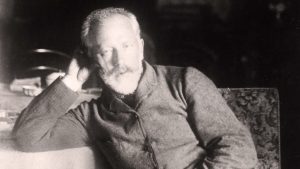
We usually transliterate the composer's name so as to have it beginning with the letter T. But why?
Read the full article30 July 2025
We’ve been living in a fantasy world for centuries
The meanings of fancy and fantasy have diverged rather considerably over the centuries, just as the spellings have also changed
Read the full article23 July 2025
Becoming vexed by vanishing vocabulary

Spelling pronunciations in general are steadily becoming part of our linguistic landscape
Read the full article16 July 2025
The long forgotten words that live on undercover

Though the word ‘swain’ may itself be obsolete in English today, there are still traces of it hanging around in our modern English language
Read the full article09 July 2025
Are Reform UK ‘dumb’ or just plain stupid?

The party’s ex-chair used the word ‘dumb’ to describe a colleague’s comments. But the word is usually employed in Britain to mean ‘unable to speak’
Read the full article02 July 2025
Ange Postecoglou: a moving family history

The Australian football manager's name tells of his family’s history of relocating
Read the full article25 June 2025
Claret: clearly not French

Claret really is an English word, not French. The best French translation of English claret is probably vin rouge de Bordeaux.
Read the full article18 June 2025
When deft turned daft: the mysteries of semantic shift

How can it be that if we go far enough back in the history of the English language, these two words were originally one and the same word?
Read the full article11 June 2025
A weak and feeble woman

Why did Queen Elizabeth I, in her famous speech at Tilbury in 1588, use two words with almost identical meanings to describe herself?
Read the full article05 June 2025
When the Great Heathen Army came to Norfolk

A large Scandinavian Viking army landed on the East Anglian coast in 865, giving places names which remain to this day
Read the full article