
In Florence, at the San Marco Museum, a talking camel is seen advising on a burial. Camels that can speak have a walk-on part in several religions and cultures, loftily putting humans right with surprising wisdom.
In this case, the ribbon of speech that unfurls from the creature’s curling lip advises that Saints Cosmas and Damian should be laid to rest together, not apart. The twins were physicians born in modern-day Turkey who converted to Christianity and are now the joint patron saints of doctors. Damian went against their code, and accepted payment for healing a young woman, so when the pair were martyred, it was believed they should not be reunited in death. Luckily, a passing camel knew better.
The tale seems ridiculous today, but for one powerful Florentine, it carried huge resonance. The mighty Cosimo de Medici identified with his namesake, patron Saint Cosmas, and saw in his own money-lender brother, Lorenzo, an analogue of Saint Damian. The devout Cosimo’s solution to unease about the family’s huge personal wealth was to plough huge amounts of money into the Dominican convent of San Marco, where he even had a double cell for his own use.
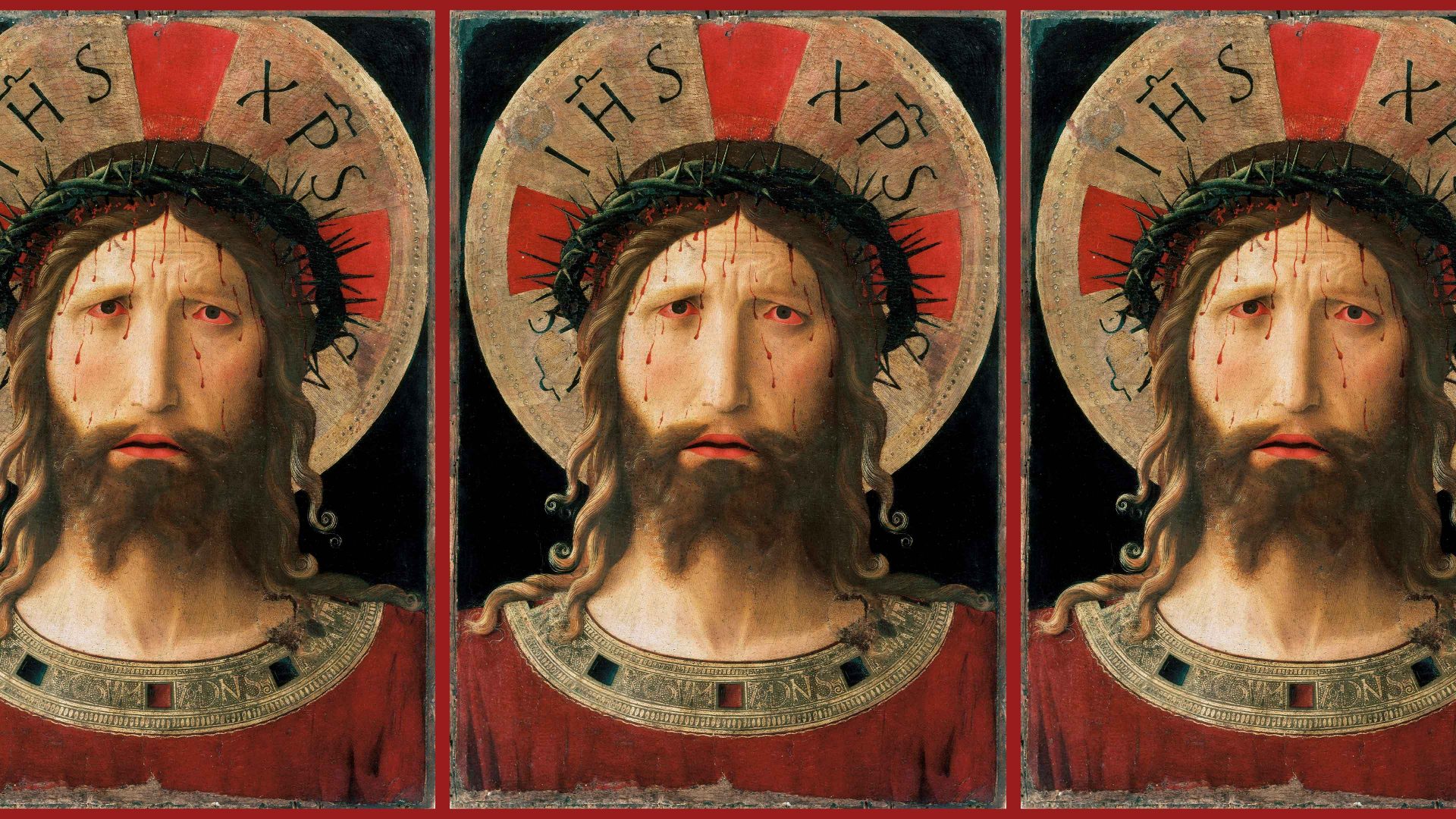
The result was not only what is considered to be the first public library, but also art on an unprecedented scale. Most of it was created by the friar and artist who we know today as Fra Angelico.
Born Guido di Pietro in around 1395, such was the impact of his devotional art that contemporaries and admirers, including Vasari, dubbed him “Angelico”, and he was beatified by Pope John Paul II in 1982. He led life on two levels – fundamentally as a friar who observed the ascetic life of his order, but also as a highly sought-after artist with a fleet of distinguished assistants, access to precious materials and a summons to the gilded halls of the Vatican.
The talking camel appears in the predella – the narrative strips of scenes below the main image – of the San Marco altarpiece. The altarpiece itself references history and geography as well as theology. Surrounding the Madonna and Child enthroned are saints including Dominic and Francis, who espoused poverty, and Cosmas and Damian as ciphers for the wealthy Medici brothers. At the foot of a throne is a priceless carpet imported from Persia, depicting stylised animals facing each other in pairs.
Suggested Reading

Nigerian art against the empire
The altarpiece is currently not in San Marco, but on loan to the Palazzo Strozzi as part of a two-site exhibition dedicated to Fra Angelico. A rare 14th-century rug similar to that depicted in the altarpiece, on loan from the Metropolitan Museum of Art in New York, illustrates the sophistication of design and outstanding craftsmanship of such objects. It is impossible to overestimate the value of international trade to the Medici and their city, the exchange of goods bringing not only great wealth and prestige, but also inspirational artistic influences.
The figures painted in the 42 cells of the order, for contemplation, inspiration and admiration, can still be viewed up close nearly 600 years on. For centuries, only the friars and a very few visitors saw these little masterpieces. They were more or less unknown outside until the 19th century.
Nonetheless, intellectuals knew of them, and references appeared in the writings of the art historians John Ruskin and Jacob Burckhardt, while artists who journeyed to see what they could included Manet and Degas. Impressively, in a city already custodian of so much art, San Marco was opened to the public as a museum in 1869.
Visitors today, climbing to the three corridors of cells, are greeted by a frescoed Annunciation of great beauty. It is painted in characteristically warm, pastel colours – Angelico has a gift for making pink, in particular, both sweet and impactful – and when the visitors peer in it glitters, as tiny particles of minerals catch the light. Light is an important factor in the cells, higher and more spacious than the term “cell” suggests. In each composition, the artist harnesses the natural light from the nearby window and casts shadows in the image to suggest that the sun itself is illuminating the scene.
In a scene on the wall of the east corridor nicknamed the Virgin of the Shadows, saints cluster around the Virgin and Child and the dichotomy between asceticism and the extreme wealth that funds high art and architecture is put into words. Turning to face the viewer, Dominic himself gestures towards two pages of text. The words advocate a holy life but also seem to turn the whole San Marco project on its head: “Have charity, preserve humility, possess voluntary poverty. I invoke God’s curse and mine on the introduction of possessions into this order.”
Luckily for generations of art-lovers, the convent’s possessions, including the priceless books in Michelozzo’s library and the devotional art, survive, while this once-in-a-lifetime exhibition reunites many pieces by the Dominican order’s greatest artist ever.
Fra Angelico is at the Museo di San Marco and the Palazzo Strozzi, Florence, until January 25, 2026.
Claudia Pritchard is a freelance journalist who writes about the visual arts, opera and classical music