
Whether fleeing in fear, standing their ground or falling for trickery, mortals never come off well when they encounter the gods in Ovid’s epic poem Metamorphoses, written in the year AD8.
The Roman poet tells over 200 stories of myth and legend, from the creation of the universe to the posthumous deification of Julius Caesar, intent on teaching us not to succumb to vanity, flattery or rivalry. That we continue to do so explains the poem’s longevity.
Ovid’s stories have filtered down to the present time, but we know little of the man who lived from 43BC to AD17 and was properly named Publius Ovidius Naso. He was born near what is now L’Aquila in modern-day Italy, was married three times, and was exiled by Augustus to the Black Sea. “Naso” is probably a reference to a prominent nose.
That Metamorphoses has endured is not merely down to the writer. For centuries, artists have been spinning great beauty out of the disaster he recorded. Karel van Mander (1548-1606), a Flemish pioneer of art history, called the Metamorphoses “the bible of artists”.
Even at a time when books were rare and precious objects, a handy pocket book could be bought in 1557, showing one potted story and an image on every page. Larger volumes would group the stories thematically with one big holding picture on each of the 15 books’ themes. These precious objects help introduce an exhibition at the Rijksmuseum in Amsterdam that is dedicated to visual interpretations of Ovid’s tales.
The artists may choose the expectation of a life-shaming event, the moment of transmogrification, or its aftermath. At times, they may capture two moments at once.
When Rubens paints Orpheus rescuing Eurydice from the underworld, the couple’s solemn walk away from Pluto and Proserpina looks promising, but it is doomed: Orpheus is about to turn his head, his eyes already beginning to look back at his beloved, the betrayal of trust that will condemn her to return to the underworld.
In tapestries created for Francesco Barberini, an influential cardinal under his uncle, Pope Urban VIII, peasants who have muddied the drinking water of Latona, mother of Apollo and Diana, are being turned into frogs. Their hands and heads are going green, while an early transgressor, already back on land, has been completely transmogrified.
Of those who attempt to flee but fail, none does so in such style as Daphne, who cannot outrun Apollo. His hot pursuit is rendered in cool marble by Gian Lorenzo Bernini in the masterpiece that will be central to the exhibition when it moves to Rome’s Galleria Borghese later in the year.
As Daphne’s slender fingers flatten into laurel leaves, we discover another aspect of the tussle between gods and mortals: sometimes a third party steps in, to lessen the victim’s pain. Apollo has caught Daphne, lifted her up as she appeals helplessly for release, but it is her father Peneus who intervenes, saving her from a fate worse than death by turning her into a laurel tree.
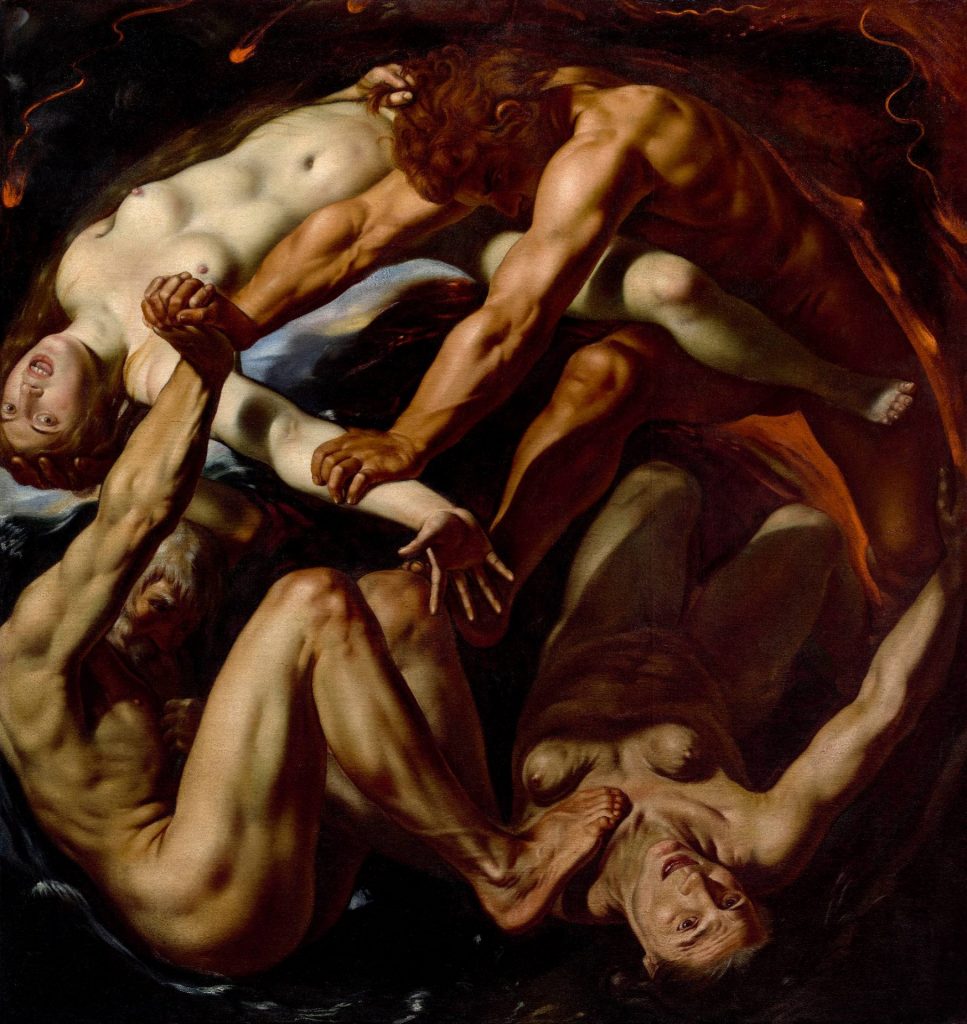
Bernini’s sculpture, one of the marvels of all human creation, was made for Cardinal Scipione Borghese, whose faith was almost as important as his passion for art. And in “the artist’s bible” were all the vices and virtues, arresting expositions and astonishing endings that a painter or sculptor could desire in their search for inspiration.
When Nicolas Poussin tackles the same subject, in his mysterious final painting, the narrative is much less clear. Daphne and Peneus are huddled together while Apollo, struck by Cupid’s arrow, looks on. Of the many other characters portrayed, some are already clinging to the branches of a laurel tree, showing the viewer in the same frame as the exposition, how the story ends.
The easiest prey are those with false hopes or impressions. Europa at first merely pets the white bull, Jupiter in disguise, who will carry her across the sea to Crete before impregnating her with the future king Minos. A veritable roster of artists capture the scene, among them Jacob Jordaens, whose action-packed The Rape of Europa (1643) has the bull Jupiter smuggled in with cows herded by Mercury, a picturesque detail in Ovid.
This was the perfect excuse for Jordaens, an accomplished painter of cattle, to show off his prowess. Creamy, spotted or with a heifer at heel, his animals distract us and beguile us, just as the little white bull does the unguarded Europa.
Conversely, the rumbustious black bull Jupiter painted by Giuseppe Cesari, known as the Cavaliere d’Arpino, could not have been smuggled without detection, being vast. He looks back slyly as Europa clings helplessly to his back over the churning sea, her sumptuous blue and orange garments flying.
Naked Danaë luxuriates in the suggestive shower of gold with which Jupiter will impregnate her. She has been closeted away by her father, Acrisius, after a prediction that he will be murdered by a grandson. She will bear Perseus (who will indeed accidentally kill the old man with a discus throw).
Ovid devoted only two lines to the myth of Jupiter and Danaë, but that was enough to prompt Titian and his workshop to paint the story at least six times over 20 years. The version on display in the exhibition is loaned by Apsley House in London, from the collection of the Duke of Wellington, and is the first of six “poesies” painted for Philip II of Spain, each inspired by Ovid. (The six were reunited for the first time at the National Gallery in London in 2020.)
Ovid appears to be sympathetic towards women, but several artists’ candour about old age translates into some unflattering portraits of those who have progressed beyond their nubile years. The maid in Titian’s Danaë stretches out her own garments to collect the dropping gold – Danaë wears nothing but a gauze flopped over one knee.
The incorrigible, overweening Jupiter, king of the gods and master of disguise, appears as a cloud swaddling ecstatic Io in Correggio’s masterly painting of 1551, painted for the Duke of Mantua and on loan from Vienna. The god’s transparent face breathes into Io’s as his wandering hand finds her bare breast from inside its paw-like puff of vapour.
Those who stand their ground may not be overcome physically, but there are other ways to lose a fight. When Arachne defies the proud and jealous Minerva and competes with her sewing skills, the goddess turns her nimble fingers into the needle legs of a spider. Ovid wraps a story within a story, relating that Arachne’s woven picture of the abduction of Europa was so lifelike that “you would have thought that the bull was a live one, and that the waves were real waves”.
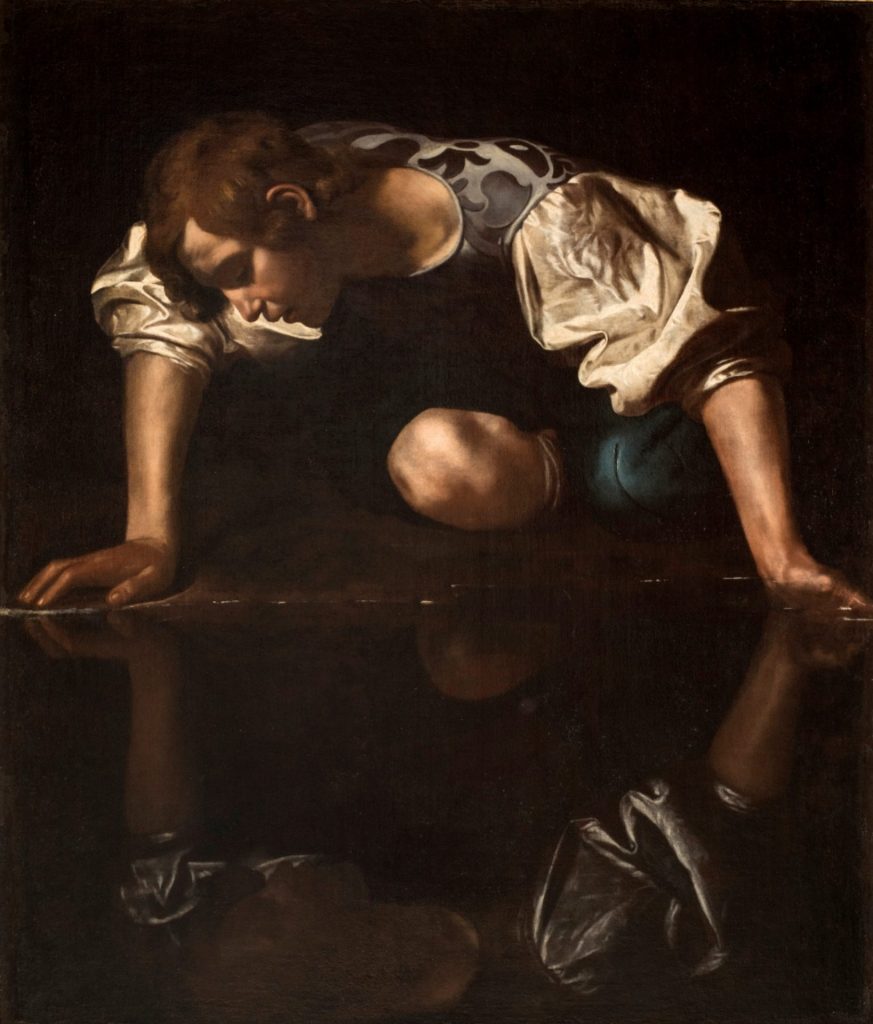
Meanwhile, Narcissus is transfixed by his own reflection, obsessed with his own beauty. Nemesis turns him into a flower – one that blooms but briefly – since he had rejected her daughter, Echo.
Among many depictions of Narcissus, none is as striking as that attributed to Caravaggio. Stripped of discernible background, the young man crouches awkwardly by a pool, his broad knee the focal point, his face to one side, leaning in as closely as possible to its own reflection. Take consolation from this tale the next time a vainglorious egotist promotes his own image. It won’t end well. It just may take some time.
Suggested Reading

Turner and Constable, forces of nature
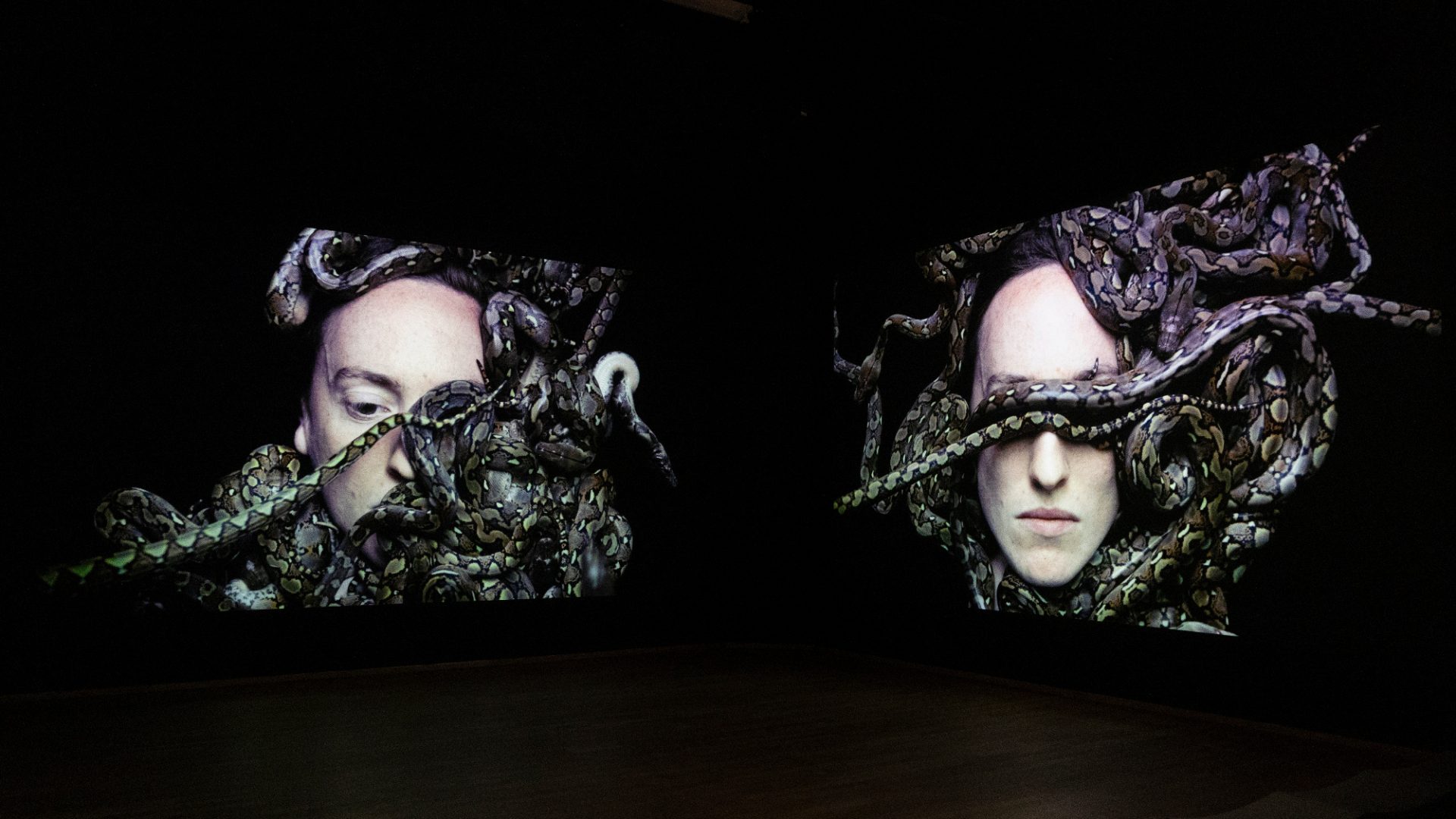
The fascination artists have for Metamorphoses threads through the old masters into the present day. Dutch artist Juul Kraijer’s take on the snake-headed Medusa, entitled Spawn, is a three-screen video installation with little green serpents winding over a woman’s impassive face.
The French-Polish artist Roman Opalka, who died in 2011, had no narcissistic illusions about his own personal appearance. He photographed himself over decades, always wearing the same, unemotional expression – and the same white shirt.
The result is both impressive and moving. Here is a man whose face, hair and demeanour are fundamentally unchanged. It is the passing years alone that have turned him from a chiselled young man to a greying sage.
The exhibition’s curators say that Ovid’s tales are relevant to today’s youth, raised on CGI, the face-altering software of social media and now AI deepfakes. The overall message of the show is that change is not only possible but that it can also, despite setbacks, be for the good. It doesn’t always take a god to intervene, just human endeavour.
Metamorphoses is at the Rijksmuseum, Amsterdam, until May 25 and at the Galleria Borghese, Rome, from June 22 to September 20