The Iranian regime believes it has god on its side. An overt Islamic theocracy, Iran has always portrayed its clash with the US as a religious battle between “the great Satan” in Washington and its holy warriors waging jihad to defend Islam.
The last time anyone checked, the US was not a Christian theocracy. But listening to the rhetoric coming from the Pentagon since Donald Trump unleashed his open-ended war on Iran, it’s hard to miss the religious overtones.
From the defence secretary’s bombastic press conferences laced with religious rhetoric to reports of commanders invoking the “Second Coming”, Christian imagery is overlaying the US military effort in Iran.
“You have multiple apocalyptic religious mentalities shaping the context of the war,” said Matthew Taylor, a scholar of religious nationalism and author of The Violent Take It by Force: The Christian Movement That Is Threatening Our Democracy. Those include an end-of-days strain of Christian Zionism in the US, the hardline Iranian regime, and elements of religious zealotry in the Israeli far right.
“You put all those together and then factor in nuclear weapons and the geopolitics and the Strait of Hormuz, the possibilities of extreme escalation keep ramping up and up – and up.”
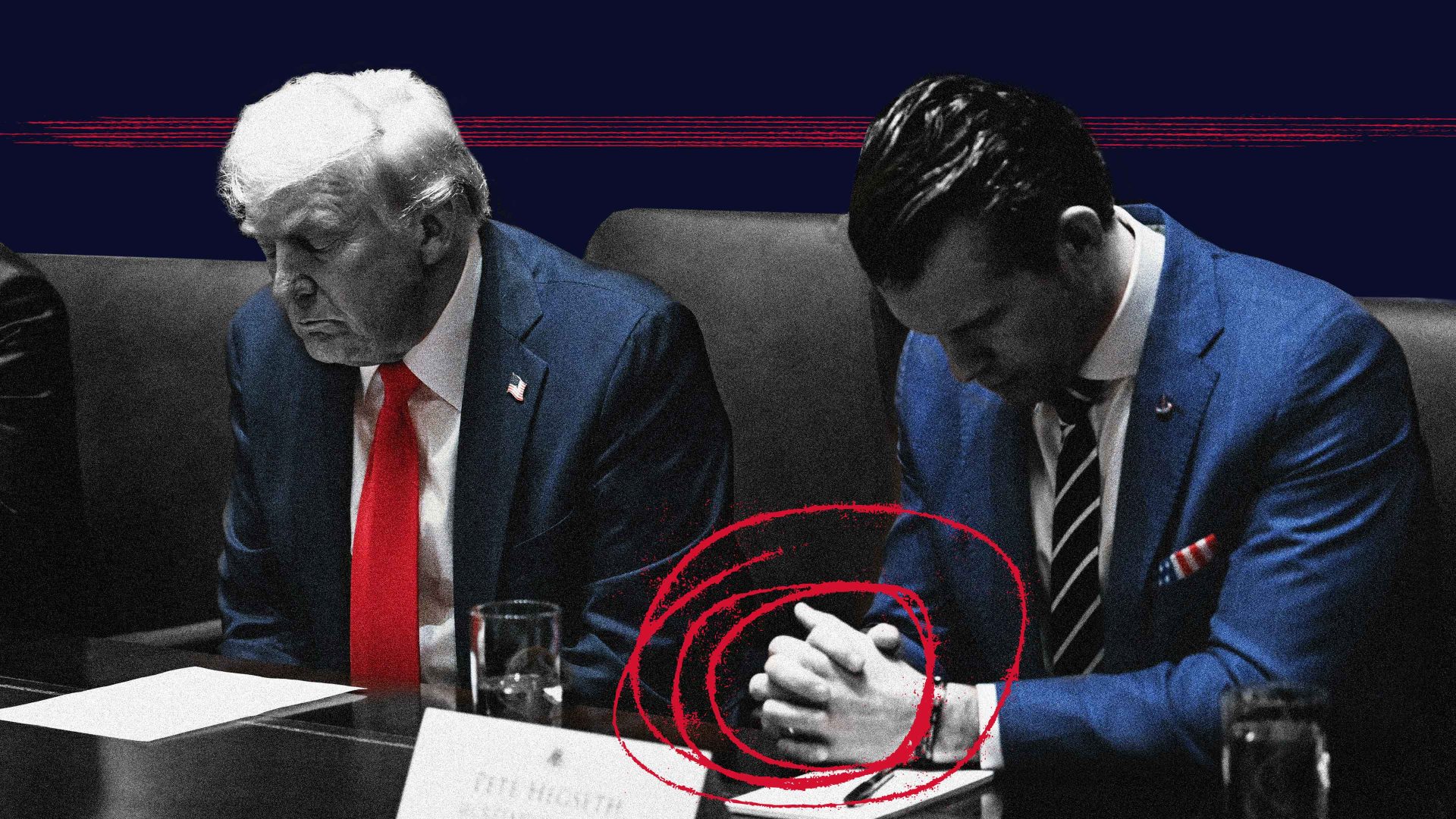
It was political opportunism rather than religious belief that propelled Trump to launch his war on Iran. But he has surrounded himself with deeply conservative evangelical Christians, and it’s a base he desperately needs to keep on side.
Suggested Reading
Pete Hegseth – the secretary of WTF
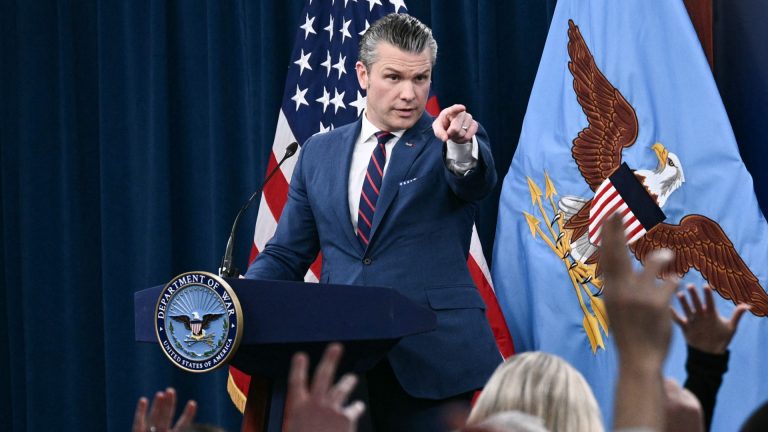
One of the most vocal is ‘secretary of war’ Pete Hegseth, the man responsible for leading the world’s most powerful military. Hegseth doesn’t do nuance. Instead, he adopts Iranian-like rhetoric in portraying the war as a struggle between good and evil, pitting “brave warriors” and “God-fearing American patriots” against the “radical Islamist Iranian adversaries” who are “barbaric savages”.
Lest anyone be confused by what sort of struggle between good and evil he is alluding to, Hegseth ended a recent press conference by quoting from Psalm 144: “Blessed be the Lord, my rock, who trains my hands for war and my fingers for battle,” he intoned.
Hegseth then ended with his own words: “May the Lord grant unyielding strength and refuge to our warriors, unbreakable protection to them and our homeland, and total victory over those who seek to harm them.”
Hegseth has never hidden his belief that Christianity is a superior religion, or that he holds Islam in very low regard: his ideology is literally written all over him. On his right pectoral muscle is a large Jerusalem cross, while in black ink across his bicep are the words “Deus Vult” (God Wills It), a battle cry for the Christian Crusaders in the 11th century. Nestled next to it on his pumped bicep is Arabic script reading “kafir”.
“In jihadi discourse, a kafir is a legitimate target for violence, so to tattoo that on your body in conjunction with Crusader tattoos is a middle finger to Muslims,” said Taylor. “It’s kind of the rhetorical and religious equivalent of ‘come at me, bro, I am your enemy’.”
But people don’t need to try and decode tattoos to understand Hegseth’s beliefs. In his 2020 book, American Crusade, he explicitly stated that Islam “is not a religion of peace” and wrote about a clash of civilisations in which “we don’t want to fight, but, like our fellow Christians one thousand years ago, we must”.
He is a devoted member of a church headed by Doug Wilson, the deeply conservative Idaho-based pastor and leader in the Communion of Reformed Evangelical Churches, a growing religious empire that includes a publishing house and a private school network.
Wilson believes homosexuality is a sin, has questioned women’s right to vote and has said that wives should obey their husbands’ desires in bed to avoid marital rape. “Natural revelation teaches us the natural submission of the wife to the husband,” Wilson has written on his blog.
In a CNN interview last August, Wilson repeated his beliefs about the submissive role of women and said he wanted the US to be under theocratic Christian rule.
Rather than distance himself from the remarks, Hegseth posted a link to the interview on his personal X account along with the text, “All of Christ for All of Life”.
Last month, Hegseth invited Wilson to address a prayer service at the Pentagon, one of the monthly Christian services Hegseth has introduced since taking the helm of the department.
He is also embedding the deeply masculine culture of Wilson’s church into the military, promoting a distinctly macho vision of US troops, ordering a review into the role of women in combat positions and barring transgender people from serving in the military.
A group advocating religious freedom in the military has said it has received hundreds of complaints that some military commanders are framing the Iran war in religious terms. In one reported incident, a commander told troops: “President Trump has been anointed by Jesus to light the signal fire in Iran to cause Armageddon and mark his return to Earth.”
Suggested Reading

Trump’s Iran war is a family business
While the Pentagon has not confirmed these reports – and did not respond to a request from The New World for comment – the language echoes the themes of another strain of evangelical Christianity close to Trump: Christian Zionism.
Christian Zionists believe that the state of Israel must exist as a Jewish homeland for a biblical end-of-times prophecy to come true, which would hasten the Second Coming of Christ and eventually lead to everyone either being damned or converting to Christianity.
Mike Huckabee, Trump’s ambassador to Israel, is a Christian Zionist, and recently said that “it would be fine” if Israel took over huge swathes of other countries in the region.
Paula White Cain, senior advisor to the newly established White House Faith Office, also follows this doctrine. She is linked to a growing religious movement known as the New Apostolic Reformation (NAR), which shares Wilson’s desires for an explicitly Christian US government and believes that Trump has been chosen by God to lead the nation.
Mike Johnson, the Republican speaker of the house, has been a frequent guest on radio shows with figures linked to the NAR. He also flies the “Appeal to Heaven” flag outside his office, a symbol that has been adopted by prominent members of the movement.
The question is how much influence these devout figures are having on US foreign policy and the day-to-day operations of the US military. Most of these individuals – including Hegseth – are not in the small influential inner circle which helps drive Trump’s policy.
But the Christian nationalists are among Trump’s most devoted followers and keeping them on side is crucial for holding his MAGA coalition together. Trump has shown his gratitude to them from day one, with Christianity seeping into domestic and foreign policy.
From establishing a domestic task force to root out what Trump claims is “anti-Christian bias” to launching bombing raids on Nigeria with the explicit motivation of protecting Christians, that religious base has had an undeniable impact on his agenda.
There is however a broad church within the MAGA movement, which includes figures who have espoused antisemitic rhetoric, including in their criticism of the Iran war.
Trump will struggle to placate these disparate elements if the war drags on, and if it continues to drift towards a “clash of civilizations” narrative. That could take the war into ever more dangerous territory. Trump may eventually come to discover that a coalition of extremists never make good bedfellows.
 Most popular


Screen scandal: How Ofcom lets GB News get away with it
GB News Scandal: Read our dossier of their flagrant Ofcom breaches

GB News Scandal: The presenters


Claudia Winkleman’s chat show is afraid of Claudia Winkleman