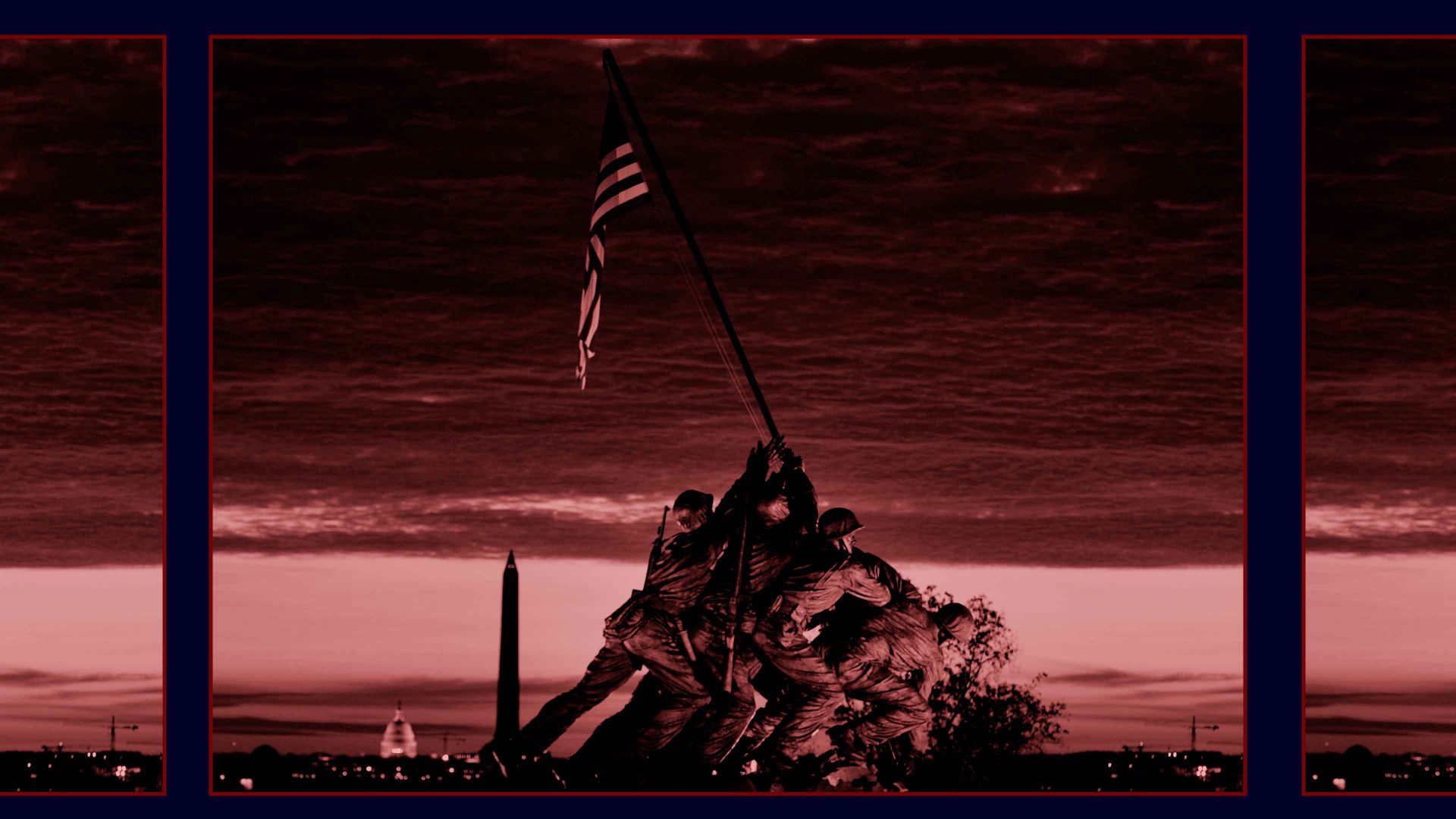
By pure coincidence, as Nicolás Maduro was sailing from Venezuela to New York, cuffed and blindfolded aboard the USS Iwo Jima, I was snapping photos of my kids grinning underneath the flag that was raised at the real Iwo Jima in 1945.
Our family jaunt to the National Museum of the Marine Corps had been in the planning phases at roughly the same time as the operation to capture Maduro, and I like to think both missions were executed with similar military precision.
But it was a peculiar feeling looking at my phone on Saturday morning and seeing Trump’s Truth Social post of the captured Maduro, dishevelled in his tracksuit aboard the warship, just as we perused a dazzlingly one-sided history of US military interventions.
Both the museum and the Maduro photo tell the same story of US military might, drawing on all the heroic myths that have helped to cement a collective delusion that one of these days, it might all work out just fine.
The museum knows exactly how to sell its story: it is anchored by multiple references to Iwo Jima, the second world war battle for the Japanese island that culminated in the iconic photo of victorious Marines raising a US flag on Mount Suribachi.
The colossal triangular museum rising out of the forest in Virginia is meant to evoke the rising flagpole; a statue recreating the photograph marks the entrance; in the gift shop, there is a rendering of the scene in Lego bricks; then of course there is the original flag.
It’s impossible not to be moved by the 6,000 Marine and Navy insignia that line a sombre wall, representing the American lives lost on the island. This was the US military used for a just cause, a reminder of the immense sacrifice made by America.
But then we move on to the more morally dubious cold war missions. The kids run whooping into a CH-46 Sea King helicopter, with full sound effects of the blades chopping the air over the Vietnamese countryside, before exiting into a mock-up of a battle scene, complete with the noises of explosions, gunfire and groaning soldiers.
Full-sized models of Marines listen sympathetically to Vietnamese villagers. But I see no mention of the massacres, or of the staggering civilian death toll.
A video extols the bravery of Marine pilots who dropped napalm over the Vietnamese jungle. But we do not see the iconic 1972 photo of Phan Thi Kim Phuc, the nine-year-old girl who has ripped off her burning clothing and runs in terror from the skin-melting chemical weapon.
Suggested Reading

Trump’s supersized Suez moment
By the time we reach the exhibits on Afghanistan and Iraq, I’m dizzy from the cognitive dissonance. We see models of US Marines sitting with Afghan elders at a Shura meeting, drinking tea and listening to their concerns.
I spent time with the US military in Afghanistan, and my most vivid memory of a Shura was the crude sketch of a cock and balls that soldiers had drawn on the back of the shaved head of their commanding officer, in full view of the Afghan elders.
Granted they were not Marines, but I’m pretty sure the consensus now is that Afghan nation-building was the most colossal waste of time, resources and lives, given that the Taliban returned in 2021 after $2tn had been spent and 50,000 Afghan civilians killed.
There appears to be some attempt at realism in the mock-up of the battle for Fallujah, with the addition of smell-o-vision giving a plastic pool of urine just the right whiff as me and the kids try to spot Marine snipers training their weapons on the marketplace. The Haditha massacre, in which Marines killed 25 unarmed Iraqi civilians, goes unmarked.
I’m not faulting the Marines for crafting their own narrative. It is not meant to be a history museum, and it is remarkably good at doing what it intends to do: it’s fun, cinematic, enthralling, emotionally manipulative and utterly effective.
But when the history of these brutal conflicts is rewritten to take on the sheen of Hollywood movies, it’s no surprise that the realities are quickly forgotten. Presidents want to create their own movie-ready tales of valour in the battlefield. Donald Trump himself said that watching the video of the raid that captured Maduro was like watching a television show.
Now he is talking up military action in Cuba, Colombia and even Greenland.
As we left the museum, a staff member joked that she hoped there would be no more wars, as they didn’t have space for any more exhibits.
Charlotte McDonald-Gibson is a journalist and author of Cast Away: Stories of Survival From Europe’s Refugee Crisis