It doesn’t take much for people in Taiwan to start asking, “Could it happen here?” Certainly, that was the case when it came to the capture of Venezuelan president Nicolás Maduro by the Trump administration. Television and print headlines blared about a part of the world that doesn’t generally get much attention here. There was a small protest outside America’s de facto embassy in Taiwan, but it largely went unnoticed.
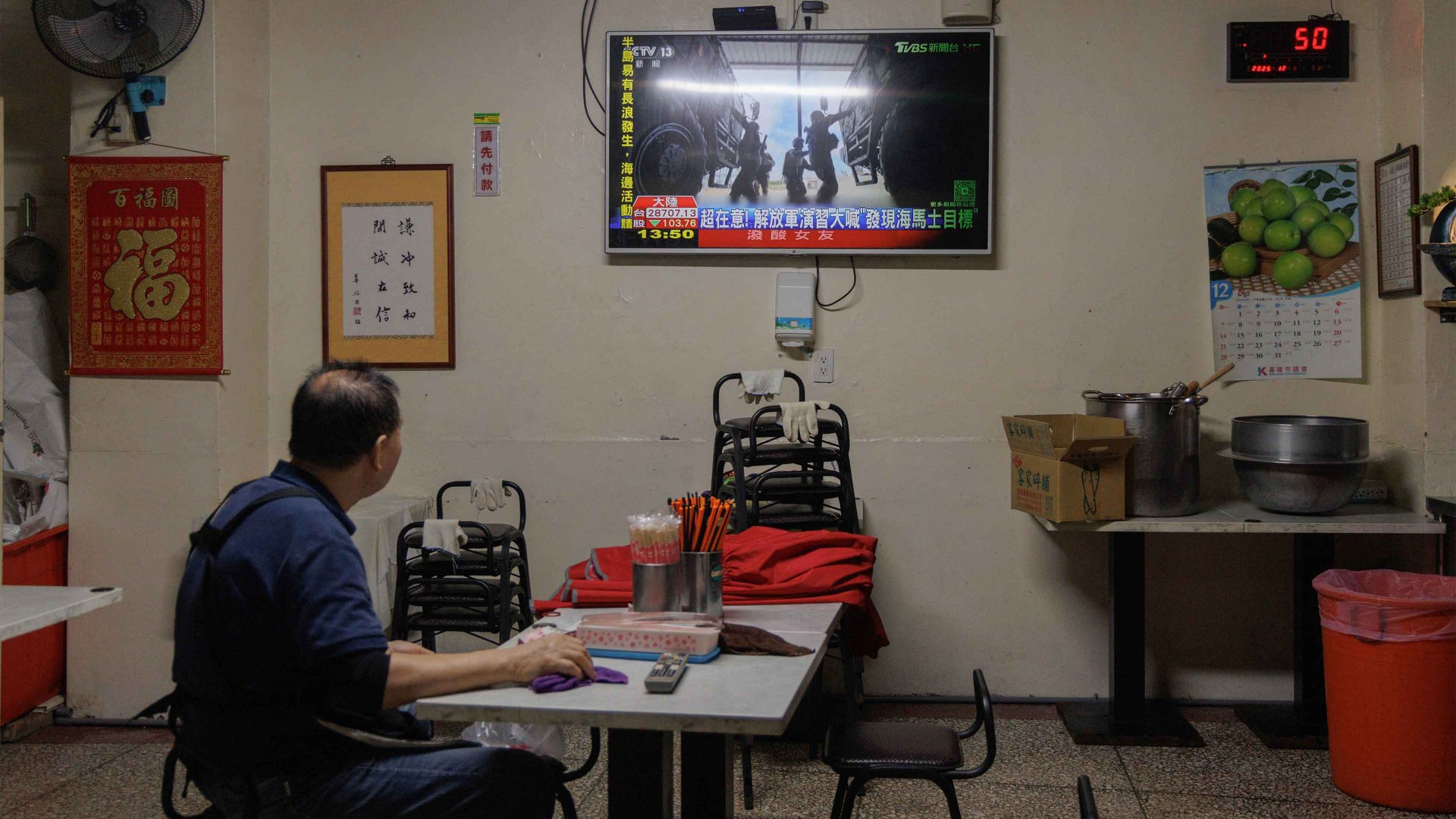
The US strike took place only a few days after a string of Chinese military drills around Taiwan. China stages these military manoeuvres twice a year now. This time, China waited until the last three days of the year to announce a new set of exercises.
The Chinese drills simulated a blockade of Taiwan, and propaganda posters put out by the Chinese government stated that resistance was pointless. The People’s Liberation Army claimed to have cut off Taiwan’s four major ports, which Taiwanese defence officials denied. The Taiwanese government claimed that it was prepared for blockade scenarios.
Just days after Maduro was captured, the government denied that a Venezuela-style decapitation strike could take place in Taiwan. It’s not clear whether people here believe that. It didn’t help when social media in China suddenly lit up with calls by nationalistic Chinese netizens for similar action to be taken against the Taiwanese president, Lai Ching-te.
Thankfully, it seems improbable that China would do this, but they could target Taiwanese politicians abroad. Last year, for instance, during a trip to Prague, a Chinese military attaché planned to ram a vehicle into the motorcade of the vice-president, Hsiao Bi-khim.
As uncertainties about the future persist in Taiwan, conspiratorial thinking is becoming ever more visible. This is especially the case regarding Russia’s invasion of Ukraine. Pro-China politicians in Taiwan have embraced the line that Ukraine provoked Russia into a defensive war by getting too close to Nato.
Suggested Reading
Here comes the Taiwanese indie boom
There has also been an increase in scepticism about the US, which often extends into conspiratorial thinking. One story now circulating is that Covid-19 originated not from a Chinese wet market in Wuhan, but was in fact a US bioweapon run amok. Another is that the US has a secret plan to “destroy Taiwan” in the event of war to avoid key semiconductor infrastructure from falling into Chinese hands. OK, it’s true – some officials have, in fact, suggested bombing Taiwanese semiconductor manufacturers to stop the Chinese getting all the tech. But the idea that Donald Trump has a big red button in the Oval Office with “Blow Up Taiwan” written on it is simply ridiculous.
But the majority of the conspiratorial thinking has been about the possibility of a secret deal between the US and China, by which China lets the US keep Venezuela in return for possibly taking Taiwan. Fears about a deal like that are on the rise.
These theories may have little basis in reality, especially as they exaggerate China’s degree of influence over Venezuela. But the view of the world as a “multipolar” one in which Great Powers have their spheres of influence and get to slice up the world as they see fit is gaining ground here.
But perhaps in Taiwan that’s not so surprising, when it would be us on the chopping block.
Brian Hioe is a DJ from Taipei and one of the founders of New Bloom Magazine