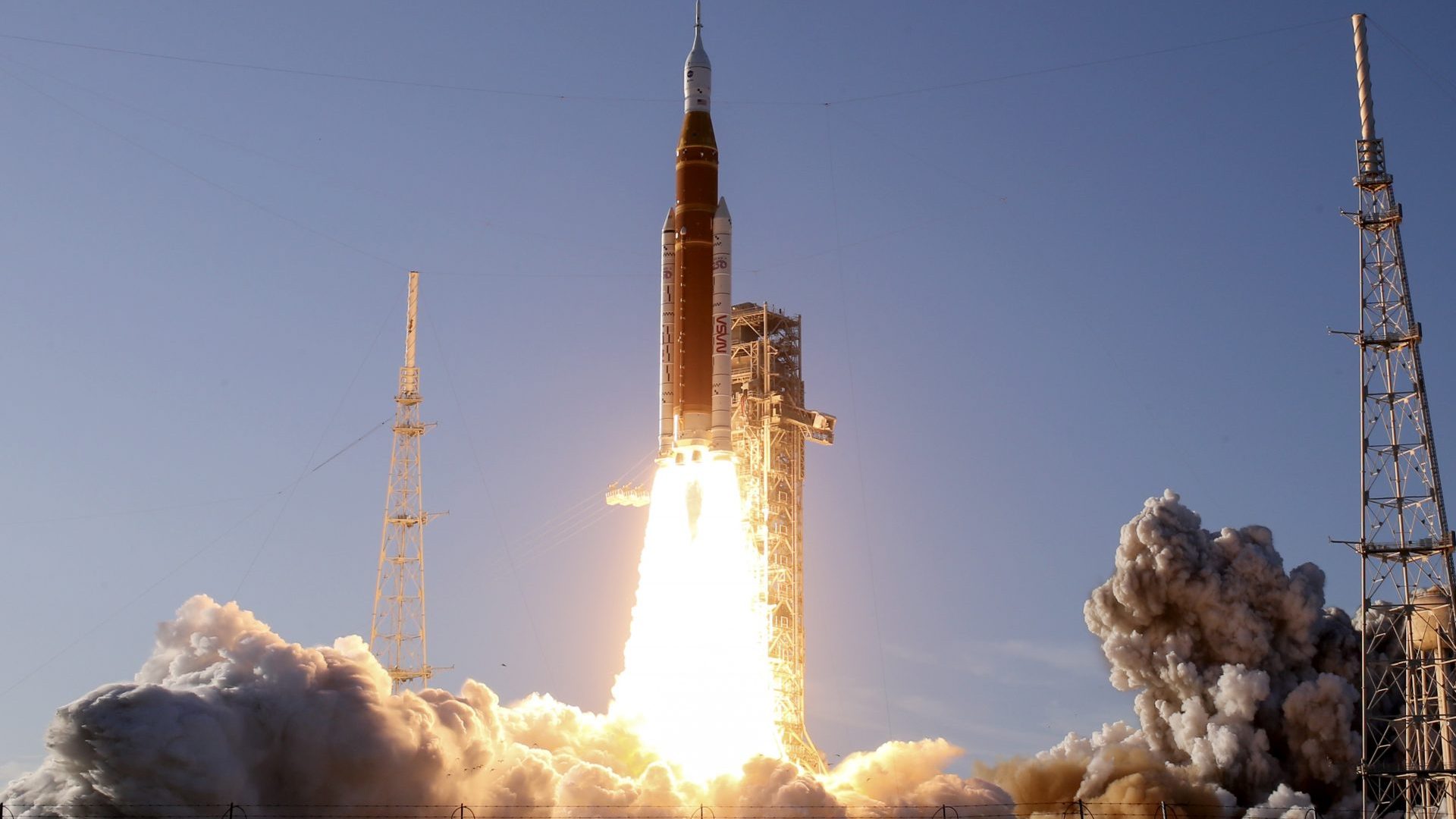
No human has visited the moon since the astronauts of Apollo 17 in 1972. Nasa’s Artemis program is attempting to change that. This week Nasa has sent astronauts on a 10-day loop around the moon, on a mission called Artemis II. The crew won’t land, but it is hoped that Artemis IV, a mission still probably several years away, will.
In December last year, President Trump signed an executive order calling for a US return to the Moon by 2028 and the establishment of a permanent outpost there by 2030. It stated that US superiority in space was a measure of national vision and willpower, contributing to the nation’s strength, security and prosperity.
The last time America landed astronauts on the moon they were in geopolitical competition with the USSR. Today they are once again in geopolitical competition, this time with China. In March, the Nasa administrator Jared Isaacman claimed: “We find ourselves with a real geopolitical rival, challenging American leadership in the high ground of space.” Today “astropolitics” is more crucial than ever, with domination of the space above the earth’s atmosphere key to the outcomes of geopolitical competition and the current conflicts engulfing our planet.
Iran’s retaliation to US and Israeli airstrikes has meant it has been a busy time at the Buckley Space Force base, in the suburbs of Denver, Colorado. That’s the home of the US Space Force’s missile warning and tracking operations room. Uniformed members of the Space Force are called “guardians”. These guardians are tracking the launch and potential impact sites of missiles being fired by Iran across the Middle East.
Just as they did for the US operation to seize president Maduro from Caracas, US Space Command will also be supporting US strikes in Iran. Part of this has included the ground-based satellite jammers of Space Force’s Delta Three electromagnetic warfare unit, which has been disrupting Iranian satellite communications.
With the advent of air power in the early twentieth century it became a common military adage that you could not win wars without air superiority. By the end of that century superiority in cyber space was becoming equally as crucial. In our century, and as the Iran conflict is making all too clear, superiority in the space above the earth’s atmosphere is now just as important.
The new, intensifying astro-political competition between states is pushing us towards conflict in space. Orbital assets on which we depend for communications, navigation, entertainment, financial transactions and defence are fast becoming a new front line of great power confrontation. However, most governments – and their voters – remain dangerously unprepared for conflict beyond the earth’s atmosphere and unaware of the impact it would have.
When asked his greatest worry about the future of space, major-general Paul Tedman, head of UK Space Command replied “space blindness”. We don’t realise the impact conflict in space would have on life on earth. Space is now a $650 billion market, which means it is bigger than AI – for now.
It’s growing exponentially with greater commercial investment from companies like Elon Musk’s SpaceX and Starlink, Virgin Galactic and VAST, who hope to put Haven-1, the world’s first commercial space station, into orbit in 2026. We have launched more satellites and invested more capital in the space industry in the last five years than during the rest of history.
We have become increasingly dependent on both civilian and military satellites in orbit, although realistically all of these are “dual use”, meaning they can be used for both commercial and military purposes. General Tedman points out that the military relies on space-based technology to communicate, navigate, identify threats and acquire and strike targets, as they are currently doing in Iran.
Wider society also relies on in-orbit technology to provide GPS, as well as signals to communicate and beam down entertainment. We also rely on the time signals from atomic clocks contained in satellites, which allow our banking and logistics networks to function, as well as the clocks in all our phones.
However, the majority of such satellites were built for efficiency not resilience. Tedman likens them to “mega container ships, which makes them very vulnerable”. Their importance and their vulnerability has incentivised our adversaries to go after them.
Suggested Reading

Who owns the moon?
In October last year, a Russian satellite was identified over the Baltic Sea sporadically and powerfully knocking out time signals. Last September, a pilot flying European Commission President Ursula von der Leyen had to land in Bulgaria using paper maps after the plane’s satellite navigation system was jammed. Sky News has reported that around 1,500 flights a day are now having their GPS disrupted.
Satellite tampering can include jamming, dazzling (using lasers to blind sensors), and hijacking or disabling a satellite by hacking. This can be done silently, without debris or explosions, which makes it deniable. It can also include, less subtly and more dangerously, physically manipulating satellites by maneuvering near or pushing a satellite out of position.
In 2021, Russia conducted a destructive anti-satellite (ASAT) missile test, destroying one of its own defunct satellites. This generated over 1,500 pieces of orbital debris that would circle the earth at speed, along with hundreds of thousands of smaller fragments. It prompted widespread condemnation due to the danger posed to the International Space Station and other satellites.
One hostile action can cause damage across a wide area of low earth orbit. This was after Kosmos-2543, a small satellite that had been deployed or “birthed” from the larger Kosmos-2542 when it reached its orbit, was observed in 2020 “buzzing” US satellites. The Russian Ministry of Defence has maintained that its activity is just “routine” inspections and surveillance of Russia’s own assets.
While it is possible that this is the case, due to the potential dual use of such satellites and Russia’s recent history of implausibly denying its offensive actions, the threat of them deliberately interfering with other satellites, is a serious problem.
In March 2025, US Space Force general Michael A. Guetlein, the vice chief of space operations, revealed that US systems had observed, “five different objects in space maneuvering in and out and around each other in synchronicity and in control,” describing this as “dogfighting in space”. While not overtly hostile, these manoeuvres demonstrate a new Chinese capability to track and potentially interfere with US and other satellites.
China, the US and other major space powers, are developing “counterspace” capabilities. Disabling an adversary’s satellites can blind its situational awareness without firing a shot on the ground. The first move in the next conflict may not come as a missile strike or special forces insertion, but as a silent, deniable manoeuvre in orbit that signals war before the world realises it has begun. In fact, this has happened before: the 2022 attack on Viasat took place in the hours before Russia invaded Ukraine. Putin’s offensive began in space.
The first move may also be the most significant. While there is currently a similar logic to the mutually assured destruction of nuclear weapons, for conflict in space, both offensive and defensive technology is still evolving. It is yet possible that one side feels their advantage is such that initiating a conflict is advantageous. Even a small advantage in space can result in a significant advantage on the terrestrial battlefield, where speed and accuracy of information are key.
Space law is outdated and underdeveloped. It is time to update and reinforce the 1967 Outer Space Treaty and its associated international agreements. It prohibits stationing weapons of mass destruction in orbit or on celestial bodies, and should be broadened to ban other types of weapons in space. In 2020, NASA drafted the Artemis Accords to support government and civilian efforts to travel to the moon and beyond, and has attempted to extend them to cover wider exploration and the use of outer space. Yet neither Russia nor China are signatories.
While the threats are increasing, so are the opportunities. Companies in partnership with governments are looking to build space infrastructure (none is in place so far; traditional satellites once launched never dock again). As well as efforts to build space stations, China wants to build a permanent human base on the moon by 2029 or 2030, along with a nuclear reactor. The US is scoping out the possibility of building a similar base, but China’s plans are more advanced.
This infrastructure could support mining on the moon and beyond, as well as energy production (including solar) from space. As the investments in space assets increase and our reliance grows, competition will intensify. The military significance will only increase with this growth.
The UK Engagement with Space Committee was opened in February this year to consider UK policies relating to space, and the opportunities and challenges. One of its members, Andrew Lansley, has indicated that it is likely to report next month and will highlight our failure to understand what space applications do for us. Lansey provides the example of smart cities being impossible without space based systems.
As most members of the European Space Agency are Nato members and with expanding Russian “grey-zone” activities, the UK should be a key voice calling for a Nato space strategy to support all members. For developing countries without their own space programs, such alliances will be key or they will soon be hostage to countries who are becoming space super-powers, and to commercial companies (located in these same countries) who can name their price at a time of increasing security and economic competition.
Humanity has spent thousands of years staring up at the stars, observing their movements and wondering what we might find up there. Space philosopher Frank White coined the term the “overview effect” after interviewing astronauts about what it is like to see earth from space. It describes the experience of awe, vulnerability and interconnectedness that can supposedly create shifts in the way people think about humanity and the planet.
Hundreds of millions of people around the world watched the first moon landings. The returning astronauts came home to a ticker-tape parade in New York and a world tour on which they met, among others, the pope and the queen. However, humans take all their flaws and competitions with them to any new domain they visit.
The first moon landings were as much about asserting US technological primacy over the USSR during the Cold War as further humankind. The sensors looking down from space are currently seeing the impacts of the hot metal of war across growing swathes of our planet. The operations room on Buckley Space Force base, is ringing with shouts of “launch Iran” and “launch Russia”, as the infra-red heat signatures of missiles are tracked.
Those driving these conflicts and the leaders that are determining national space strategies have not experienced the overview effect and remain motivated by more earthly desires. As astro-politics is intensifying and our adversaries are looking to exploit our vulnerabilities, we may find out sooner rather than later how much we rely on space for life on earth.
 Most popular


Yes, it's a genocide

The race to save the Beatles


Matt Goodwin’s road to derision

How Jon Stewart told me the brutal truth about Trump and Hegseth