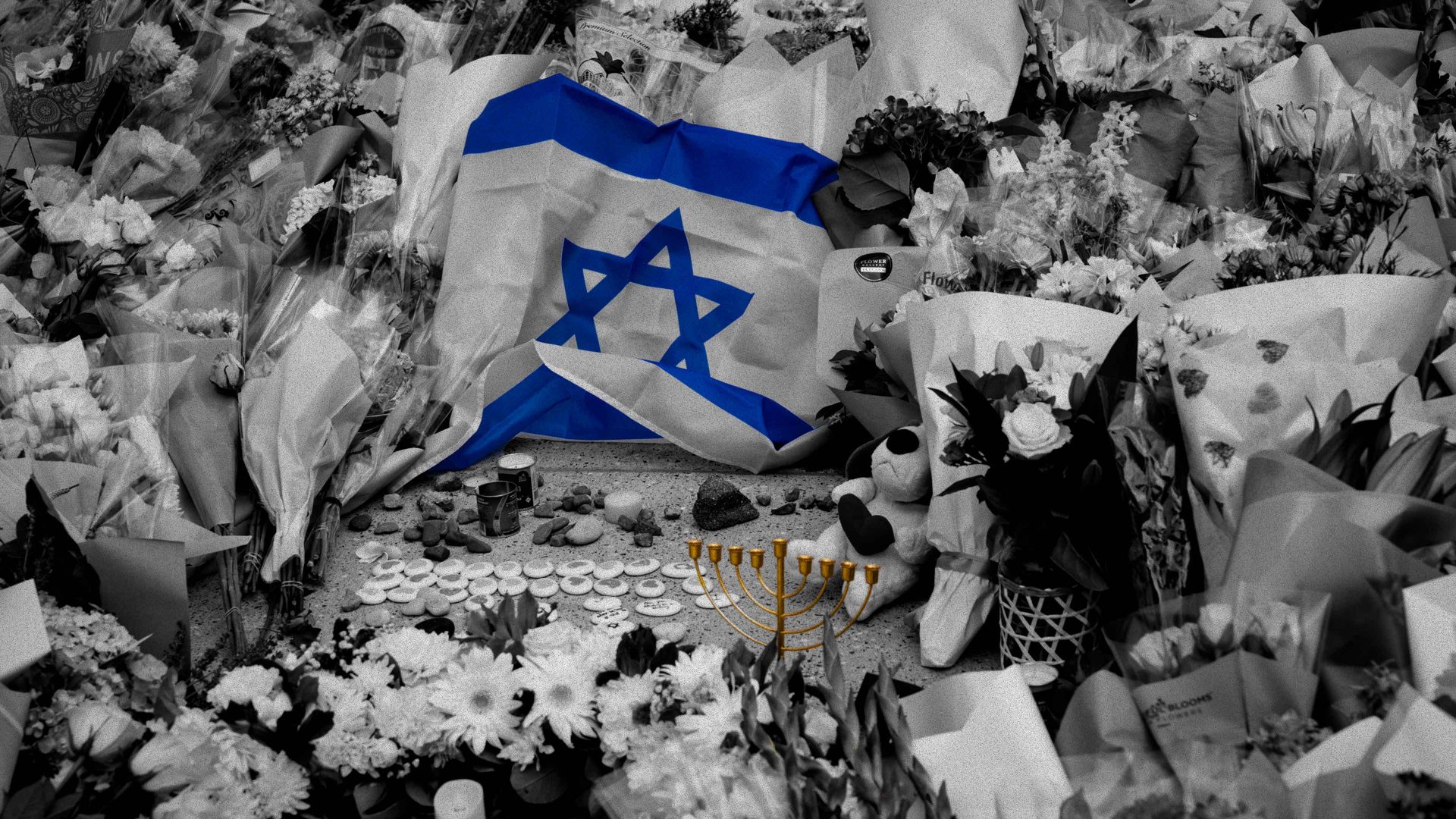
There are places a country tells itself stories about, and Bondi is one of them. It is not just a beach. It is a promise that whatever horrors exist elsewhere, they are held at bay by water, light, and distance. A Hanukkah gathering also carries its own quiet grammar. Candles. Children. The choreography of continuity. A ritual explicitly designed to say: we are still here.
When violence erupts in a place like this, it ruptures a national story that says geography protects us. That history is something imported via documentaries and foreign headlines. That Australia is a place where the world’s anger arrives diluted, sun-bleached, softened by time and tides.
This is why the shock lands so heavily, not just grief, but vertigo. The sense that Australia’s firewall has failed. That the war we watched on screens – buffered by commentary, disclaimers, and distance – has stepped barefoot onto the sand.
The rage that follows is a howl that says: this was not supposed to happen here. The Australian social contract – informal, unspoken, deeply felt – has been violated.
For many, this is not a tragedy to be processed but a conclusion to be drawn. “I told you so” arrives early and loudly. The event is seized on as proof that warnings ignored have consequences: that immigration, particularly Muslim immigration, is not merely an economic or social question but a civilizational gamble. That you cannot import people without importing their wars. This is how fear becomes doctrine.
The transformation of grief into grievance is rapid and chilling. What begins as a legitimate fear for public safety mutates into something broader and more corrosive – a narrative in which entire communities are suspect, not because of what they have done, but because of what someone like them has done.
The argument hardens. It is no longer about policing or radicalisation or mental health. It becomes metaphysical. About incompatible values. About whether pluralism itself is naïve. About whether coexistence was always an illusion sustained by luck.
The tragedy is immediately conscripted into political service. And once that happens, the dead are no longer simply mourned. They are mobilised.
At the centre of this event is not one story, but two. They occupy the same space without touching. For the attackers, the frame is brutally contemporary. Gaza. Rubble. Bodies pulled from ruins. A death toll that climbs beyond abstraction into obscenity. In this narrative, borders are irrelevant. The conflict is global. Responsibility is collective. Retaliation is moral. In this view, the attack is not hatred but accounting.
But for the people running for cover beneath picnic tables, history is not modern at all. It is ancient, intimate, and unfinished. To be Jewish is to live with a long memory that is not optional. A memory written into rituals, names, absences. A memory of being targeted not for policy, but for existence. When violence erupts at a Jewish celebration, it bypasses geopolitics entirely. It does not arrive as critique. It arrives as recurrence.
They do not think of Gaza in that instant. They think of Kishinev. Of the Inquisition. Of Europe in the 1930s. Of the knowledge, passed down without needing to be spoken, that there are moments when the world decides your presence is intolerable.
Suggested Reading
Bondi Beach and the politics of meeting hate with hate
This is the catastrophic misalignment at the heart of the violence. The attackers believe they are striking a state. The victims experience an attempt on a people.
The anger over Gaza is real. It is justified. It is shared by millions who would never harm a civilian. But to demand that those under fire interpret bullets as political commentary rather than existential threat is to ask for an impossible generosity. It is to ask them to translate terror into theory while bleeding.
In the aftermath, another silence settles in. It is not the silence of shock, but of prohibition. To mention Gaza is, in many spaces, to be accused of justification. To explain becomes indistinguishable from excusing. The mere act of contextualisation is treated as a moral failure, a dilution of outrage.
Yet to refuse context entirely is its own kind of dishonesty. We are trapped in a binary that our public language cannot escape. Absolute condemnation or dangerous nuance. Mourning or analysis. Choose one.
So we pretend the shooters emerged from nowhere. As if they were meteorites rather than products of a world saturated in images of annihilation. As if rage does not travel, does not compound, does not metastasise across borders and feeds and screens.
Explaining a spark is not the same as endorsing the fire. But our discourse lacks the maturity to hold that distinction. We fear that acknowledging causality will fracture solidarity and that complexity will weaken condemnation.
The result is a conversation that cannot speak honestly about why violence now travels so easily, so far, so fast.
We condemn – and we must. But we do not inquire. We moralise, but we do not investigate. We speak of evil as if it were self-generating, requiring no soil. And in doing so, we guarantee recurrence.
Bondi will recover. Icons always do. The sand and wind erase footprints. But something lingers beneath that ease. A recognition that distance no longer protects and that imported conflicts are not metaphorical. That global rage does not respect national myths. That pluralism, if it is to survive, will require more than slogans and denial.
I do not ask for equivalence, or for a flattening of moral distinctions or a softening of condemnation. Shooting civilians is terror. Full stop.
Instead, I ask for something harder: the capacity to hold multiple truths without weaponising them. To acknowledge the horror of Gaza without translating it into permission. To recognise Jewish fear as historical. To confront the failures of integration without surrendering to collective blame.
After the shooting stops, what matters is not how quickly we find certainty, but whether we resist the urge to turn grief into ammunition. Because once every tragedy becomes proof, every society becomes a powder keg. And the distance collapses again.
 Most popular
Iran war: It’s time for Europe to become a superpower

Operation Epic Fuck-up is the quintessence of this Trump administration

The murder of Sarah Everard made me an activist

The big secret of Small Prophets