In the autumn of 1928, Alexander Fleming returned to his cluttered London lab after a long summer holiday. On a plate streaked with golden staphylococcus bacteria, he noticed something odd: a fuzzy, blue-green mould had drifted in, and around it, the bacteria had dissolved. Fleming soon realised that he had discovered a substance that could kill bacteria without hurting animals. After toying with the name “mould juice”, he dubbed the new substance “penicillin”.
A brilliant visionary had discovered the world’s first antibiotic. Millions could now benefit from this miracle cure.
That’s the myth we’re told: the lone scientist and the brilliant insight that reshapes human history. But the truth involves more tinkering, more teamwork and more trade in ideas.
Yes, Fleming saw the bacteria-killing power of Penicillium mould. But in his own lab, penicillin led nowhere. Fleming wasn’t a chemist. He couldn’t isolate or purify the active compound, nor could he figure out how to scale it into anything useful. Throughout the 1930s, his discovery sat in the scientific archives, a biological curiosity rather than a medical revolution.
The real breakthrough came more than a decade later, when a team at Oxford – Howard Florey, Ernst Chain and Norman Heatley – dug out Fleming’s paper and set about making a workable antibiotic. They painstakingly figured out how to extract and stabilise penicillin, first in mice, then in humans. To scale production, they collaborated with US chemical engineers and government agencies.
Fleming played a critical role, but he was not the sole inventor. Penicillin took more than a decade to produce. It was the collective endeavour of many minds over many years.
A central lesson from the history of innovation is that most great inventions aren’t the result of a lone genius shouting “Eureka!”. They’re more often the product of years of careful trial and error. Successive inventors build on one another’s work.
If invention was all about the inventor rather than the setting, simultaneous invention would be rare. In fact, simultaneous invention is surprisingly common.
Suggested Reading
Is the AI bubble about to go “pop” – and what happens if it does?
Two people separately claimed to have invented the air gun. Three people invented the sewing machine. Five people claimed to have invented the steamboat. The thermometer had six inventors. Edison’s Electric Light: Biography of an Invention lists 23 inventors of incandescent bulbs before Edison. In the 1990s, dozens of tinkerers built their own search engines before Google grew to dominate the market.
Technological breakthroughs often happen as soon as the conditions are right: more akin to running the first four-minute mile than painting the Mona Lisa.
Yet we remain drawn to the great man theory of invention. Fleming and Edison have been joined in the modern pantheon by Steve Jobs and Elon Musk. Names make history easier to tell. Diverse teams are harder to profile in a biography.
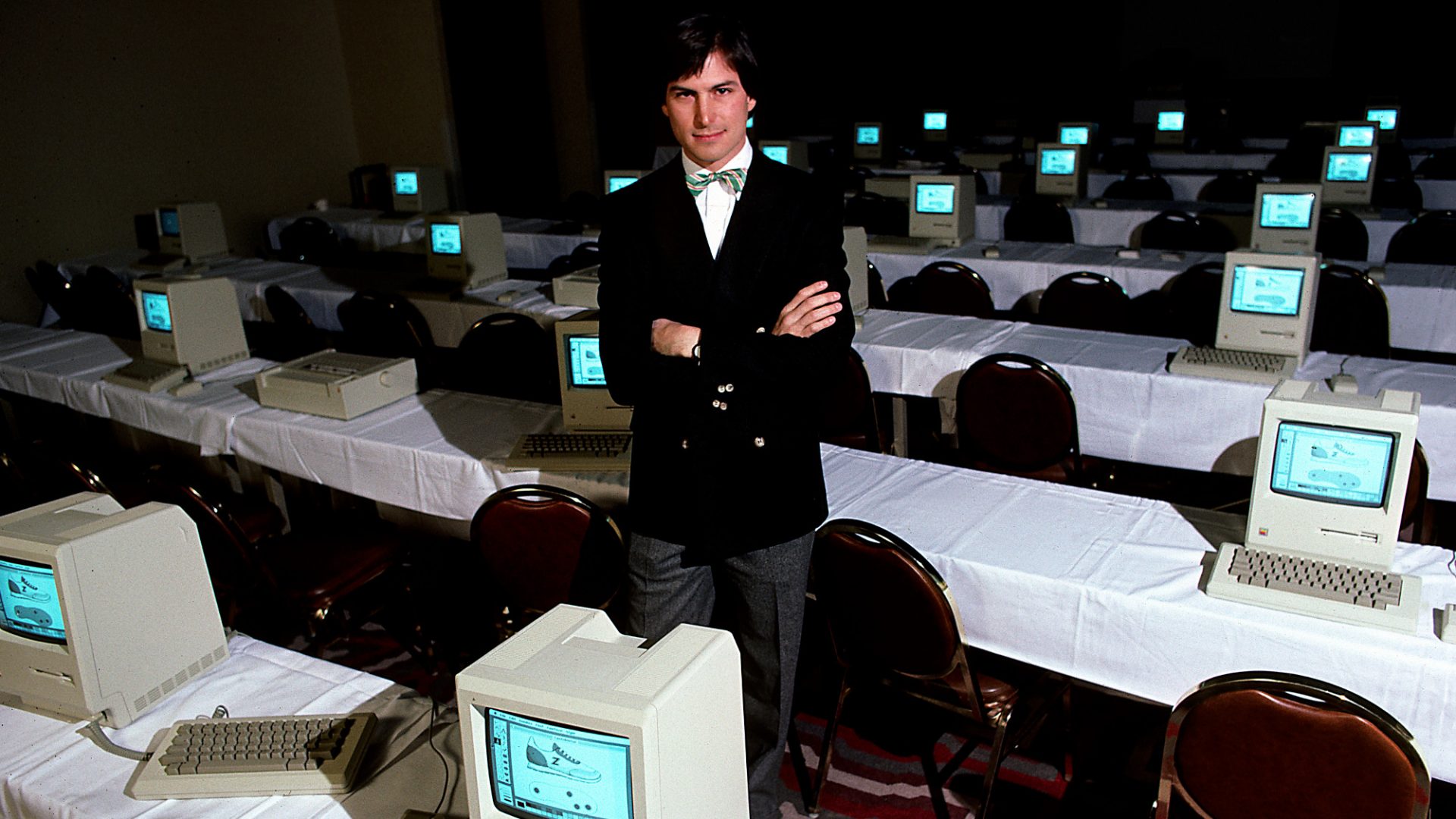
Jobs’s own story illustrates the point. In 1984, Apple launched the Macintosh, a mouse-driven computer with a graphical user interface. Before this, most users faced the MS-DOS C:\> prompt, typing commands and file paths from memory. The Macintosh replaced that with menus, windows and icons you could point to and drag.
But the interface drew heavily on ideas from Xerox PARC, which Jobs had visited. Xerox PARC had developed the graphical user interface, Ethernet, the laser printer and a version of the computer mouse. Apple’s achievement was to take ideas already circulating at the technological frontier and turn them into something ordinary people wanted to use.
Luck played a role too. The Macintosh came with multiple typefaces and proportionally spaced fonts because Jobs had sat in on a calligraphy class a decade earlier, instilling in him a love of beautiful typography. The trade in ideas across disciplines is a fundamental driver of innovation.
Teams are becoming more important to invention. The average scientific paper today has nearly three times as many authors as in the 1950s. In fields including biochemistry, crystallography, applied physics and immunology, more than 90% of published work is co-authored.
Scientific collaboration was behind transistors, the moon landing, mRNA vaccines and artificial intelligence. Individuals win Nobel prizes, but they invariably credit their teams in acceptance speeches.
The popular imagination will probably continue to attribute inventions to individuals such as Fleming, Edison, Jobs and Musk. That’s understandable, since humans like stories, and a solo inventor makes for a simpler tale. But history is messier, and more interesting. Innovation is usually less eureka moment than shared labour.
Andrew Leigh is a member of the Australian parliament and author of The Shortest History of Innovation (Old Street Publishing)