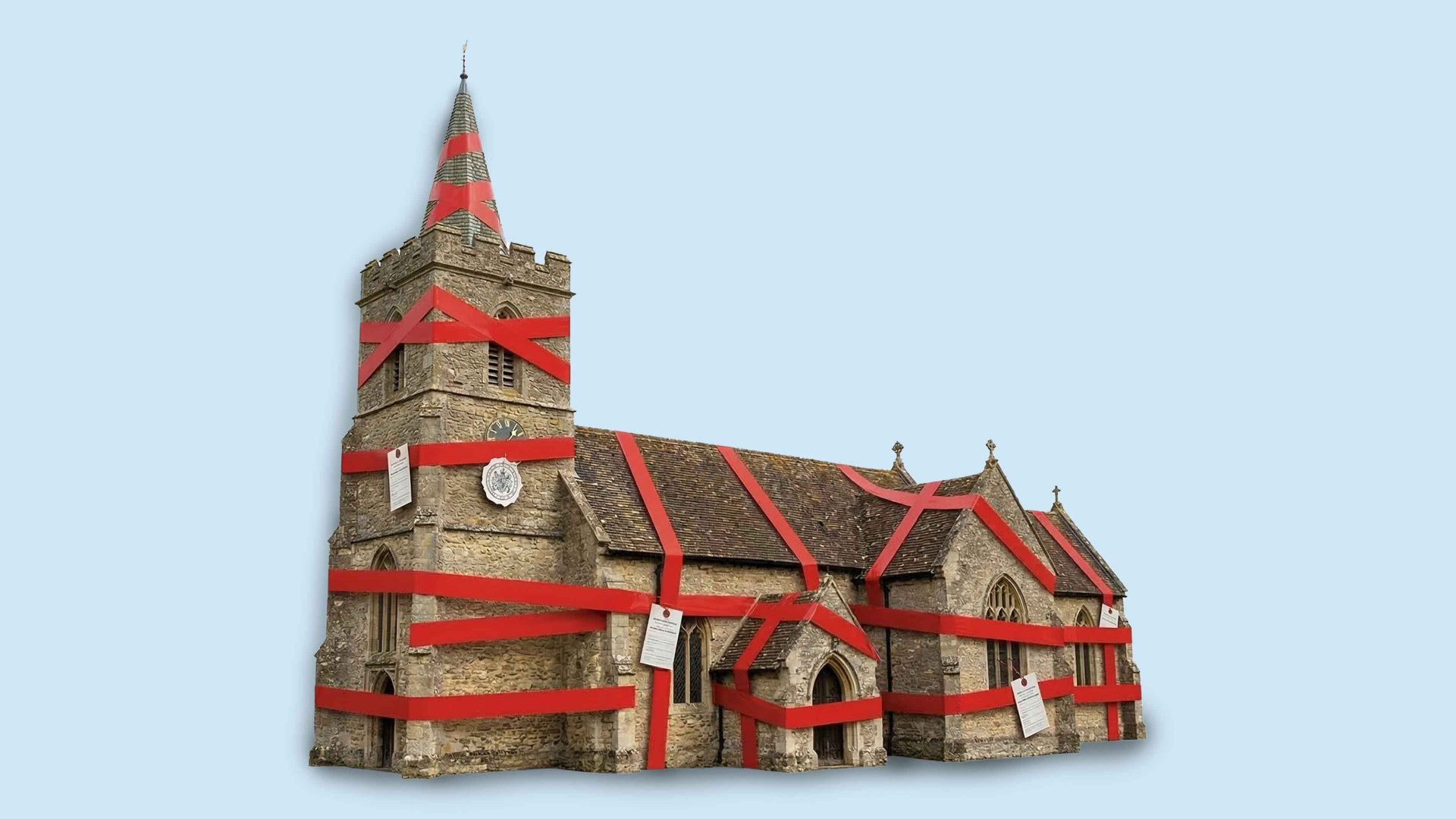
Zia Yusuf’s suggestion that all the churches in England should be listed to stop them being converted into mosques was, said the Rev Gerry Lynch, the rector of five listed churches in rural Wiltshire, “just clickbait, and bigoted clickbait at that”.
“There have been times when the expectations of our growing Muslim population have bumped against our traditional freedoms – as we’ve seen in the case of the Batley schoolteacher, the Wakefield mum, and the CPS’s decision to appeal against the acquittal of Hamit Coşkun. These proposals do nothing to deal with issues like those,” the rector added.
Nothing in listed-building status prevents a church or chapel from being repurposed for another religion. All that listing a building does in practice is to increase the bureaucratic load required to change anything, even the ordering of the furniture.
Justin Welby, the former archbishop of Canterbury, spent his six years as a parish priest fighting to remove the pews in his church. He failed. The Church of England is responsible for 45% of the Grade I listed buildings in England, which means that preserving them as architectural heritage takes expensive precedence over any other functions they might have.
If Reform were serious about preserving England’s visible Christian heritage, its policy would be for the state to take over responsibility for repairing listed churches.
Church to mosque conversion is rare. A church in Peckham, in south-east London that passed through a chain of owners after being sold in 1965 ended up as a mosque. Ever since then, whenever the Church Commissioners have sold buildings, they have included restrictive covenants that make it impossible for any future owners to turn them into mosques, even if the planning authorities approve, as a case in the Potteries showed last year.
Suggested Reading

God is back… and He’s trending
Reform claimed to have found 41 church buildings that had been changed into mosques. I cannot find evidence of that. What I can find, however, is a list of notable English mosques that comprises a total of 15 former Christian churches, all of which once belonged to various Protestant denominations, but none to the Church of England.
The kind of Christians who don’t go to church now form the overwhelming majority of self-identifying Anglicans in England. The wholly bogus claim that the archbishop of Canterbury is “the spiritual leader of 80 million people worldwide” rests on the idea, current in the 1990s, that there are 50 million Anglicans in Britain alone.
There are now far fewer people who would even identify as Anglicans, but Reform supporters are probably disproportionately among them. They just don’t go to church, so the Church of England, to them, consists of what the media say about the church.
Regular churchgoers, by contrast, think the church is made up of their congregation, and nothing outside it has any real existence. The opinions of bishops or archbishops come to them from another planet altogether.
Which planet then does Danny Kruger inhabit, the Reform MP, or James Orr, Nigel Farage’s close adviser and theologian? Both men are committed to a programme of restoring what they understand as Christian England. Both must have known that Yusuf’s proposal was ridiculous. They seem to have made the same Faustian bargain as the American evangelicals who welcomed Donald Trump as God’s appointed agent, whatever his character flaws. Any enemy of liberalism is a friend of theirs.
Kruger in particular has a capacity for embracing stark contradictions: “I think we are suffering from having a totally unregulated sexual economy,” he told Politics Home. He then added that he’s “not interested in your love life, or anything about your personal life – that is your business”.
If in fact we are all suffering from other people’s “unregulated sexual economy” as Kruger and much of the New Right believe, then other people are going to have to change their behaviour for our benefit (and ultimately for theirs too, the conservative Christian would add).
This brings us to what seems the deepest split in the coalition that Reform wants to build. The social and sexual conservatives who share Kruger’s vision of a good society are largely practising Christians, or Muslims – and immigrants or of immigrant stock. The core of the party’s support, however, are non-practising Christians, for whom skin colour or ethnicity matters more than anything else.
These two halves share a belief in the importance of social cohesion and a distress at the atomisation of society – but the societies they dream of building or restoring are quite incompatible with each other.
The ridiculous proposal to strangle the Church of England still further in the red tape of the planning system is just one symptom of the incoherence at the heart of the project.
Andrew Brown is a journalist, former Church Times columnist and author of Fishing in Utopia, a memoir about his life in Sweden